

 ADVERTISEMENT
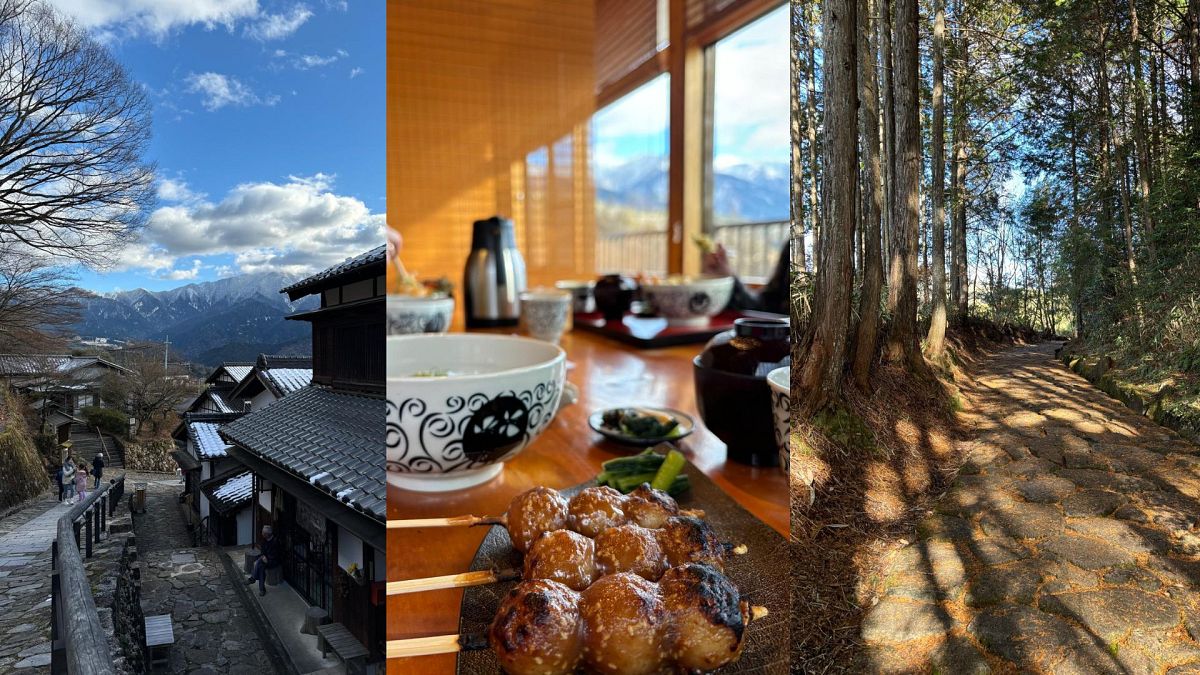
Beneath my feet, the dark stone slabs of the Nakasendo road are worn and mossy. Travellers have trod this path for over 400 years, a thought that gives me goosebumps - or perhaps that’s just the icy minus five degree air.
Tall magnolia trees and thickets of bamboo prevent the sunlight from penetrating so frozen patches of snow cover the ground.
High up in the Japanese Alps, the only sounds I hear are birdsong and water gurgling through the channel beside the path. But when travellers first walked this ancient route, it would have been a far less meditative affair.
Nakasendo road: A 400-year-old route in Japan travellers can still walk
The Nakasendo road was established in the 1600s to facilitate trade and travel between Kyoto and the shogun capital Edo - now Tokyo - for military rulers, samurai and warlords.
Straggling caravans of people and laden horses sometimes took days to pass through a single village. Those who traversed this route were important and wealthy, so teahouses, shops and accommodation sprung up along the way, flourishing into small towns.
The Nakasendo road still exists in its entirety - as do dozens of the post towns it weaves between - forming an epic walking route across central Japan.
Most of the route is now on modern roads, but the section that runs through the Gifu prefecture is an ideal two-to-three-day walk, plunging you back into rural Japan of the feudal era.
Woodblock prints of the Nakasendo in Ena city
I begin my hike in Ena city, where I visit the Hiroshige Museum of Art to give me some inspiration for my journey.
The centre is dedicated to ukiyo-e woodblock prints from the 19th century, including the series ‘Sixty-nine Stations of the Nakasendo’. They depict everyday scenes of heavily burdened travellers, pit stops at teahouses, bathers at an onsen and crowded market towns.
In the background are pale mountains, delicate cherry blossoms, far-off shrines and glimpses of a translucent sea.
One scene of Oi juku, a post town just a handful of hills away from Ena, seems particularly apt as the formless shapes of cloak-draped travellers trudge ankle-deep through a snowy landscape.
Teahouses and mountain shrines along the Nakasendo road
The most atmospheric portion of the ancient highway in the Gifu prefecture is just outside the town of Ochiai on the outskirts of Nakatsugawa.
In Ochiai, you can visit a ‘honjin’, an officially appointed inn turned museum that gives an idea of the precautions once needed at wayside accommodation. There’s a secret escape window, a ceiling passage for the ninjas that guarded travelling lords and semi-transparent panels so assailants couldn’t hide.
The town also has a sharp s-shaped bend in the road, which is characteristic of post towns and helped travellers under attack to shake off bandits.
Walking out of Ochiai, you begin the steep ascent to the Jikkoku Pass. En route, you can dip into the Io-ji temple, usefully dedicated to recovery from journeys and featuring healing deities in niches.
ADVERTISEMENTJust beyond is the only section of the 400-year-old stone pavement that has been preserved - and later extended - allowing you to walk for around half an hour as the Edo-era travellers would have.
The section finishes at the two-story Shin Chaya inn, where you can have tea, homemade plum wine or a futon for the night.
Slip back in time in two Edo-era post towns
The road continues to the post town of Magome with the snow-capped Kiso mountains as a backdrop.
As tour buses come and go, it has the busy feel of a long-journey pitstop. Spacious restaurants with mountain panoramas and roadside stalls serve on-the-go snacks like sticky sesame sauce-coated rice balls and tangy miso on a spoon, paired with thermal jugs of hot green tea.
ADVERTISEMENTMagome has a partly rebuilt 17th-century high street of low, dark wood houses, sake breweries and shops selling souvenirs like straw hats and yukata robes.
More historical is the Manpuku-an Eishoji Buddhist temple just up the hill with a giant bell poised to be struck by a bamboo stick and an interior shrine with silvery silk panels and gilded lanterns.
The section of the Nakasendo road of the Gifu prefecture ends at Magome, but just over the border in the Nagano prefecture is the pristinely preserved town of Tsumago.
Cars are prohibited along the main street of shuttered houses with traditional screen doors, and phone lines and power cables have been concealed.
ADVERTISEMENTStay in a traditional ryokan like Edo-era travellers
To complement the historic walking experience, shun new-fangled accommodation and opt to stay in a ‘ryokan’. These are traditional inns that are affordably priced but rich in experiential offerings.
Ryokan Ichikawa in Ena city has been a site of lodgings for 400 years, although the current structure dates back to the 1950s. Even so, it echoes the historic style of hospitality. Shoes are removed in the lobby and guests are supplied with plastic slippers.
Rooms feature tatami matting, futon beds with surprisingly soporific rice pillows, paper screens and low tables. Ryokans often don’t provide ensuite bathrooms but have shared toilets and a communal bathing area.
Dinners are where these traditional inns excel. In a spacious room with heaters blasting, I am treated to a seven-course meal hosted by the 15th and 16th-generation innkeepers - mother and daughter - in silk kimonos with pinned-up hairdos.
ADVERTISEMENTThe procession of courses begins with an array of miniature bowls containing morsels of black mushrooms simmered in soy sauce, fried shrimp wrapped in kadaif pastry and fried millet gluten topped with miso.
This is followed by raw blue prawns, amberjack and konjac, delicate and fresh. The second course of fat-marbled Hida beef arrives sizzling on individual grills with melting lumps of butter and sliced vegetables. Steamed shrimp dumplings in soup, pickles and rice come next, followed by a pumpkin pudding.
After that feast, I drift off quickly under the plump duvet, though not without first checking for lurking assailants behind the screens.