

Retail Brokers Chase Savers As The Trading Cycle Cools
From children's pension accounts to banking licences and payments, online brokers are building businesses that depend less on active traders. The shift promises steadier revenue, but it brings thinner fees, closer supervision and a long wait for returns.
Online brokers built their businesses on active traders. Their latest moves point somewhere else: towards savers, families and institutions whose money tends to stay put. In November alone, brokers in Germany and Poland priced or launched products for long-term savers, a European online broker set out plans for its own banking licence, and a large US-listed financial group reported its retail trading arm shrinking inside a record year. The commercial logic is clear. Whether the economics work at prices close to zero is less so.
The sharpest example is in Germany. Trade Republic said on 25 November that it will charge no custody, savings plan or ETF product costs on the Frühstartrente, the state-funded pension accounts for children that start on 1 January. The government will pay €10 a month for each child aged six to 18, or €1,440 per child, and providers may charge at most 1 per cent a year. Trade Republic said parents had opened more than 500,000 children's accounts with it since May 2025.
Giving products away rests on the rest of the business. Trade Republic's latest published accounts, for the year to September 2025, showed commission income of €732.6m and net profit of €232.7m. Since July it has charged €1 per order, after Germany's exemption from the EU ban on payment for order flow expired.
The prize is sizeable. Deutsches Aktieninstitut counted a record 14.1 million people in Germany holding shares, equity funds or ETFs in 2025, 2 million more than a year earlier, with people under 40 accounting for more than 60 per cent of the increase. Brokers have also cut fees close to zero on the new adult pension accounts that open in January, competing for part of the €240bn held in the Riester plans those accounts replace, according to Finance Magnates.
Why brokers want steadier money
The mechanism is about the quality of revenue. Trading income rises and falls with volatility. Assets held for a pension or a child's future earn smaller fees, but they are steadier, they generate interest income and they give a broker more chances to sell other services. That matters for listed brokers, whose earnings suffer when markets go quiet.
StoneX shows the pressure. Its retail FX and CFD revenue fell 15 per cent to $42.4m in the September quarter, its lowest in at least three years, as average daily trading volume dropped 17 per cent. After overhead the segment lost $9.2m, even as group net income for the year rose 72 per cent to $525.4m. The self-directed retail segment's share of group operating revenue fell to 6.3 per cent from 9.8 per cent, by Finance Magnates' calculation.
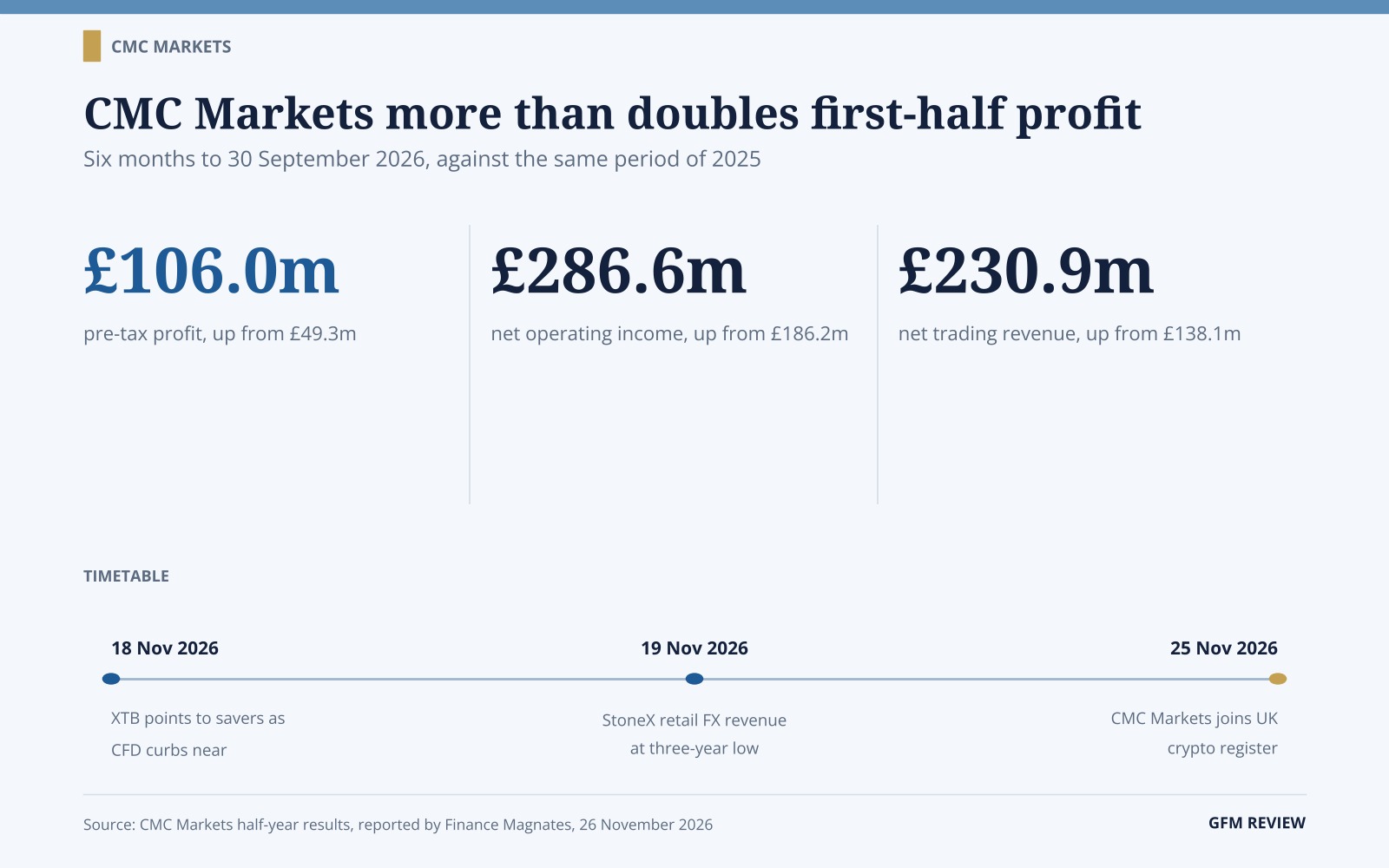
CMC Markets is attempting the shift from a position of strength. Net operating income rose 54 per cent to a record £286.6m in the six months to 30 September and pre-tax profit rose 115 per cent to £106.0m, with institutional clients growing fastest even though volatility stayed below its historical average for most of the period. Founder and chief executive Peter Cruddas said the result showed the group no longer depends mainly on the retail trading cycle. The FCA also registered CMC Markets UK as a cryptoasset business with effect from 25 November, on conditions that keep clients' coins inside its platform.
Licences, wrappers and new brands
Serving savers often means behaving more like a bank. flatexDEGIRO said on 18 November that its listed parent will apply for its own banking licence and plans to merge its bank into it after the 2027 annual meeting, subject to approvals, to simplify its structure and speed up decisions. The bank serves more than 3.5 million customers in 16 countries, up from 3 million accounts in November 2024.
In Poland, DM BOŚ, which has traded as Bossa for more than 30 years, launched Investia in late November: portfolios of exchange-traded funds chosen by licensed advisers, from PLN 1,000 at 1.2 per cent a year. It chose a separate brand because, it said, savers often see the stock market as too risky. DM BOŚ ran about 6.4 per cent of Polish brokerage accounts at the end of October, against 42 per cent at XTB, which describes its own transformation from a CFD broker into an investment app as the Polish regulator prepares new limits on contracts for difference.
Interactive Brokers is moving in a different direction, towards automation for active clients. On 21 October it launched IBKR Autonomous Trading, which lets eligible clients authorise connected AI platforms to submit orders within a separate account partition, under instructions and safeguards the client defines. It is a bet that technology, rather than price alone, keeps self-directed investors engaged.
Product shelves are widening in the UK as well. Robinhood opened US initial public offerings to its UK customers on 9 November with no commission, adding to the crypto trading it introduced there in August and the stocks and shares ISA it launched in February.
Others to watch
- Plus500 said on 26 October that full-year revenue and EBITDA will be ahead of market expectations, after nine-month revenue rose 11 per cent to $666.1m, and it has acquisitions of broker-dealers in the US and Brazil pending.
- Tiger Brokers owner UP Fintech reported record client assets of $64.8bn at the end of the third quarter, up 6.7 per cent on the previous quarter.
- Webull opened South Korean shares to its Hong Kong clients on 23 November, with commissions from 0.08 per cent.
- Marex launched a global payments platform on 23 November covering more than 150 currencies, after FCA authorisation to provide payment services.
- Saxo will give eight athletes, including Lando Norris and Magnus Carlsen, €500,000 each in simulated money from January, with a public leaderboard tracking their portfolios.
What the shift could overlook
Savings products bring scale but thin margins. Germany's 1 per cent cap on children's accounts is a ceiling, and the most prominent offer is already free. Brokers are paying to win accounts whose state contributions will take years to build meaningful balances, and the earnings come later, if at all, from cash interest and other services.
Banking ambitions carry their own costs. A licence brings capital requirements and closer supervision, and BaFin only lifted a capital surcharge on flatexDEGIRO in October, according to Finance Magnates. Regulators are also tightening the older business: a deputy chairman of Poland's regulator said 267,000 clients of Polish brokers lost nearly PLN 2bn on CFDs last year.
Nor has trading revenue lost its weight. At XTB, leveraged products still earned 90 per cent of the trading result last quarter, Finance Magnates reported. The shift towards savers is a direction of travel, not yet a change in where most brokers make their money.
The first evidence arrives in January, when Germany's children's and adult pension accounts open. Account numbers will come quickly. The measure that matters is how much money stays, and whether brokers can earn a return on it under capped fees. For CMC, its Westpac partnership, due to go live in the half-year starting April 2027, will test how far institutional business can offset quieter retail markets. In Poland, the shape of the new CFD limits will show how hard regulators push a transition the brokers say is already under way.
Crypto Trading Firms Raise Capital As UK And EU Rules Close In
Investors are backing institutional crypto trading, settlement and payments firms even as prices fall and stablecoin sup... Read more
Cross-border Advisers Expand In Europe As Tax Changes Reshape Expat Planning
Wealth firms serving Britons abroad are opening offices and winning licences across southern Europe and the Gulf. The nu... Read more
Pension Inheritance Tax Change Is Reshaping The UK Advice Market
From April 2027 unused pensions fall into the inheritance tax net. UK advice firms are buying, building and specialising... Read more
CFD Brokers Redraw Their Licence Maps As European Regulators Tighten
Retail brokers are selling and buying client books, entering new countries and wiring accounts to AI assistants. Account... Read more
Banks Turn To AI Agents As Compliance Rules Demand More Proof
Specialist vendors are moving AI from alert triage into screening, investigations and onboarding. New rules in Singapore... Read more
Brazilian And Mexican Credit Fintechs Turn To Bank Debt To Grow
BBVA Spark has committed more than US$100 million to two Mexican fintech lenders this month, while Brazilian venture fun... Read more