

CFD Brokers Redraw Their Licence Maps As European Regulators Tighten
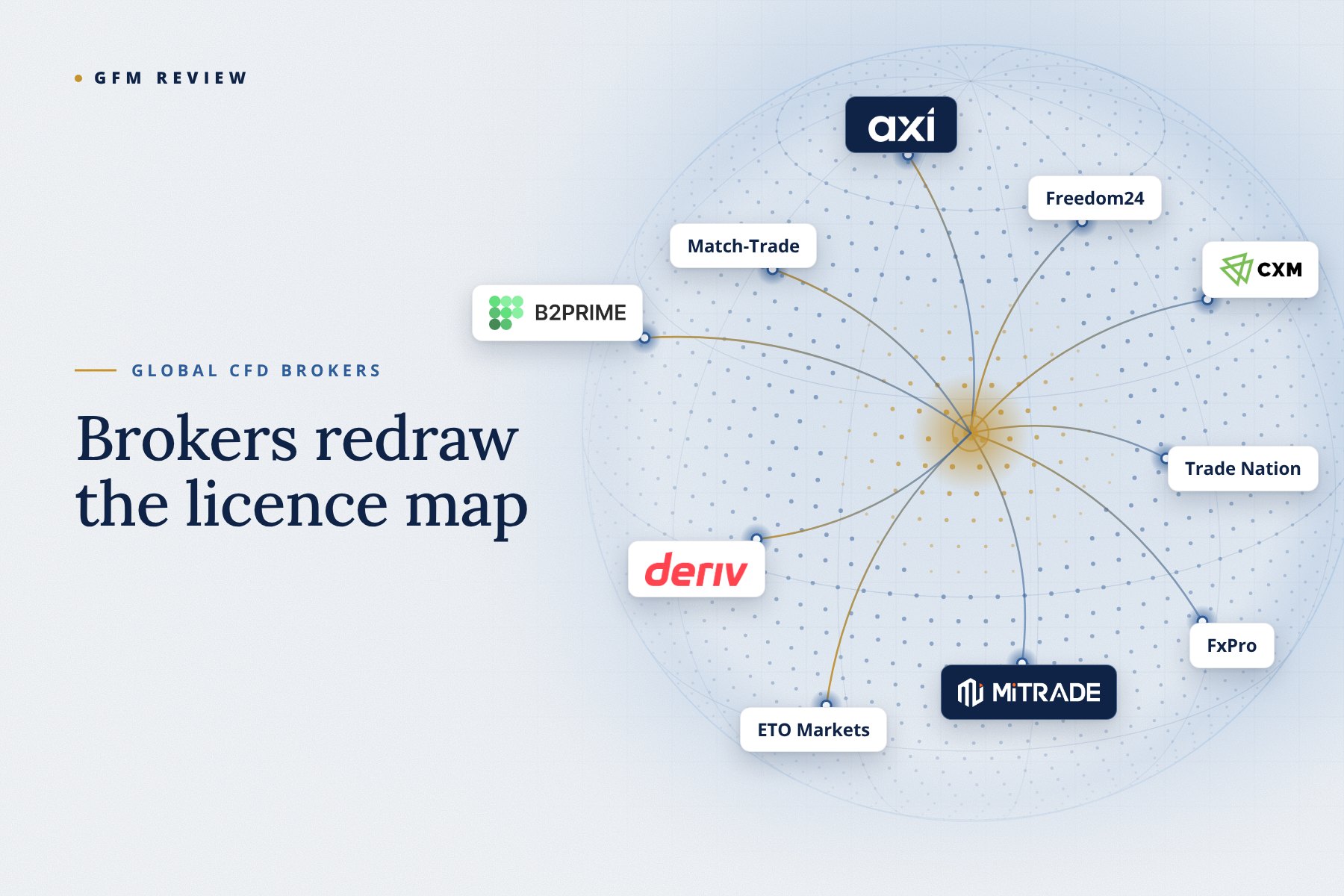
Retail brokers are selling and buying client books, entering new countries and wiring accounts to AI assistants. Account numbers have rarely been higher, but trading per account is falling and supervisors are questioning the product again.
The retail contracts for difference (CFD) industry is redrawing its map. In six weeks this autumn, one London-headquartered broker agreed to sell its European client book, another entered Poland on a Portuguese licence, a third bought a South African broker for its local licence, and two connected client accounts to AI assistants that can prepare or place trades. The common thread is a search for growth in places, and through channels, where the rules and the economics still work.
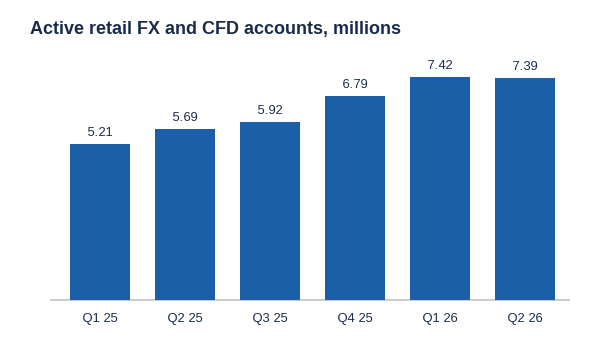
The pressure behind those moves shows up in the data. FM Intelligence, the research arm of Finance Magnates, counted 7.42 million active retail FX and CFD accounts at the end of the first quarter of 2026, up from 5.21 million a year earlier. In the second quarter the base held at 7.39 million, but average monthly volume fell to $30.46 trillion from $32.85 trillion and volume per account fell 7 per cent. Activity per account declined at 45 of the 51 brokers in its study. Preliminary figures suggest volumes recovered by about 8 per cent in the third quarter.
More clients, thinner trading
A CFD lets a client take a leveraged position on the price of a share, index, currency or commodity without owning it. Brokers earn from spreads, commissions and overnight financing, and those that take the other side of client trades can also profit from client losses. Revenue therefore depends on how much clients trade, not simply on how many sign up.
The listed brokers show how uneven that has become. StoneX, which owns FOREX.com, reported a 15 per cent fall in quarterly retail FX and CFD revenue to $42.4 million in the three months to September, and the segment made a loss of $9.2 million after allocated overhead, in a year of record profit for the group. Plus500, by contrast, reported third-quarter revenue up 11 per cent to $203.2 million and is building a multi-asset app for US clients due in the first quarter of 2027.
The product mix is shifting as well. Currency pairs made up 13.7 per cent of the volume reported by tracked brokers in the second quarter, against 26.8 per cent a year earlier, as clients moved into metals, indices and equities. A broker built around foreign exchange now has to compete for business that looks more like equity and commodity trading.
Regulation is the other pressure. European rules introduced by ESMA in 2018 capped retail leverage at between 30:1 and 2:1, after national supervisors found that 74 to 89 per cent of retail accounts typically lost money. On 17 November, shares in the Warsaw-listed broker XTB fell 17.5 per cent after the deputy chairman of Poland's regulator, the KNF, said a new intervention on CFDs would come soon. He said 267,000 clients of Polish brokers had lost money on CFDs the previous year, with combined losses of nearly PLN 2 billion.
Six different bets
FxPro has chosen to step back from the EU. On 14 October it agreed to sell the client book of its Cyprus entity to Capital.com, subject to approval by the Cypriot regulator. Peter Aust, its chief operating officer, said the vast majority of the group's recent growth had come from outside Europe. FxPro keeps its London headquarters, its FCA licence and its licences in the Bahamas and the Seychelles.
Trade Nation is moving the other way. On 15 October it launched in Poland, passporting the licence it holds from Portugal's CMVM and offering złoty accounts, Polish shares and support in Polish. It had also agreed to buy the UK client book of FXCM. The Polish launch came a month before the KNF signalled fresh curbs, which shows how quickly the ground can shift under a new entrant.
CXM Group bought its way into a licence. On 16 October it agreed to acquire TD Markets, a Johannesburg broker with more than 50,000 active clients and a licence from South Africa's Financial Sector Conduct Authority. CXM's existing licences are in the Seychelles, Mauritius, the UAE and Cambodia, and the terms were not disclosed. The deal gives CXM a foothold in a market where, according to Finance Magnates, the cost of the derivatives licensing regime has pushed several international brokers out.
Axi and Freedom24 are testing distribution through AI. On 14 October Axi let eligible MetaTrader 5 clients connect their accounts to Claude, Anthropic's assistant, through the Model Context Protocol, an open standard for linking AI tools to outside services. Clients can check prices and open or close positions, with each order approved in the chat, and Axi describes the service as an alpha. On 26 October Freedom24 opened its Tradernet infrastructure to AI tools in the same way, and says every trading order still requires client confirmation.
Mitrade illustrates the measurement problem. On 24 November it said it had passed 8 million registered users after adding nearly 1.7 million in 2026, with trading volume up 44 per cent. FM Intelligence estimates that it had about 121,000 active trading accounts in the third quarter, roughly 1.5 per cent of the registered total, and puts its volume growth for the first nine months nearer 25 per cent.
Others to watch
- ETO Markets, which operates through entities in Australia, the Seychelles and Mauritius, added zero-commission US stock CFDs on 17 November.
- B2PRIME hired Malcolm Collins, formerly of LSEG and oneZero, as head of market development on 12 November to build new business lines.
- Deriv chief growth officer Prakash Bhudia said on 19 November that event contracts are structured much like the digital options the broker already offers.
- STARTRADER, whose entities are licensed by regulators including the UAE's Capital Market Authority, ASIC and the FSCA, sponsored the MENA Investment Congress in Dubai on 24 November.
- Match-Trade Technologies, which supplies trading platforms to brokers and prop firms, named Michał Copiuk, formerly head of XTB's institutional business, as chief executive from 1 December.
What the strategies have to prove
Each move rests on an assumption that has yet to be tested. Selling a European book assumes that growth in offshore and emerging markets will stay more profitable once compliance costs are counted, and South Africa shows that local licensing can be expensive. Entering Poland assumes the KNF's next step will be manageable. XTB's chief executive, Omar Arnaout, has argued that the regulator is more likely to tighten suitability checks than to separate CFD and share accounts, but the KNF has given no timetable or detail.
AI connectors raise questions of their own. Approval prompts keep a person in the decision, yet Axi's help pages note that clients can set an action to "Always allow" in Claude's permission settings. It is not yet clear how supervisors will treat an assistant that prepares leveraged trades for retail clients, or who carries the blame when it misreads an instruction.
Headline user numbers need the most care. Registered users, funded accounts and active traders measure different things, and the gap in Mitrade's figures shows how far apart they can sit. A broker that adds sign-ups without adding trading has bought cost, not revenue.
What to watch next is the detail of the KNF's CFD measure, CySEC's decision on the FxPro book and the final third-quarter account figures from FM Intelligence. Those figures will show whether the recovery in volume came from more traders, or from the same traders trading more.
Crypto Trading Firms Raise Capital As UK And EU Rules Close In
Investors are backing institutional crypto trading, settlement and payments firms even as prices fall and stablecoin sup... Read more
Cross-border Advisers Expand In Europe As Tax Changes Reshape Expat Planning
Wealth firms serving Britons abroad are opening offices and winning licences across southern Europe and the Gulf. The nu... Read more
Retail Brokers Chase Savers As The Trading Cycle Cools
From children's pension accounts to banking licences and payments, online brokers are building businesses that depend le... Read more
Pension Inheritance Tax Change Is Reshaping The UK Advice Market
From April 2027 unused pensions fall into the inheritance tax net. UK advice firms are buying, building and specialising... Read more
Banks Turn To AI Agents As Compliance Rules Demand More Proof
Specialist vendors are moving AI from alert triage into screening, investigations and onboarding. New rules in Singapore... Read more
Brazilian And Mexican Credit Fintechs Turn To Bank Debt To Grow
BBVA Spark has committed more than US$100 million to two Mexican fintech lenders this month, while Brazilian venture fun... Read more