

Pension Inheritance Tax Change Is Reshaping The UK Advice Market

From April 2027 unused pensions fall into the inheritance tax net. UK advice firms are buying, building and specialising to meet the planning work it creates, but whether the demand lasts, and who keeps the assets, is far from settled.
Little more than four months before unused pension funds enter the inheritance tax net, the UK advice market is already reorganising around the change. Consolidators are buying firms with wealthy, older client books, planners are building their own investment products and specialists are opening for families with complex needs. The question for clients and investors is whether a one-off tax change creates lasting demand for advice, or a burst of planning work that fades once the new rules bed in.
The policy itself is settled. From 6 April 2027 most unused pension funds and death benefits will count towards an estate for inheritance tax. HMRC estimates that of around 213,000 estates with inheritable pension wealth in 2027 to 2028, 10,500 will face a bill where previously they would not and 38,500 will pay more, with the average liability rising by about £34,000. The Exchequer expects the measure to raise £710m in its first year, climbing to £1,665m by 2030 to 2031.
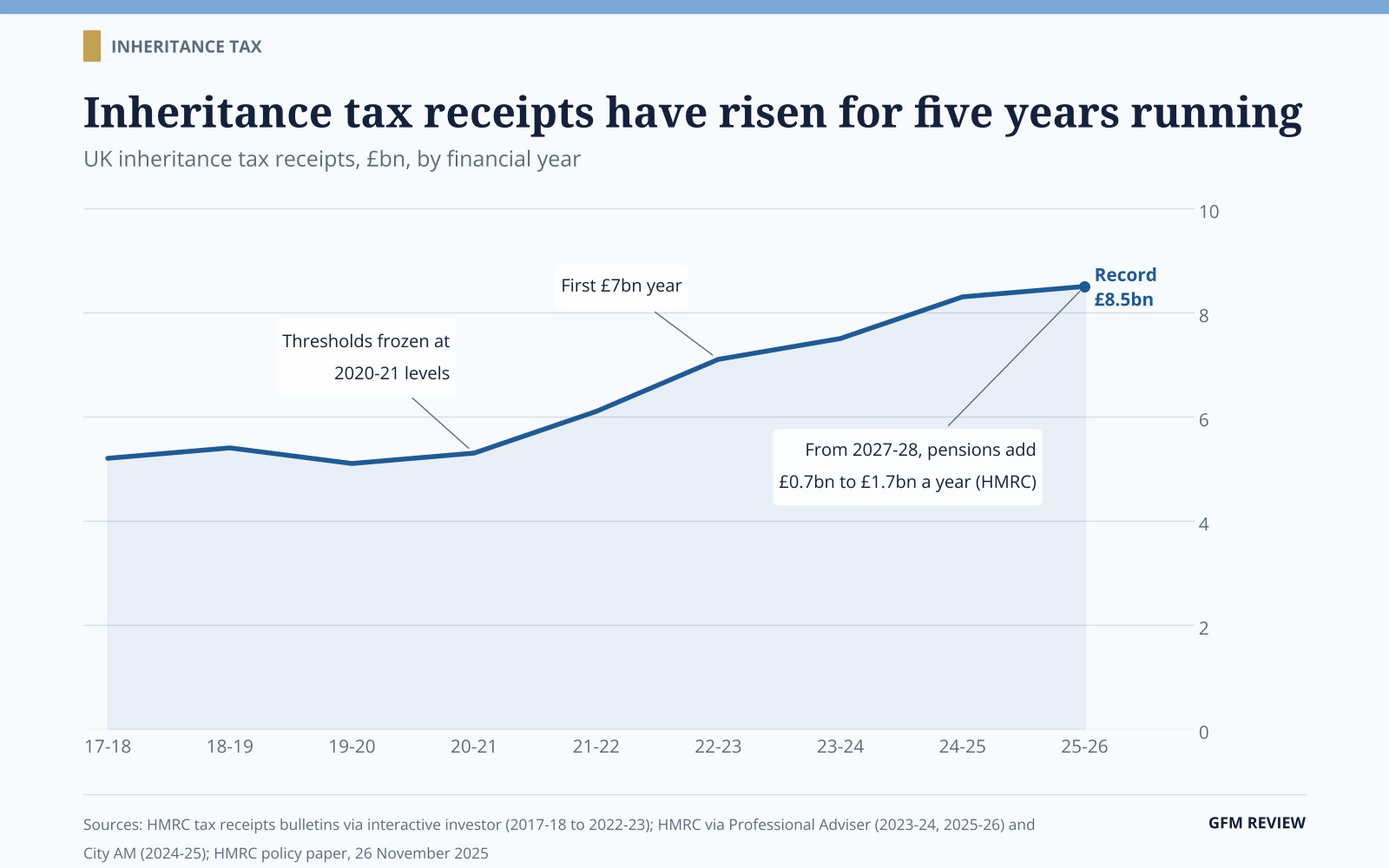
That sits on top of a tax that is already growing without new policy. HMRC said inheritance tax receipts reached £5.5bn in the seven months to October 2026, 7 per cent more than a year earlier, and it expects them to keep rising while thresholds stay frozen at their 2020 to 2021 levels until 2030 to 2031.
Why advice firms see an opening
The mechanism is simple. Until now a pension has been one of the most efficient assets to leave untouched on death. From 2027 that advantage largely disappears for estates above the thresholds, so clients who planned to pass on pension wealth must revisit drawdown, gifting, trusts and the choice of investment wrapper, often across several generations of a family. That is work a calculator cannot easily do.
The administration changes too. Personal representatives will need to obtain pension values from scheme administrators and settle any tax due, adding work for executors at a difficult time and giving families another reason to plan ahead.
Product providers are seeing it first. Research by Chesnara Life found 71 per cent of advisers expect to use onshore investment bonds more once the change takes effect, while Standard Life said new business in its international bond rose 34 per cent year on year in the third quarter.
Clients appear to value the conversation. A YouGov survey of 4,859 adults for the adviser platform Nucleus found that people who had spoken to an adviser about the pension change scored 7.6 out of 10 for confidence, against 4.3 for those unaware of it. Among those who had paid for advice in the past two years, 96 per cent found it helpful. Only 9 per cent said they would be comfortable with fully automated advice powered by artificial intelligence.
Consolidators buy scale and succession
The clearest commercial response is consolidation. On 27 November Fairstone said it had completed the purchase of 336 Financial Management, an Edinburgh firm with £402m of assets and more than 450 clients, which first partnered with Fairstone in February 2025 under its gradual buy-out programme and will become Fairstone Edinburgh. Fairstone reports more than £23bn of client assets across over 50 locations.
A day earlier Perspective announced its 150th acquisition in 18 years, the London Chartered Financial Planning firm Holden & Partners, which specialises in sustainable and responsible investment. Holden's managing partner, Steve Pyne, said the sale followed a two-year selection process and the retirement of two senior partners. That is a reminder that succession, not only tax, drives many of these deals.
The pace is steady rather than frantic. Professional Adviser's running tracker of 2026 deals lists at least five announced in November, including Chester Rose's purchase of Bespoke IFA in Berkshire, with £250m of assets, and Lync Wealth Management's purchase of two South East firms with £210m between them.
For acquirers, the logic is to spread compliance, technology and investment costs across more clients. For sellers, it is an exit. The risks sit in integration and client retention, both of which take years to show.
Scale does not guarantee flows. St James's Place reported record funds under management of £242.4bn at the end of September, yet third-quarter net inflows fell to £570m from £1.76bn a year earlier, which it put down to market volatility and caution before the Budget. In July it had linked a fall in first-half net inflows, from £3.8bn to £2.7bn, to market uncertainty and what it called impending changes to the retirement and financial planning landscape. City AM reported that the same upheaval had also increased client retention, with client numbers rising to 1,064,000 from 1,037,000 over the half.
Some firms are changing how they run money rather than buying more of it. Matthew Douglas, an independent firm with advisers in Suffolk and Surrey, launched two multi-asset funds on 26 November, moving around £80m from its model portfolio service and expecting about £300m within a year. Founder Matthew Pescott Frost cites capital gains tax advantages for clients and greater scalability for the firm, and says he expects lower costs for clients over the medium to long term. That expectation has yet to be tested.
Others to watch
- Evelyn Partners is the investment manager for both of Matthew Douglas's new IFSL Wheatsheaf House funds, as well as for the firm's discretionary portfolios.
- Quilter, which oversees £160.5bn, obtained HMRC data showing 7,730 people already hold £1m or more in ISAs, and illustrates that 540,130 could pass that mark within 20 years with average contributions.
- Planit Future, launched on 25 November by Rhiannon Gough, founder of the UK Alliance of SEND Advisers, offers financial, legal and life planning to families supporting a disabled child or adult.
- Radiant Financial Group chief executive Simon Cogman-Hellier, responding to the Nucleus research, said: "We should never confuse efficiency with advice."
- Greenarch Wealth Management, a Chartered firm in Newcastle, agreed on 23 November to take on the client books of the adviser Steve Wombwell, according to Professional Adviser.
What the rush could overlook
The tax change creates work, but it can also move money out of the products advisers manage. If clients draw down pensions faster to spend or give away, advised assets may shrink even as demand for advice rises. HMRC acknowledges that behaviour of this kind may reduce the number of estates affected, and treats its own estimates as a maximum.
Other wealth is building elsewhere. Quilter's projections of ISA millionaires are, in its own words, illustrations rather than forecasts, and ISAs do not generally shelter wealth from inheritance tax. That points to a broader estate planning market, not one tied only to pensions.
Competition is also widening. Since 6 April 2026, firms authorised by the Financial Conduct Authority can offer targeted support, suggestions designed for groups of consumers with shared characteristics, aimed at an estimated 23 million people underserved by advice and guidance. Pension providers and banks can now reach clients that advisers have traditionally priced out.
The first hard evidence arrives after April 2027. Inheritance tax receipts for 2027 to 2028 will show how much planning has reduced the bill, and results from the consolidators will show whether acquired clients stay. For advice firms asking families to trust them with decisions that last a generation, retention, not acquisition counts, will be the measure that matters.
Crypto Trading Firms Raise Capital As UK And EU Rules Close In
Investors are backing institutional crypto trading, settlement and payments firms even as prices fall and stablecoin sup... Read more
Cross-border Advisers Expand In Europe As Tax Changes Reshape Expat Planning
Wealth firms serving Britons abroad are opening offices and winning licences across southern Europe and the Gulf. The nu... Read more
Retail Brokers Chase Savers As The Trading Cycle Cools
From children's pension accounts to banking licences and payments, online brokers are building businesses that depend le... Read more
CFD Brokers Redraw Their Licence Maps As European Regulators Tighten
Retail brokers are selling and buying client books, entering new countries and wiring accounts to AI assistants. Account... Read more
Banks Turn To AI Agents As Compliance Rules Demand More Proof
Specialist vendors are moving AI from alert triage into screening, investigations and onboarding. New rules in Singapore... Read more
Brazilian And Mexican Credit Fintechs Turn To Bank Debt To Grow
BBVA Spark has committed more than US$100 million to two Mexican fintech lenders this month, while Brazilian venture fun... Read more