

Crypto Trading Firms Raise Capital As UK And EU Rules Close In
Investors are backing institutional crypto trading, settlement and payments firms even as prices fall and stablecoin supply shrinks. Regulators in London, Brussels and Washington are now setting the terms on which those firms may operate.
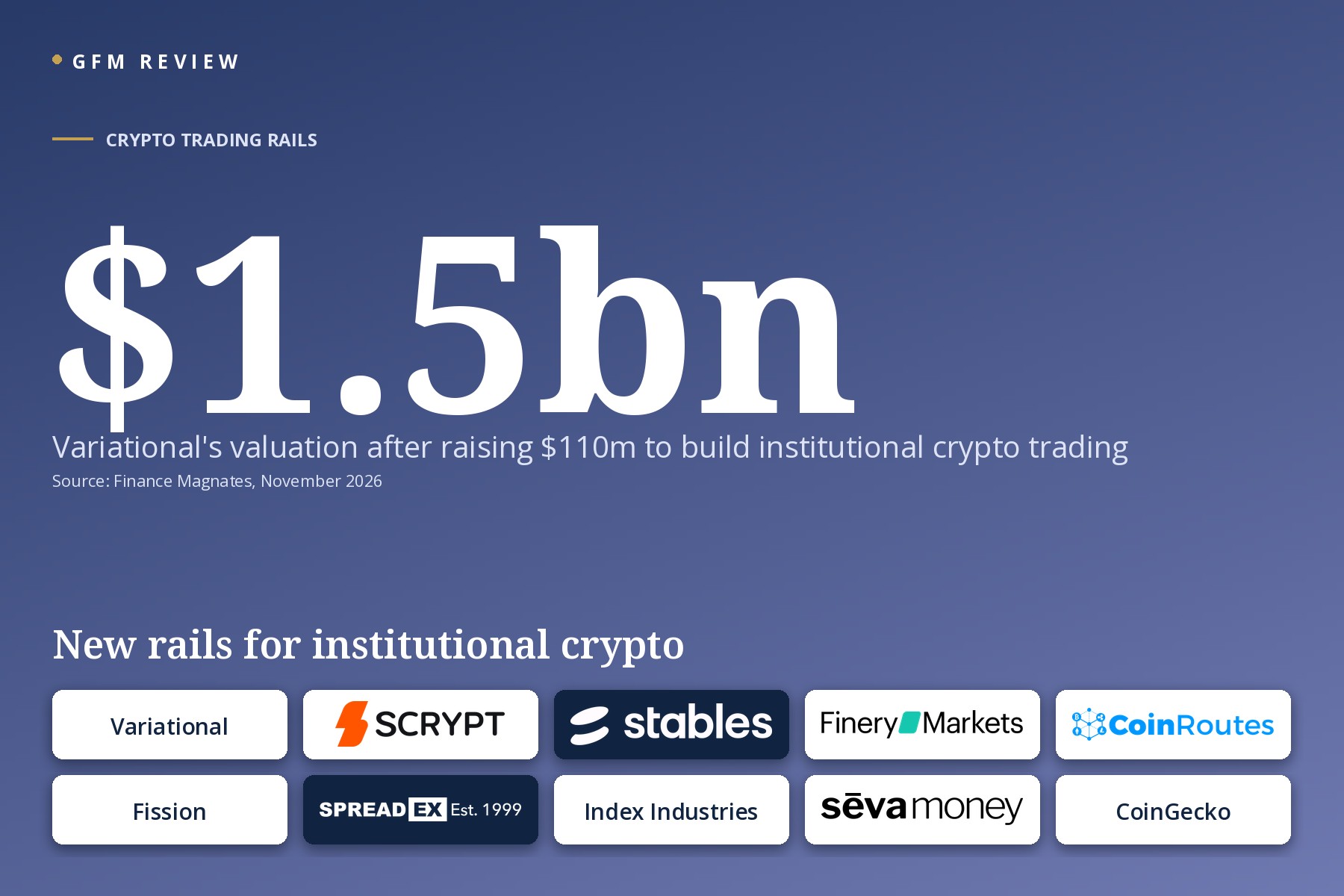
Capital is still flowing to the companies that move crypto between institutions, even as the market around them weakens. On 18 November Variational, a derivatives trading platform, raised $110m at a $1.5bn valuation. Within days Tether, the largest stablecoin issuer, had invested in the Swiss settlement firm SCRYPT and the payments company Stables. These deals landed in a month when bitcoin touched a four-month low and the supply of stablecoins, the dollar tokens that serve as crypto's settlement currency, continued to shrink.
The question is whether investors are backing durable market infrastructure or simply the parts of the sector still able to raise money. The answer depends heavily on regulation, which is arriving in Britain, Europe and the United States at the same time.
The rules arrive
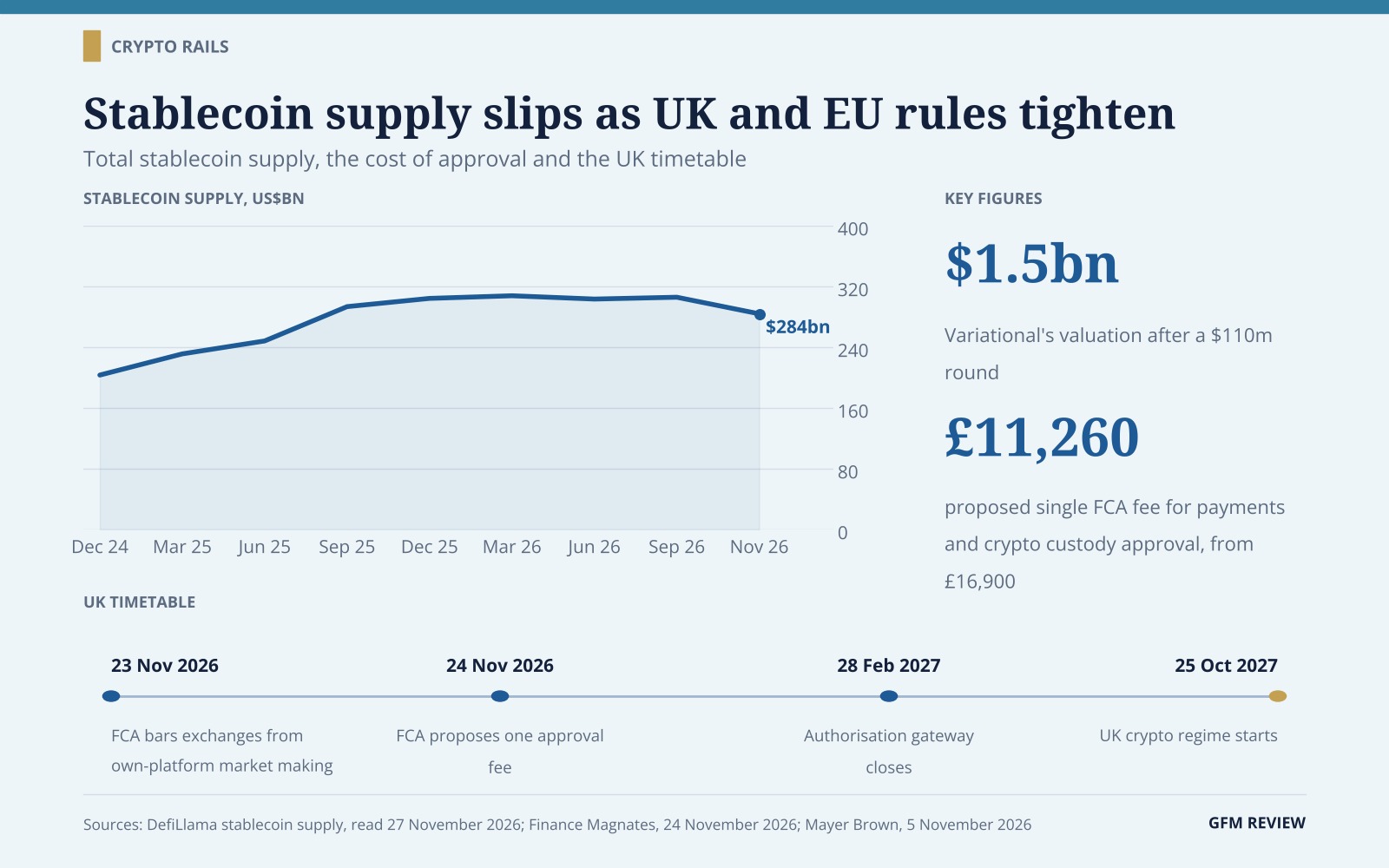
The UK timetable is now fixed. The Financial Conduct Authority published final rules on 30 June 2026 requiring trading platforms, intermediaries, custodians, stablecoin issuers and staking providers to be authorised, with capital requirements, market abuse rules and the Consumer Duty applying. Its application window opened on 30 September and closes on 28 February 2027; the regime takes effect on 25 October 2027. According to Mayer Brown, firms that apply within the window and are still awaiting a decision can keep operating, while existing anti-money-laundering registrations do not convert automatically.
The most consequential detail concerns conflicts. From October 2027, platforms may not trade against their own capital on venues they run, although third-party market makers can continue. The FCA's reasoning is that a platform sees order flow other participants cannot. It estimates the regime will cost the industry £1.315bn. Separately, it has proposed a single £11,260 fee for firms seeking both payments and crypto custody approval, down from a combined £16,900, with consultation closing on 19 January 2027.
Europe moved first. The transitional period under the EU's Markets in Crypto-Assets regulation ended on 1 July 2026, and the European Securities and Markets Authority told unauthorised providers to stop onboarding EU clients and wind down in an orderly way. In the United States, the GENIUS Act on stablecoins takes effect on 18 January 2027, and the Office of the Comptroller of the Currency issued its final rule on 21 October.
The commercial logic follows from these rules. Regulation separates functions that crypto exchanges have often combined: running a venue, making markets, holding client assets and settling trades. Firms that do one of those jobs well, and neutrally, become more useful to banks and funds that must show regulators who stands on the other side of a trade. Compliance costs also favour scale, which helps explain why investors are concentrating their money.
Where the money is going
Variational offers swaps and perpetual contracts on crypto, shares and commodities. Its Series B was led by Bain Capital Crypto, and Finance Magnates reported that the Cayman Islands-registered platform had more than 100,000 accounts and more than $475bn of volume since its 2025 launch. More than half of its daily volume now comes from traditional markets, a sign that crypto rails are being used for non-crypto exposure. It is not available in the US or Canada.
Tether's investments in SCRYPT and Stables, both of undisclosed size, show the issuer buying distribution. The SCRYPT investment, crypto.news reported, is meant to support the expansion of the firm founded by Norman Wooding into fiat accounts and third-party payments; its website says it has moved more than $50bn for over 350 institutional clients since 2019. Stables builds USDT payment infrastructure for Asia and the Middle East and says it supports more than 160 markets and over $2bn of annual USDT volume. When the issuer of a stablecoin funds the businesses that distribute it, clients will reasonably ask how neutral those businesses remain.
Finery Markets, based in Limassol, added pricing in more than 20 African and Latin American currencies through a partnership with LINK on 25 November. The firm serves about 150 institutional clients in 40 countries and reports more than $75bn of cumulative volume. It says stablecoins carried 83 per cent of trades on its network in the first nine months of 2026.
CoinRoutes, which routes institutional orders across many venues and reports more than $700bn of notional volume, added custom over-the-counter options from STS Digital on 23 November. STS, regulated in Bermuda, takes the other side of each contract. Independent routing of this kind gains relevance once exchanges can no longer act as market makers on their own venues.
Fission, a New York company, raised a $10m Series A led by Pantera Capital, announced on 15 October. It buys tokenised fund shares so investors can exit without waiting for a redemption window. Chief executive Jonathan Shaffer told Fortune that such a sale normally takes about 200 days, while Fission settles "in 90 seconds or less". The model shifts liquidity risk onto Fission's own balance sheet, and its eight staff will need to price that risk well.
Others to watch
- Spreadex, the UK spread betting firm, appears on the FCA's list of registered cryptoasset businesses with a status effective 16 November, according to the Chain Daily register tracker.
- Index Industries emerged on 10 November with a $50m seed round led by Lightspeed Venture Partners, to build a daily US home price index and a token tracking it for non-US investors.
- Seva Money, a London start-up, raised a $5m seed round co-led by Blockwall and Revent on 9 November for white-label wallets and cards that let remittance recipients hold fiat or stablecoins.
- CoinGecko announced backing from the Solana Foundation on 17 November; the foundation's chief product officer, Vibhu Norby, said it now holds a majority interest, Cointelegraph reported.
Testing the optimism
The funding headlines sit against a weaker backdrop. DefiLlama data show total stablecoin supply at $283.98bn on 26 November, down from a 2026 peak of $314.39bn on 17 May. Bitcoin fell to $62,080.91 on 15 November, according to Cointelegraph. Galaxy Research counted $4.519bn of crypto venture investment across 296 deals in the third quarter, down 20 per cent by value and 24 per cent by number on the previous quarter, with later-stage rounds taking about three quarters of the capital. Large rounds for a few firms, in other words, sit alongside a thinner market for everyone else.
Security risk has not gone away either. Binance said in October that about $6.3bn had been stolen from it, which would make it the largest crypto theft on record, a reminder that counterparty and custody failures remain a central risk for the sector.
Several claims also deserve caution. Volume and client figures are company statements, not audited numbers. The sums Tether invested and the terms of the CoinGecko deal are undisclosed. The UK perimeter is not settled: HM Treasury laid draft amendments in September adding exclusions for proprietary trading and market making, and the FCA's related consultation closed on 18 November.
The first hard deadline is 28 February 2027. Any of these firms that intends to serve UK clients after October 2027 must have applied by then to keep operating while the FCA decides. Whether the regulator authorises them, and on what conditions, will show whether this year's valuations rested on regulated businesses or on the hope of becoming one.
Cross-border Advisers Expand In Europe As Tax Changes Reshape Expat Planning
Wealth firms serving Britons abroad are opening offices and winning licences across southern Europe and the Gulf. The nu... Read more
Retail Brokers Chase Savers As The Trading Cycle Cools
From children's pension accounts to banking licences and payments, online brokers are building businesses that depend le... Read more
Pension Inheritance Tax Change Is Reshaping The UK Advice Market
From April 2027 unused pensions fall into the inheritance tax net. UK advice firms are buying, building and specialising... Read more
CFD Brokers Redraw Their Licence Maps As European Regulators Tighten
Retail brokers are selling and buying client books, entering new countries and wiring accounts to AI assistants. Account... Read more
Banks Turn To AI Agents As Compliance Rules Demand More Proof
Specialist vendors are moving AI from alert triage into screening, investigations and onboarding. New rules in Singapore... Read more
Brazilian And Mexican Credit Fintechs Turn To Bank Debt To Grow
BBVA Spark has committed more than US$100 million to two Mexican fintech lenders this month, while Brazilian venture fun... Read more