

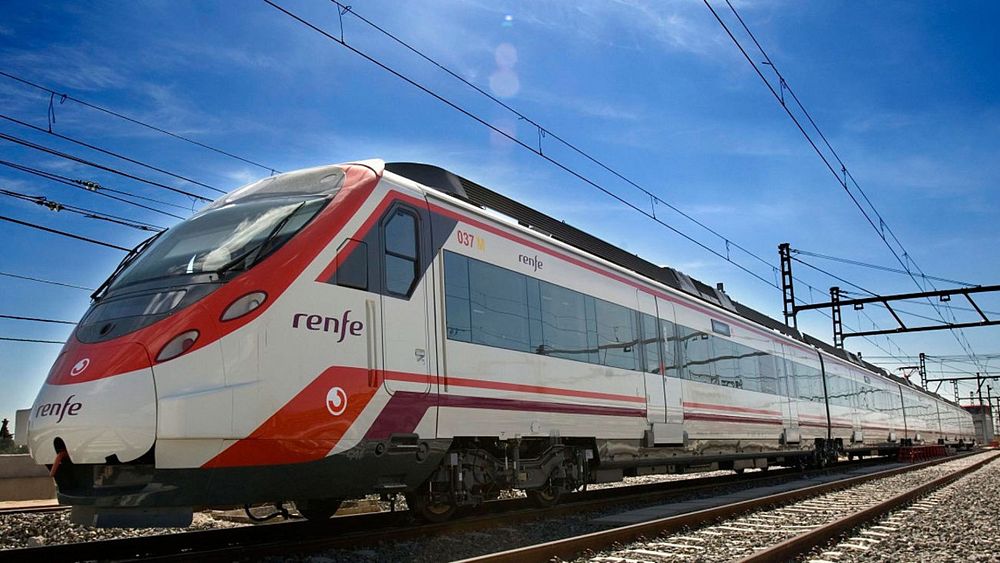
Spain’s national rail operator has recently launched new routes connecting to major cities in France.
 ADVERTISEMENT
Now, rumour has it that Renfe has its sights set on Portugal.
Various media outlets have reported that it is launching services linking Madrid and Lisbon, and the northwest Spanish port city of A Coruña with Porto.
The two countries’ capitals have not been linked by a direct train since 2020, when Renfe discontinued its overnight train-hotel service.
Here’s everything we know so far.
Spanish trains could take advantage of Portugal’s new high-speed line
Portugal is developing a new high-speed train line, the first part of which is due to be completed in 2024.
The 100km line from Elvas to Evora will cut the journey time between Lisbon in west Portugal and Badajoz in west Spain from three-and-a-half to under two hours.
It will be part of a wider Iberian high-speed rail network that will also connect Lisbon to Porto in around 1 hour 15 minutes - less than half the time it currently takes.
According to Spanish news site La Información, it is hoped the line will connect Madrid and Lisbon via Badajoz in six hours by 2027.
The coastal line, meanwhile, could extend to Vigo, Santiago and A Coruña in northwest Spain, while Madrid could be connected to Porto via Salamanca.
“There are no definite plans confirmed or approved at the moment concerning Portugal,” a Renfe spokesperson said when contacted by Euronews Travel.
However, they did confirm that the Madrid-Extremadura high-speed rail line - currently under construction - will connect with the Portuguese city of Evora in future. By 2030, this line is projected to extend to Lisbon via Poceirão.
ADVERTISEMENTWhy is there no train line between Spain and Portugal?
Renfe needs to invest €15 million to adapt part of its rolling stock to Portuguese infrastructure, according to La Información.
Various infrastructure issues need to be addressed before cross-border trains can operate. These include discrepancies in electrical voltages and signalling systems that are not expected to be resolved until at least 2025, the news site reports.
Portugal’s railway manager Infraestruturas de Portugal and state operator Comboios de Portugal (CP) say they are yet to receive formal notice of Renfe’s plans.
Earlier this year though, the Spanish and Portuguese prime ministers endorsed plans to improve train connectivity between their two countries in line with the EU’s plan to liberalise Europe’s railways.
Renfe stopped operating the Madrid-Lisbon Trenhotel Lusitania in May 2020 due to the pandemic, and never resumed the service.