

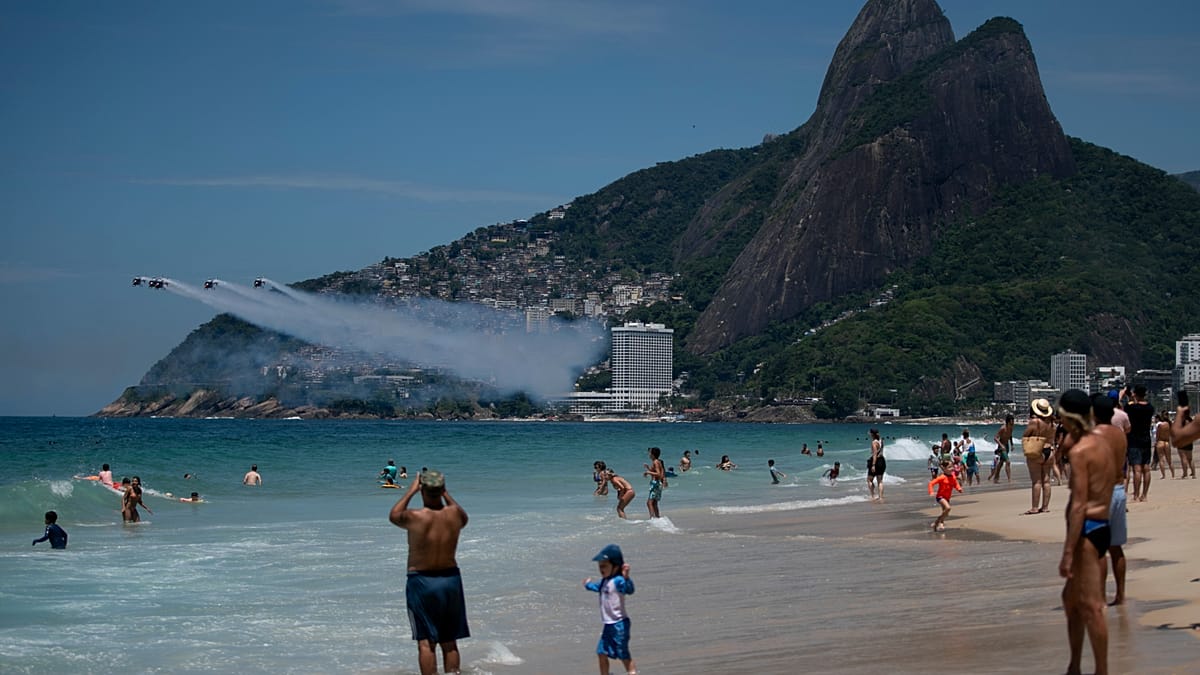
Brazil welcomed 9.3 million international tourists last year, a 37 per cent increase over the previous year’s 6.7 million. An unprecedented figure, it places the country at the forefront of global tourism growth, according to UN Tourism.
Europeans have become one of the main drivers of this boom. In total, travellers from France, Portugal, Germany, Italy, the United Kingdom and Spain accounted for 1.8 million visitors, 20 per cent more than the previous year.
Spain, the sixth-largest source of tourists to Brazil, contributed 160,000 visitors – 92 per cent more than three years ago. This progress reflects not only growing interest in Brazil but also a substantial improvement in air connectivity.
Why European tourists are flocking to Brazil
One of the main catalysts for this growth has been the launch of new direct routes with Europe, especially Spain, which now has up to six.
In 2025, Brazil inaugurated two new connections operated by Iberia, linking Madrid with Fortaleza (Ceará) and Recife (Pernambuco), opening a direct gateway to the Brazilian northeast – a region rich in beaches, culture, gastronomy and hospitality.
These routes are in addition to existing connections from Madrid and Barcelona to major destinations such as São Paulo, Rio de Janeiro, Salvador and Campinas, operated by different airlines.
At the European level, Lisbon and Porto remain the main hubs for entry into the country, reinforcing the Iberian Peninsula’s role as a natural bridge between Europe and Brazil.
São Paulo airport remains the main entry point, with more than 2.7 million international visitors, followed by Rio de Janeiro with almost 2.2 million, and Rio Grande do Sul with 1.5 million.
'Brazil is in fashion'
The economic impact of this influx of visitors is huge. Tourism already accounts for 8 per cent of Brazil’s GDP, and international travellers brought around €7.3 billion into the country in 2025, a key injection for the national economy in the context of recovery and international repositioning.
For Marcelo Freixo, president of Embratur, the Brazilian tourism promotion agency, this record is no coincidence.
“Brazil is in fashion. We have never received as many foreign tourists as we do now,” he says.
“This historic result is the outcome of intense work that combines international promotion, improvements to our offer and more connections with the world.”
Freixo stresses that extending direct access to the northeast “is opening doors for more people to experience the most genuine aspects of Brazil: authentic, diverse and unforgettable experiences”.
In his view, the change goes beyond tourism. With the presidency of Luiz Inácio Lula da Silva, Brazil has regained international weight.
“Brazil is now a respected country,” he says. After a period he describes as “very delicate and difficult”, marked by isolation and loss of prestige, he notes, “People have no interest in visiting a country that is not respected.”
Is it safe to travel to Brazil?
Despite record growth, the main challenge remains the perception of security, a key factor for international travellers.
Freixo argues that Brazil has made clear progress in this area. “It is a safe country,” he says. “Tourism helps make every city safer, and this is essential for our promotion.”
According to Embratur, 95 of tourists who visit Brazil want to return, a figure that reinforces the message of confidence.
Even so, the challenge remains: consolidating this image of safety, improving internal mobility and ensuring that foreign visitors stay longer in different regions of the country.
To this end, Brazil has launched initiatives such as the Brazil Air Pass, which allows travellers to fly to up to eight domestic destinations with a single fare, making it easier to discover lesser known parts of the country.
'Joy' is what sets Brazil apart
Beyond figures and air routes, Freixo highlights an intangible element that, in his view, sets Brazil apart from other destinations: “the joy of our people.”
“I don’t think there is any other place where people feel as welcome as in Brazil,” he says.
He concludes with a phrase that sums up the country’s message: “Our main export product is not coffee, it’s joy – and we have plenty of that.”
With more flights, a shifting international image and an increasingly diverse offer, Brazil is consolidating its position as one of the major players in global tourism, with Europe and Spain in particular as a key partner in this new phase.