

 ADVERTISEMENT
The European Commission has decided to initiate infringement proceedings against Spain because of the sanctions it enacted against five low-cost airlines.
Spanish authorities fined the carriers following their decision to impose additional charges on passengers for extra hand luggage.
Brussels argues that, although the Court of Justice of the European Union has ruled that baggage must, in principle, be free of charge, this guarantee must respect reasonable requirements relating to the weight, dimensions and security of the baggage.
Baggage that exceeds these "reasonable" requirements, the Commission's statement reads, "is subject to the freedom to set prices".
Spain now has two months to respond to the Commission and provide adequate justification or remedy for its decision.
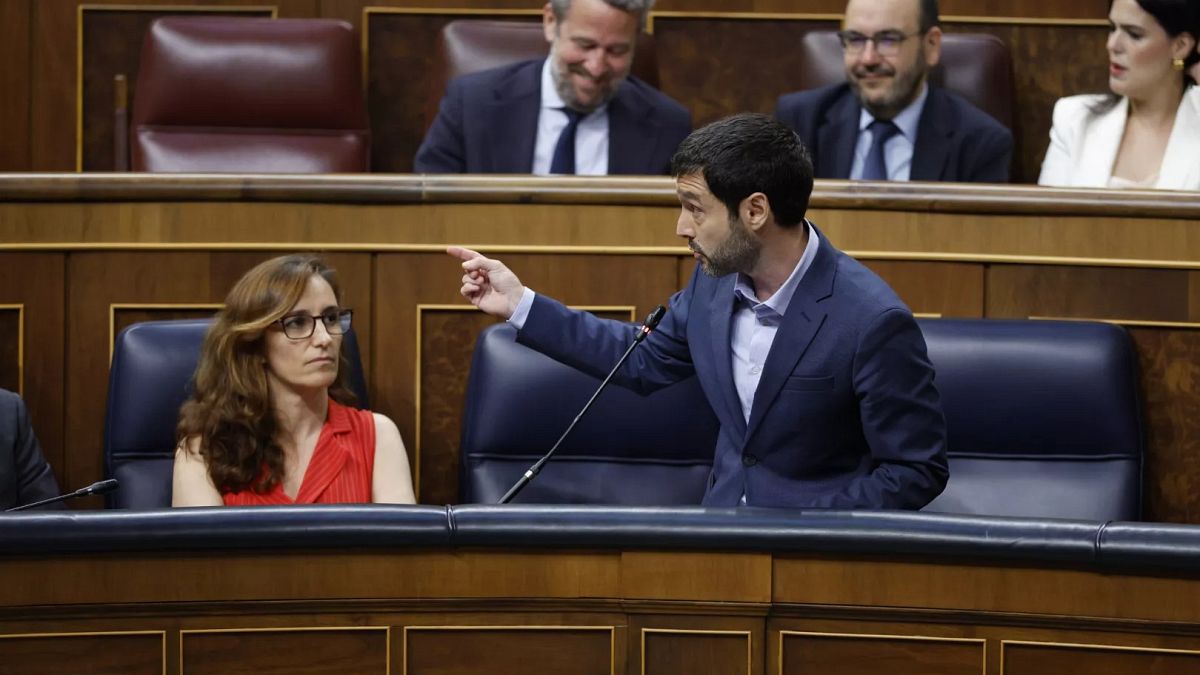
The procedure has hit hard at one of the flagship policy initiatives of the Spanish Minister for Social Rights and Consumer Affairs, Pablo Bustinduy, who has been fiercely attacked by Ryanair's CEO, Michael O'Leary.
"This is hurting European consumers and you don't have to listen to me any more: the Commission has confirmed that these measures are illegal," O'Leary told a press conference on Wednesday.
Spain defends sanctioning of budget airlines
Bustinduy described it as "regrettable" that the Commission has decided to "openly position itself as the multinationals' defence lawyer".
The minister claims that the arguments of Apostolos Tzitzikostas, the European Commissioner for Tourism, side with the budget airlines, without considering contributions from consumer associations or the Spanish government.
"We know that we move in an environment where there are great interests at stake," said the Madrid politician.
His ministry has assured today that the recently opened case does not affect the sanctions against the five airlines already fined, which are currently being appealed in the High Court of Justice of Madrid and in the National Court of Appeals.
Why did Spain fine low-cost airlines?
The government fined five low-cost airlines 11 months ago for what it considered to be illegal surcharging of passengers, among other irregularities.
The sanctions punished the charging of a supplement for hand luggage in the cabin; the fees for reserving adjacent seats in the case of minors, dependent persons and their companions; the impossibility of paying in cash; and the imposition of disproportionate fees on passengers for the physical printing of boarding cards.
Consumer Affairs also criticises the lack of clarity in the prices published in the offers on their websites.
Ryanair received the largest fine, €107,775,777, which represents 60 per cent of the total. It was followed by Vueling, with €39,264,412, and EasyJet, with €29,094,441.
Two other airlines were also fined, although with much smaller amounts: Norwegian, with €1,610,001, and Volotea, with €1,189,000.
The financial and dialectical war between Spain and Ryanair continues
Ryanair CEO O'Leary has also lashed out again at what he considers to be excessive fees for airlines at Spanish airports, after eliminating several seats at regional airports. "For the summer season, we will eliminate another million seats," he threatened.
In a harsh statement published in September, the public company that manages Spanish airport facilities, Aena, denounced O'Leary's attacks, claiming that Ryanair is pursuing a strategy of harassment and demolition not only in Spain, but also in those European countries where it wants to gain more profit margins.
"It is difficult to find in contemporary business history another case like Ryanair's where the discordance between the operational excellence of a company and the dishonesty of its communication policy is so astonishing," the company wrote in a press release.
"Aena has proposed a €0.68 increase in airport charges in 2026. The decision to take a plane does not depend on whether the ticket costs 68 cents more, but Ryanair insists time and time again on the contrary while raising its fares by an average of 21 per cent over the last year."