

 ADVERTISEMENT
Sicilians have been waiting for a bridge between the island and the Italian mainland for years, sick of using ferries to cross the Strait.
But, now, one man has found a novel new way of making the crossing: on foot. Yes, really.
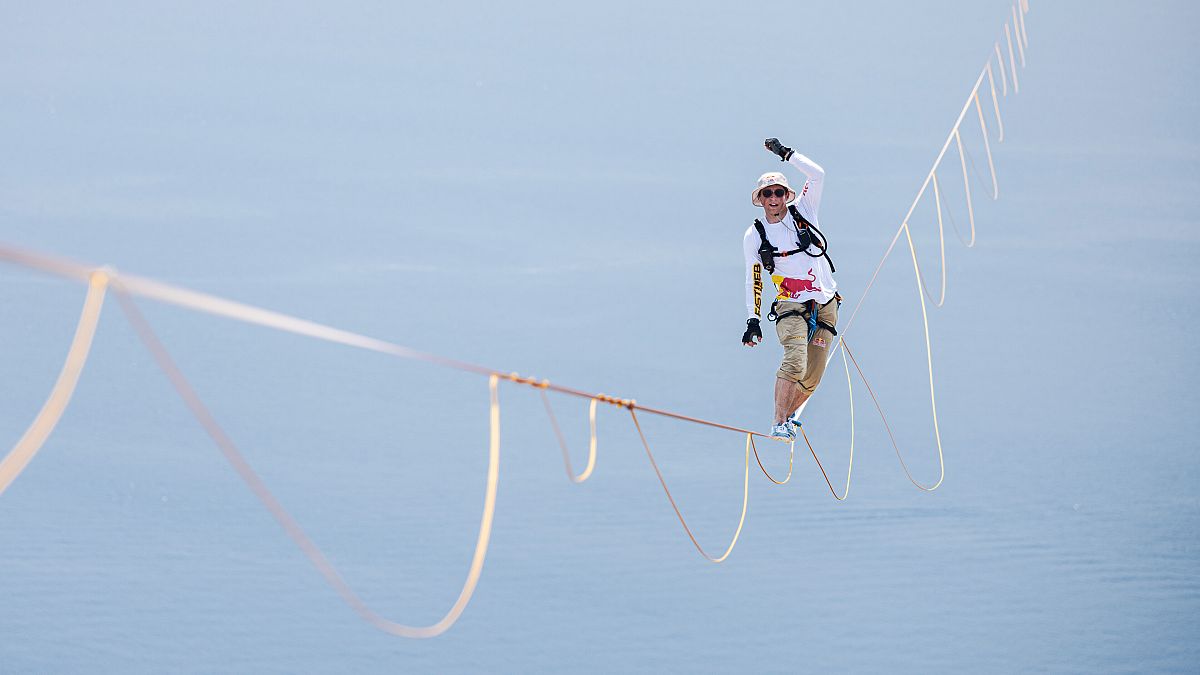
Estonian slackline athlete Jaan Roose made history on Wednesday (10 July) as the first person to walk across Italy’s Strait of Messina.
The slackline he used for the daring feat was the longest ever constructed - measuring 3,646 metres, more than 3.5 kilometres.
Roose managed to complete the treacherous journey in just under three hours, technically beating the existing Guinness World Record distance of 2,710 metres.
Sadly for him, though, a fall in the final 80 metres prevented him from officially setting a new World Record.
“I feel 'Jaantastic’” - Roose is thrilled with his efforts, despite the setback
On Wednesday, in the mainland city of Villa San Giovanni, Roose ascended to the anchor point on Santa Trada, a 265-metre tower that surpasses the height of Italy’s tallest skyscraper.
Stepping onto his slackline, a strip of webbed fabric measuring only a terrifying 1.9 cm wide, he began his journey.
The entire trip was a distance of longer than 30 football fields.
At its lowest stretch, the slackline was 100 metres above the water. In the final stage, Roose ascended 130 metres in elevation to the endpoint on Sicily’s Torre Faro tower, which he reached 2 hours and 57 minutes after he began the mission.
Using extraordinary balance and concentration alongside exceptional strength and stamina, he was forced to withstand winds of up to 38 km/h and temperatures reaching 28 celsius.
Unfortunately, just 80 metres before the finish, Roose fell off the slackline.
That stumble means that, despite slacklining significantly further overall than the previous world record of 2,710 metres, he has not broken a new world record.
Despite this disappointment, the 32-year-old said, “I feel 'Jaantastic', I am super happy, a bit tired and worn out. But guys, I made history! I walked 3.6 kilometres across the Strait of Messina! It was a long walk, full of surprises from start to finish, I had some difficulties, but the weather was good! I expected more wind.”
Who is Jaan Roose?
The Estonian native is already a three-time slackline world champion - and the only athlete ever to complete a double backflip on a slackline.
ADVERTISEMENTHis previous achievements include completing the world's longest single-building slackline in Qatar and appearances in films like 2016’s Assassin’s Creed and Wonder Woman 1984, released in 2020.
However, he had never attempted anything as audacious and demanding as the Messina Crossing.
Roose spent more than six months preparing for the Messina Crossing and worked together with an eight-person team, who helped him to set up the slackline with meticulous care.
The process involved a helicopter carrying a pilot rope to guide the slackline into place, marking the longest in history, with the line then tensioned using a custom-built winch system.
ADVERTISEMENTWhat is the Messina Strait - and will a bridge across it ever be built?
The Messina Strait, a narrow channel on the Mediterranean Sea, divides Italy's Calabria region from the island of Sicily.
It’s been written about for centuries, even appearing in Homer's seminal work The Odyssey.
“The strait possesses historical and cultural significance going back for thousands of years, as well as incredible natural beauty,” Jaan Roose said, “Combine that with variable weather conditions and strong marine currents, and it offered a unique and meaningful opportunity to push the limits of slacklining.”
The idea of having a bridge connecting Sicily to mainland Italy has been around for arguably as long as Homer’s writings.
ADVERTISEMENTThe ancient Romans were keen to link Italy’s ‘foot’ to its ‘ball’ via a rudimentary bridge, removing the necessity to cross the strait via boat.
Over the last several thousands of years, the bridge has almost come to fruition on several occasions - but they’ve always fallen flat.
As of 2024, though, the Italian government has approved plans - and it looks like a bridge could actually be built.
Set to cost around €11.6 billion, once complete, it will be the longest suspension bridge in the world.
ADVERTISEMENTAt 3,600 metres long, the robust design means theoretically it could withstand a 7.5 magnitude earthquake and 300 mph winds.
The bad news though? It’s not set to be completed until at least 2032.
Until then, you’ll have to make like the Italians and either take a plane or a ferry between the mainland and Sicily.
If you feel like taking both options in one trip, you can also take a train from Sicily to Rome and Naples which boards its own ferry.
ADVERTISEMENT