

 ADVERTISEMENT
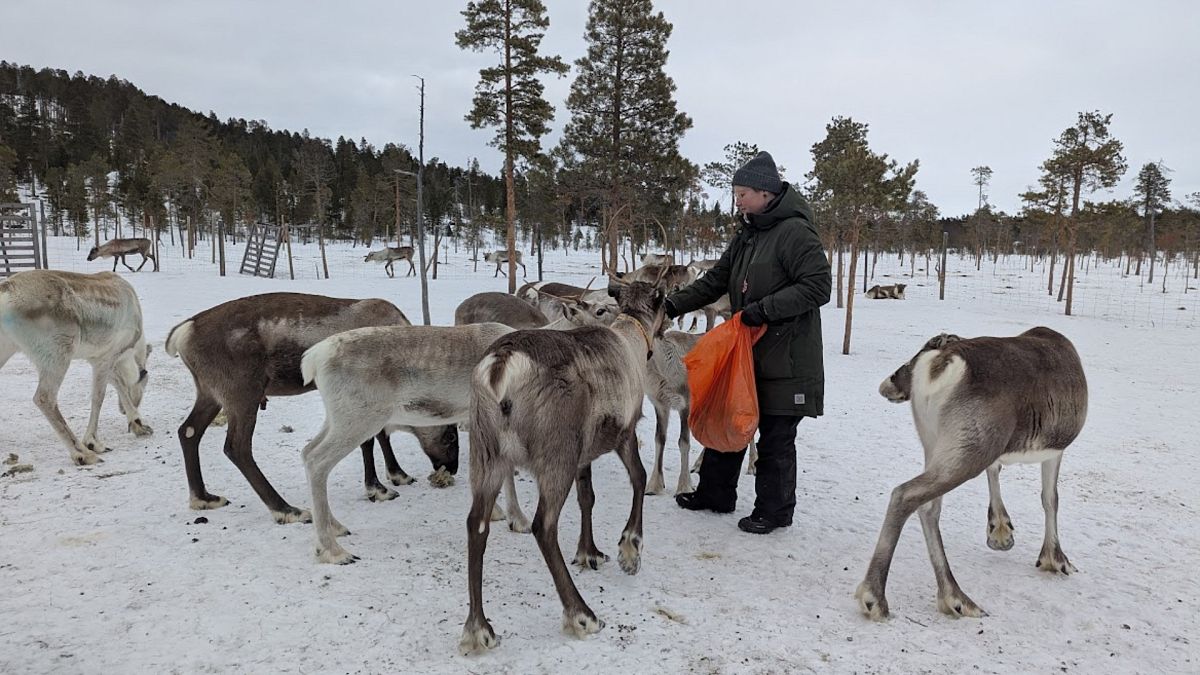
Reindeer crowd around Raisa Kitti as soon as she enters the paddock, sticking their big, velvety noses into the sled full of food she’s towing.
They trot behind her as she scatters the pellets in a spiraling line but don’t show the same reserve when she pulls out some bright green moss. “This is their chocolate,” Kitti says as three big snouts tear it from her hands. “They love it.”
Kitti introduces several of the animals by name - and by personality. “This is the big boss,” she says, pointing to a reindeer with a white pelt and one peeling antler. “He’ll let you scratch him under the chin,” she adds, demonstrating. “This younger one is like a chili pepper, you know? Small but very strong.”
Kitti and her husband lovingly run Reinina Reindeer Farm near Inari, Finland, where his family has been herding reindeer for over 400 years. This is the homeland of the Sámi, Europe’s only Indigenous people.
For centuries, they have herded reindeer and used every part of the animal: meat for food, bones and antlers for tools, and leather for clothing.
Challenging misinformation about Sámi culture
Today, the reindeer also attract tourists, and Kitti brings small groups to the farm to feed the herd and learn about Sámi culture. She also runs cooking classes and workshops, teaching visitors to craft jewellery and souvenirs from reindeer hides.
Family businesses like Reinina Reindeer Farm are part of a new wave of positive-impact experiences in Finnish Lapland, finally allowing the Sámi to benefit from the tourism boom.
For decades, tourism had been led by non-Sámi companies that were selling a distorted image of Indigenous life. Igloos and husky sleds dominate the brochures, though neither is a traditional part of Sámi culture but rather imported from North America.
This tourism has not only failed to benefit the Indigenous community financially but has actively harmed it by encroaching on herding grounds and spreading misconceptions. In recent years, however, the Sámi have taken back the narrative.
Inari: The cultural heart of the Sámi
Upon first glance, the village of Inari, with a population of 650 people, appears little more than a couple of supermarkets and a few dozen houses along the edge of a large lake.
Yet it is considered the cultural capital of Finland’s Sámi population, home to the Sámi Parliament and the country’s most comprehensive Indigenous museum.
The Siida Sámi Museum, refurbished in 2022 and awarded the European Museum of the Year Award in 2024, is an essential stop for understanding Sámi culture.
Through stunning photographs, household objects, clothing, and interactive panels, the museum walks visitors through millennia of Sámi history and artistry. It introduces them to the lifestyle and culture of people today, from reindeer herding to music and art.
The displays highlight a culture that is both deeply rooted in tradition and evolving with the times. Next to a skateboard painted with Sámi designs and a car key hung with a reindeer bone, a sign reads: “Outsiders sometimes criticise the Sámi for adopting ‘foreign influences’… But what if this is simply something the Sámi want to do?”
The irreverent tone directly challenges the idea that Indigenous cultures should remain frozen in time for the entertainment of visitors.
ADVERTISEMENTThe Sámi are telling their own story
“What the Sámi want is a tourism that tells the true story of who they are. A story connected to today, not just to the past, unlike most of the stereotypes,” explains Kirsi Suomi, a project coordinator at the Sámi Parliament who has been instrumental in several sustainable tourism initiatives.
The Sámi have battled cultural exploitation for decades, Suomi explains. In the mid-90s and again in 2008, activists protested against non-Sámi Finns dressing up in faux-Sámi costumes for tourist entertainment. This practice dates back to 1950 when Eleanor Roosevelt visited the Arctic Circle. Local authorities hastily built a “Sámi” village for her, with wooden cabins and actors wearing cheap replicas of Sámi dress.
Over time, those log cabins were transformed into Santa Claus Village, home to Father Christmas, reindeer, and various “Sami” experiences. This isolated spot on the Artic Circle, close to the town of Rovaniemi, became one of Lapland’s most popular tourist destinations, with over 500,000 visitors a year.
Yet, out of several hundreds of businesses catering to tourists, fewer than half a dozen are Sámi-led. Visitors pay for husky rides and shamanic drumming performances, unaware that what they see is far from authentic Sámi culture.
ADVERTISEMENTEthical guidelines to help tourists make informed choices
To combat this pervasive misrepresentation, Suomi led a parliamentary project in 2018 to define ethical guidelines for Sámi tourism.
“We took an example that already existed in Australia and adapted it to the Finnish scenery,” she says. These guidelines help visitors understand how to engage with Sámi culture respectfully, highlighting, for example, that people in traditional Sámi dress are not tourist attractions and should not be photographed without permission.
They also discourage tourists from trespassing on private lands or setting up camp in reindeer grazing areas.
“Visitors forget that people are not props,” says Suomi. “They even show up to funerals, taking pictures of grieving families in traditional dress.”
ADVERTISEMENTSuomi is now developing a certification programme to help tourists identify ethical, Sámi-led businesses. The programme, funded by NextGenerationEU, will be announced at the European Indigenous Tourism Conference, which Inari’s Sami Parliament is hosting in May.
It will be the first event of its kind, bringing together Indigenous tourism representatives from Finland, Norway, Sweden, and Greenland. The certification will help tourists make informed choices and give visibility to businesses like Reinina Reindeer Farm, which operate on a small, sustainable scale and share real insights into Sámi life.
Many tourists want more ethical experiences
Kitti has noticed that many visitors are looking for this kind of experience.
“People have become more aware that it is not ok to put some reindeer hides on and pretend to be a shaman,” she says. “Our visitors want to learn and understand our lives and culture.”
ADVERTISEMENTMeanwhile, her tourist business has provided an economic opportunity for her family. The revenue it generates helps them care for their reindeer and preserve their way of life.
Yet, Kitti and Suomi are fighting an uphill battle, I realise as I enter a large souvenir shop on my last day in Inari.
Busloads of tourists pour into the store and peruse aisles filled with Santa figurines, Christmas ornaments, and “Lapland Shaman” dolls. Matchboxes show staged photos of people dressed up in fake Sámi clothes. Huskies feature on postcards, plushies, mugs, magnets, and even dream catchers - another import from North American Indigenous cultures.
Outdated stereotypes are firmly on display and available for purchase by anyone with a few euros in their pocket.
ADVERTISEMENT