

 ADVERTISEMENT
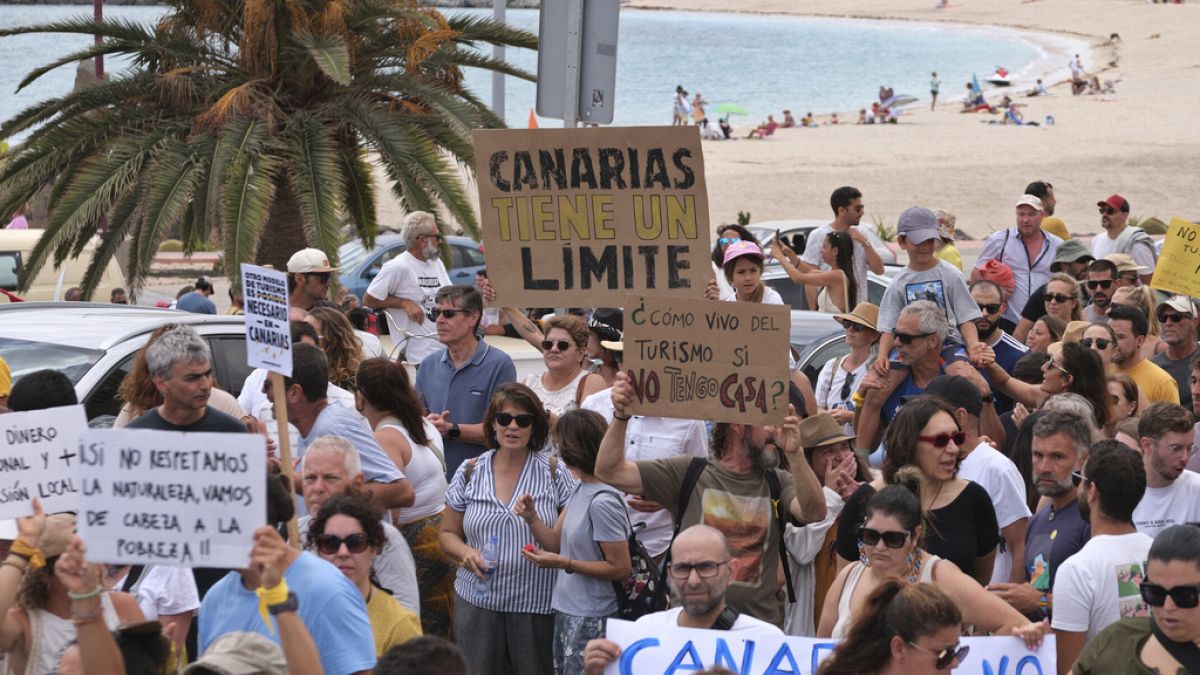
This weekend, residents of Spain’s Canary Islands are coming out in force to protest against mass tourism.
People on the archipelago have been growing increasingly vocal about its struggles with visitor numbers.
Last year, locals held multiple protests to highlight overtourism’s strain on local infrastructure and housing availability. They look set to continue again this summer as residents say little has been done to tackle the problem.
Protests planned across Spain against overtourism
On Sunday, 18 May, residents of the Canary Islands will take to the streets to join protests organised by campaign group Canarias tiene un límite (The Canary Islands have a limit).
Demonstrations will be held on all the islands of the archipelago as well as in several cities across Spain.
Protests will begin at 11 am on the seven main Canary Islands - El Hierro, La Palma, La gomera, Tenerife, Gran Canaria, Lanzarote and Fuerteventura - and at 12pm on mainland cities including Barcelona, Madrid and Valencia.
Residents in the German capital of Berlin are also planning to take to the streets in solidarity.
Why are residents of the Canary Islands protesting?
The organisers say they are protesting to oppose the current economic model "based on overtourism, speculation, inequality and the infinite growth on very limited land”.
Instead, they want a transition to a people-centred, environmentally responsible model that respects the archipelago’s ecological and social needs.
Specifically, they are calling for a halt to destructive hotel projects across the islands and the building of a motor circuit on Tenerife; a moratorium on new tourist developments; guaranteed access for residents to healthcare and housing; and a functional ecological tourist tax.
The group also wants the immediate introduction of measures to curb marine pollution and the creation of an environmental restoration law.
Canary Islands receive record number of tourists in March
Earlier this month, authorities announced that the Canary Islands received more than 1.55 million foreign visitors in March, up 0.9 per cent on the record set in the same month last year.
The figures were released by the Canary Islands National Statistics Institute (INE), which added that the total number of international tourists for the first quarter of 2025 was 4.36 million, an increase of 2.1 per cent year-on-year.
The tourist influx comes despite dozens of protests staged last year by Canary Island residents against mass tourism.
ADVERTISEMENTSimilar demonstrations have already taken place this year. Over Easter, around 80,000 hospitality workers in Tenerife, La Palma, La Gomera and El Hierro walked out in a dispute with unions over pay.