

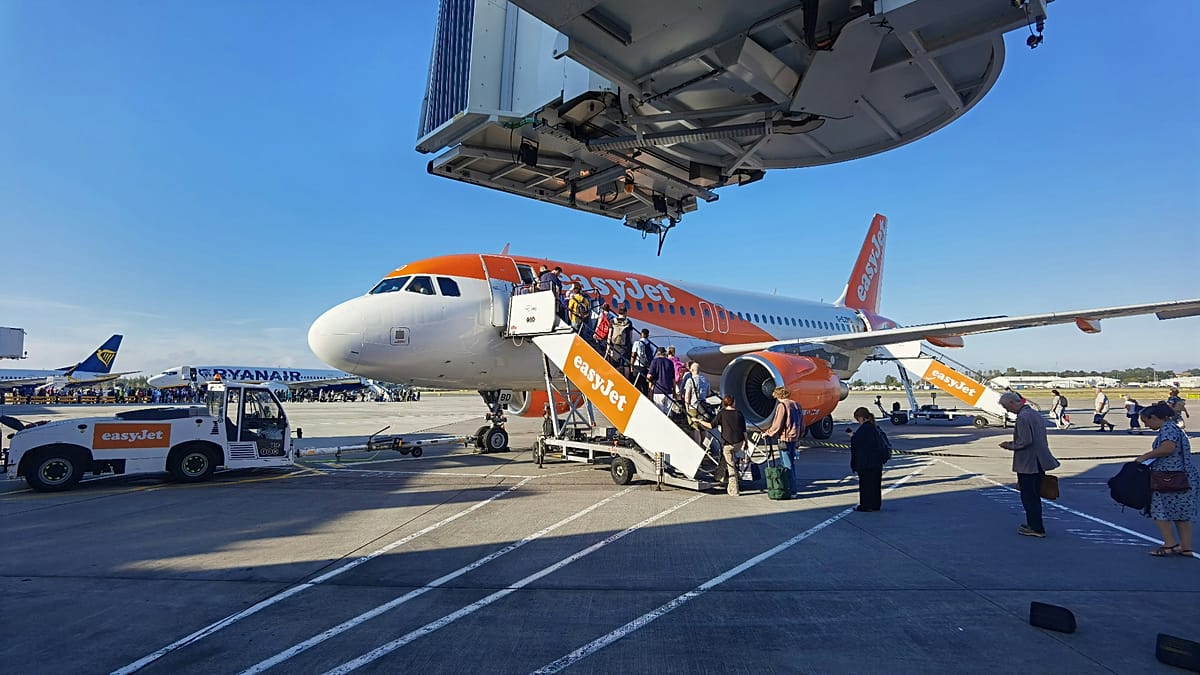
Thirty years ago to this day, the first orange and white liveried aircraft of the newly launched airline easyJet left from Luton Airport in the UK.
Fast-forward to 2025, and the company is one of Europe’s leading low-cost carriers.
In August, easyJet celebrated flying 80 million passengers to and from Bristol Airport, and in October, it reached 50 million passengers at Manchester Airport.
EasyJet has marked the 30th anniversary of its first flight by operating another on the same route, staffed entirely by crew turning 30 this month.
Here’s a look at the evolution of easyJet over the last three decades.
The birth of Britain’s biggest budget airline
EasyJet was founded by Greek Cypriot entrepreneur Sir Stelios Haji-Ioannou in 1995 to offer low-cost fares in Europe.
He saw an opportunity in the mid-1990s as the UK and the rest of Europe looked to deregulate aviation, allowing airlines to fly where they wanted and charge whatever fares they wanted.
The company set up their base in Luton, about 55 kilometres from London. Then, it was a regional and little-used airport but it meant saving on costs.
The airline had one aircraft, which made its inaugural flight on 10 November 1995 from Luton to Glasgow.
In 1996, easyJet launched its first international route, from Luton to Amsterdam, followed by further routes to Nice and Barcelona.
By 1997, the airline was already growing rapidly, with more international routes and a second base in Liverpool.
Clever, low-budget marketing was part of the carrier’s success.
The airline launched its first route from Luton to Glasgow for £29 (€33) one-way with the slogan 'fly to Scotland for the price of a pair of jeans'. On average, the cost of a return fare for the same route was over €100 on rival airlines like British Airways at the time.
In 1999, millions of UK viewers followed its operations on ITV’s ‘Airline’ programme.
"Letting the cameras into a small airline - it was a free audience. That put easyJet into every home in Britain," Stelios told the BBC.
EasyJet fares are cheaper today than in 1995
Today, easyJet is one of Europe’s largest low-cost carriers, with 356 aircraft, more than 1200 routes, and 19,000 staff.
A new report from the airline found that connectivity between the UK and Europe has grown 61 per cent since 1995, with 987 more unique airline routes.
EasyJet operated 170 of these new direct routes and nearly one-fifth of all routes between the UK and Europe last year.
The study also showed that its starting fares have dropped from £29 (€33) in 1995 to £26 (€29) today, which works out as a 55 per cent reduction when inflation is taken into account.
"EasyJet has made it possible for millions of people to travel easily and affordably, opening up new opportunities that once felt out of reach," the airline's chief executive Kenton Jarvis said.
"The benefits of this are clear, not just in the economic impact this has had for the UK, but also in the lasting impact that the democratisation of travel has had for society, which we have been incredibly proud to contribute to over the last 30 years," he said.
While cheap fares are good for the wallet, some travellers initially worried that cost-cutting could mean compromising safety. EasyJet has assuaged concerns with a consistently high safety ranking.
Earlier this year AirlineRatings, an airline review site, released its annual rankings of the world’s safest airlines.
EasyJet came 4th in the global rankings, making it the second safest European low-cost airline after Ryanair.
When it comes to the number of passengers flown without a fatal accident, it ranks second in the world after Ryanair. Like the Irish carrier, it hasn’t had a fatal accident in its 30 years of operations.
EasyJet is one of Europe’s most polluting airlines
EasyJet’s expansion comes with a well-documented downside. The boom in the aviation industry has resulted in millions of tonnes of excess carbon dioxide being released into the atmosphere.
Last year, campaign group Transport & Environment found easyJet was one of the ten most polluting airlines in Europe. It came in 5th place, with a 6 per cent increase in emissions compared to 2023.
In 2022, easyJet launched a net-zero roadmap, acknowledging that its "operations are negatively contributing to climate change".
“That’s our journey to 2050, when overall we envision our flights won’t contribute any additional carbon to the atmosphere by minimising the footprint of every customer we fly through carbon reduction and addressing any remaining emissions through carbon removal,” the airline wrote in a statement.
But the plan has been branded “misleading” by experts.
Consumer group Adfree Cities filed a complaint to the UK’s Advertising Standards Authority in 2024.
It highlighted that the roadmap does not address easyJet’s absolute emissions (i.e. the total amount of CO2 released) but is instead based on reducing carbon intensity - the emissions per passenger.
This means that as the airline has no plans to reduce passenger numbers, its absolute emissions will likely increase.