

Climate Change: Construction Companies Told To Stop Knocking Down Buildings
By Roger Harrabin
BBC energy & environment analyst
image source, Getty Images
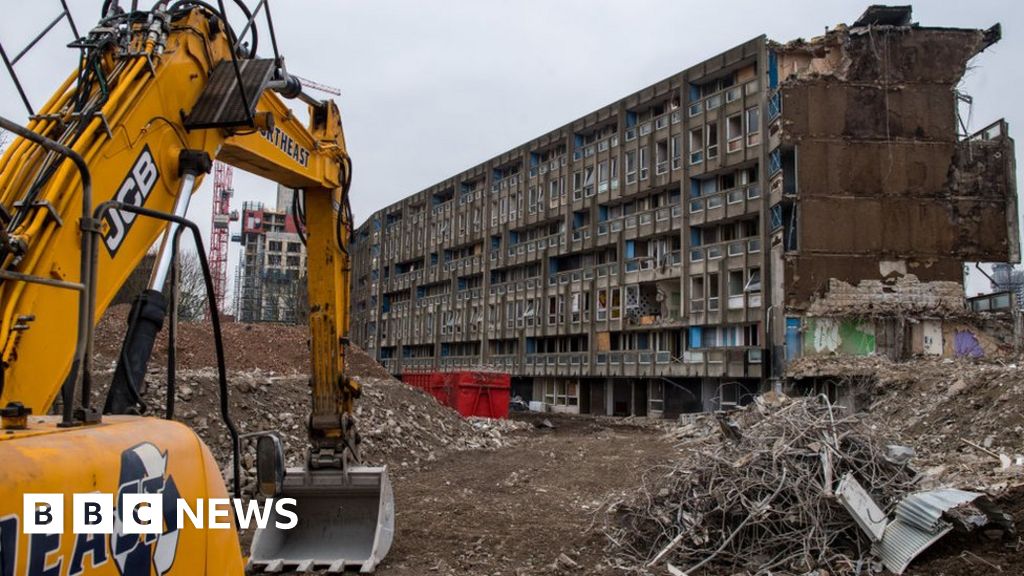
Britain’s top engineers are urging the government to stop buildings being demolished.
Making bricks and steel creates vast amounts of CO2, with cement alone causing 8% of global emissions.
They say the construction industry should where possible re-use buildings, employ more recycled material, and use machinery powered by clean fuels.
They are concerned about "embodied emissions", which is the CO2 emitted when buildings and materials are made..
They believe that unlike carbon from aircraft, vehicles and gas boilers, embodied emissions are not in people's minds.
They suspect few people realise there's a carbon impact from, for instance, building a home extension.
The report, steered by the Royal Academy of Engineering, said a new way of thinking is needed before planning new homes, factories, roads and bridges.
Prof Rebecca Lunn from Strathclyde University, one of the report's authors, said: "Our biggest failure is that we build buildings, then we knock them down and throw them away. We must stop doing this."
Fellow author, Mike Cook, adjunct professor at Imperial College, challenged the government's £27bn road-building programme because of the embodied emissions created to obtain the concrete and tarmac, as well as the use of very polluting machines to construct the highways.
Prof Cook told BBC News: "We have to radically revise the way we look at things.
"The most important thing is to maximise the use of existing road infrastructure by using smart motorways to maximise every inch of tarmac."
Speaking in a personal capacity, he added that the decision on Heathrow expansion should be re-visited following stronger warnings from climate scientists.
Prof Cook said questions should be asked whether projects such as HS2 - with its massive embodied carbon - will really benefit future generations.
The Chartered Institution of Building Services Engineers' Dr Julie Godefroy urged the government to set targets for the construction industry to move swiftly towards zero carbon, including embodied emissions.
She observed: "We have to avoid demolition and new-build. Often most of the material in an existing building is underground - so we should seek to use existing foundations."
A spokesperson for the Department of Business, Energy and Industrial Strategy (BEIS) responded to a request from BBC News for a comment by stating that the UK was a "world leader in tackling climate change".
They added: "We are committed to reducing emissions from the construction sector, and have set up the Construct Zero programme to support the industry to achieve their climate commitments."
The spokesperson said that the government, earlier this year, had set out their Industrial Decarbonisation Strategy, which was "the government's comprehensive assessment" of how industry, including the construction sector, could decarbonise in line with the government's net-zero plans.
Also, they explained, ministers this week had announced £220 million of funding to help UK industry reduce their carbon emissions and improve energy efficiency.
Refurb over rebuild
The Royal Institution of Chartered Surveyors (RICS) estimates that 35% of the lifecycle carbon from a typical office development is emitted before the building is even opened. The figure for residential premises is 51%.
It wants the government to change the VAT rules which can make it cheaper to rebuild than to refurbish a standing building.
Its managing editor Will Hurst said: "This staggering fact has only been properly grasped in the construction industry relatively recently. We've got to stop mindlessly pulling buildings down."
From Chip War To Cloud War: The Next Frontier In Global Tech Competition
The global chip war, characterized by intense competition among nations and corporations for supremacy in semiconductor ... Read more
The High Stakes Of Tech Regulation: Security Risks And Market Dynamics
The influence of tech giants in the global economy continues to grow, raising crucial questions about how to balance sec... Read more
The Tyranny Of Instagram Interiors: Why It's Time To Break Free From Algorithm-Driven Aesthetics
Instagram has become a dominant force in shaping interior design trends, offering a seemingly endless stream of inspirat... Read more
The Data Crunch In AI: Strategies For Sustainability
Exploring solutions to the imminent exhaustion of internet data for AI training.As the artificial intelligence (AI) indu... Read more
Google Abandons Four-Year Effort To Remove Cookies From Chrome Browser
After four years of dedicated effort, Google has decided to abandon its plan to remove third-party cookies from its Chro... Read more
LinkedIn Embraces AI And Gamification To Drive User Engagement And Revenue
In an effort to tackle slowing revenue growth and enhance user engagement, LinkedIn is turning to artificial intelligenc... Read more