

Boffins Invent DNA Tape That Could Pack 375 Petabytes Into An LTO Cart
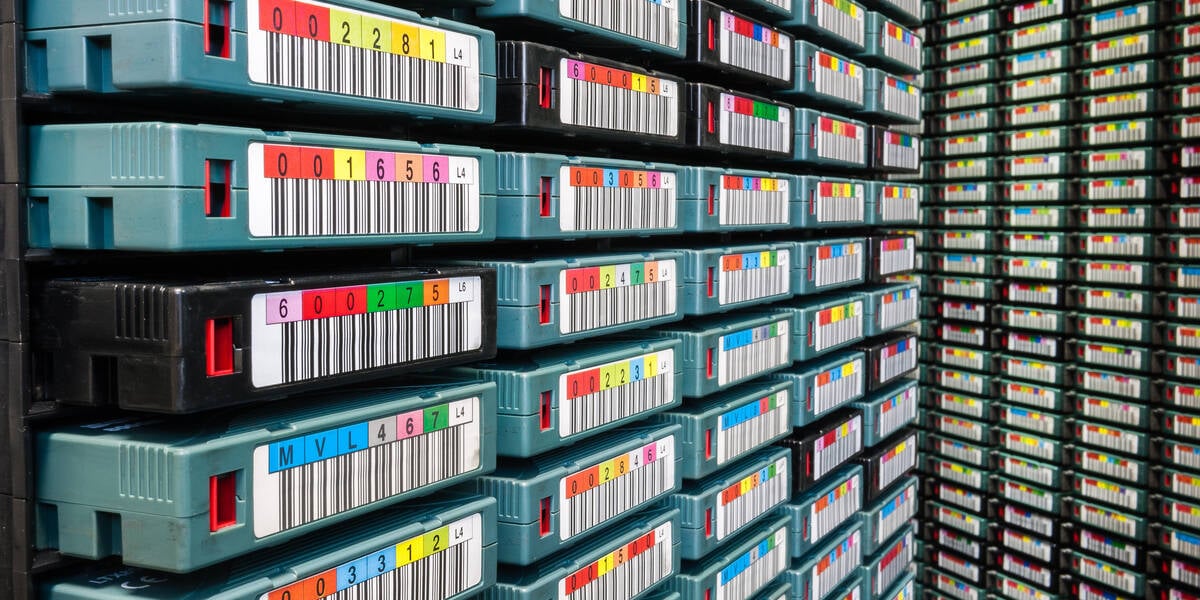
Imagine replacing thousands of LTO-9 tapes with just one cartridge. It's possible – if a Chinese research team's experimental DNA tape storage system reaches its theoretical maximum capacity.
Professor Xingyu Jiang from China's Southern University of Science and Technology in Shenzhen and his research team published a paper in Science Advances on Thursday detailing how they built a cassette that holds good old-fashioned polyester-nylon composite tape and writes to it by depositing DNA.
DNA is a very dense storage medium and storage researchers have tried to use it for data storage, but without much success, because it’s hard to find info within DNA and read times are slow.
Jiang's team claims to have addressed that problem, establishing a sequence of data partitions on the tape and identifying each of these with a bar code.
The researchers wrote that they designed their tape membrane with "a large number of hydrophilic and hydrophobic spaces to form barcode patterns" which are "continuously arranged on DNA tape by laser inkjet printing, generating 5.45 X 10⁵ addressable data partitions per 1,000-m tape." (Hydrophilic substances have a tendency to mix with or dissolve in water while hydrophobic ones repel water.)
That barcode can be read and used as an index, making it faster to access the required portions of the tape. The data itself is stored as DNA within the hydrophilic sections. To read the deposited DNA later, the scientists soaked the target partition in sodium hydroxide solution and sequenced that solution to finish reading the files.
Radical, but not yet practical
Jiang's team only wrote 156.6 kilobytes of data to a test tape for their experiment, consisting of four "puzzle pieces" depicting a Chinese lantern. If the data were damaged, it wouldn't assemble correctly. The researchers managed to successfully recover the lantern image without issue, but it took two and a half hours or not-quite one kilobyte per minute.
At those speeds we may as well go back to using IBM 711 punch card readers to handle our future data storage needs.
That same recovery process could be reduced to just 47 minutes, the team said, "if the recovery operation and the synthesis of protection layers are performed uniformly on the data partition after the DNA data recovery."
Again, that’s woefully slow.
The good news is this medium has excellent storage capacity and density.
Based on their deposition of 156.6 kb of data on the tape, Jiang's team believes their DNA tape could store around 74.7 gigabytes of actual data per kilometer. Exclude known theoretical losses like barcode space and DNA losses during deposition and recovery (i.e., "if this technology gets way better"), and Jiang's team estimated that the "theoretical maximum storage capacity could be as high as 362 petabytes of DNA tape per kilometer."
Given the length of an LTO-9 tape is 1,035 meters, that's a theoretical 375 petabytes of data on a single DNA tape of the same length.
- China breakthrough promises optical discs that store hundreds of terabytes
- In homage to Jurassic Park, researchers store DNA in amber-like polymer
- Say hello to the epi-bit, a new approach to DNA data storage
- Altered carbon: Boffins automate DNA storage with decent density – but lousy latency
That's a lot of data on a single cassette, but let's not get carried away by theoretical maximums.
Given the aforementioned "actual data per kilometer" of around 74.7 GB, that LTO-9 DNA tape is going to have a capacity more in the neighborhood of 77 gigabytes - way less than the current LTO-9 capacity of around 18 terabytes, or 45 TB if you compress it.
This DNA tape is therefore a science project.
We could not reach Jiang or his team for comment, but they seem to believe their development is an important one given how much data humans and machines create every day.
"Nonvolatile memory based on semiconductors has reached the limits of Moore's Law, and new media are necessary to store unbelievably large amounts of data," the authors wrote. "DNA has the potential to become the next-generation information storage medium due to its high storage density … however, no existing DNA data storage device has yet achieved … robust data management capabilities comparable to commercial storage systems."
One problem solved – now to do something about that surprisingly limited capacity and punch card-level speed. ®
From Chip War To Cloud War: The Next Frontier In Global Tech Competition
The global chip war, characterized by intense competition among nations and corporations for supremacy in semiconductor ... Read more
The High Stakes Of Tech Regulation: Security Risks And Market Dynamics
The influence of tech giants in the global economy continues to grow, raising crucial questions about how to balance sec... Read more
The Tyranny Of Instagram Interiors: Why It's Time To Break Free From Algorithm-Driven Aesthetics
Instagram has become a dominant force in shaping interior design trends, offering a seemingly endless stream of inspirat... Read more
The Data Crunch In AI: Strategies For Sustainability
Exploring solutions to the imminent exhaustion of internet data for AI training.As the artificial intelligence (AI) indu... Read more
Google Abandons Four-Year Effort To Remove Cookies From Chrome Browser
After four years of dedicated effort, Google has decided to abandon its plan to remove third-party cookies from its Chro... Read more
LinkedIn Embraces AI And Gamification To Drive User Engagement And Revenue
In an effort to tackle slowing revenue growth and enhance user engagement, LinkedIn is turning to artificial intelligenc... Read more