

Baidu Unveils New Self-driving Taxi In China
By Zoe Kleinman
Technology editor
Chinese technology giant Baidu has unveiled the next vehicle to join its self-driving taxi service, Apollo Go.
It says its new model, the Apollo RT6, has the the road skills of a driver with 20 years' experience.
Under Chinese regulation, the autonomous cars currently still require a safety driver's presence.
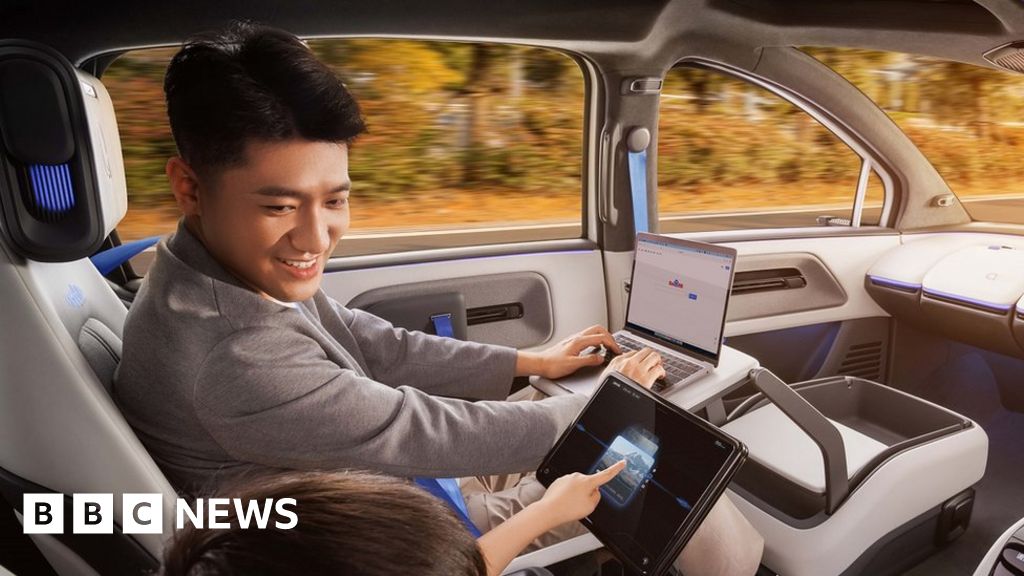
But one day, Baidu says, the RT6's detachable steering wheel could be replaced by extra seats, vending machines, desks or games consoles.
Image source, Qian Jin/Baidu
Each Apollo RT6 would cost 250,000 yuan (£31,000) - significantly less than previous models, Baidu said.
"This massive cost reduction will enable us to deploy tens of thousands of [automated vehicles] across China," co-founder and chief executive Robin Li told the company's annual technology conference.
"We are moving towards a future where taking a robo-taxi will be half the cost of taking a taxi today."
Baidu wants the RT6 to join its existing fleet in the second half of 2023, for a small-scale trial, and plans eventually to have 100,000 of them on the roads.
The vehicle is packed with 38 sensors, including:
- eight light-detection and ranging (Lidar) sensors
- one 6mm (0.2in) wave radar
- 12 ultrasonic sensors
- 12 cameras
Baidu says its robo-taxis, running on a trial basis in 10 cities in China, including Shenzhen, Shanghai and Beijing, have given more than one million rides since its service launched, in 2020.
There had been discussion on the country's social-network Weibo about the impact on jobs if they became official, BBC China analyst Kerry Allen said.
"While pilot schemes have been rolled out, there have been perceptions online that they are still 'hard to find' or that appointments are difficult to make, in order to try one out," she added.
Other companies in the robo-taxi space in China include:
- AutoX, backed by Chinese technology giant Alibaba.
- Pony.ai, founded by former Google and Baidu engineers and backed by Toyota
From Chip War To Cloud War: The Next Frontier In Global Tech Competition
The global chip war, characterized by intense competition among nations and corporations for supremacy in semiconductor ... Read more
The High Stakes Of Tech Regulation: Security Risks And Market Dynamics
The influence of tech giants in the global economy continues to grow, raising crucial questions about how to balance sec... Read more
The Tyranny Of Instagram Interiors: Why It's Time To Break Free From Algorithm-Driven Aesthetics
Instagram has become a dominant force in shaping interior design trends, offering a seemingly endless stream of inspirat... Read more
The Data Crunch In AI: Strategies For Sustainability
Exploring solutions to the imminent exhaustion of internet data for AI training.As the artificial intelligence (AI) indu... Read more
Google Abandons Four-Year Effort To Remove Cookies From Chrome Browser
After four years of dedicated effort, Google has decided to abandon its plan to remove third-party cookies from its Chro... Read more
LinkedIn Embraces AI And Gamification To Drive User Engagement And Revenue
In an effort to tackle slowing revenue growth and enhance user engagement, LinkedIn is turning to artificial intelligenc... Read more