

Long-haul Carrier Emirates Test Flies Boeing 777 On Sustainable Fuel
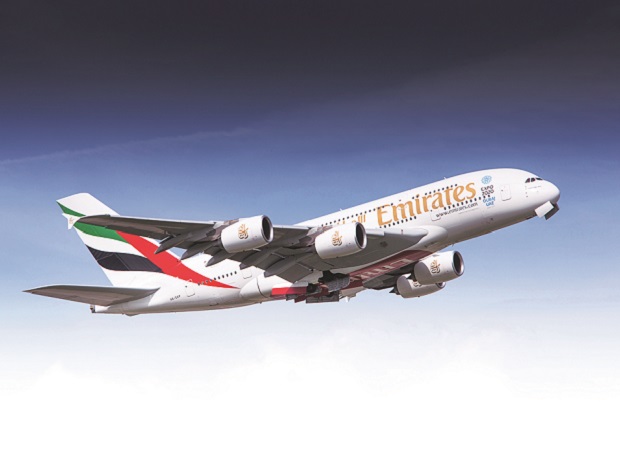
Long-haul carrier Emirates successfully flew a Boeing 777 on a test flight Monday with one engine entirely powered by so-called sustainable aviation fuel. This comes as carriers worldwide try to lessen their carbon footprint.
Flight No. EK2646 flew for just under an hour over the coastline of the United Arab Emirates, after taking off from Dubai International Airport, the world's busiest for international travel, and heading out into the Persian Gulf before circling back to land.
The fuel powered one of Boeing's two General Electric Co. engines, with the other running on conventional jet fuel for safety.
This flight is a milestone moment for Emirates and a positive step for our industry as we work collectively to address one of our biggest challenges reducing our carbon footprint," Adel al-Redha, Emirates' chief operation officer, said in a statement.
Emirates, a state-owned airline under Dubai's ruler Sheikh Mohammed bin Rashid Al Maktoum, described the sustainable fuel as a blend that mirrored the qualities of jet fuel. It included fuel from Neste, a Finnish firm, and Virent, a Madison, Wisconsin-based company.
Virent describes itself as using plant-based sugars to make the compounds needed for sustainable jet fuel, while Neste's fuel comes from vegetable oils and animal fats. Those fuels reduce the release of heat-trapping carbon dioxide typically burned off by engines in flight.
Aviation releases only one-sixth the amount of carbon dioxide produced by cars and trucks, according to World Resources Institute, a nonprofit research group based in Washington. However, aeroplanes are used by far fewer people per day meaning aviation is a higher per-capita source of greenhouse-gas emissions.
Aeroplane and engine manufacturers have been designing more-efficient models, in part to help keep down costs of jet fuel one of the biggest expenses airlines face. Emirates, for instance, used over 5.7 tons of jet fuel last year alone, costing it USD 3.7 billion out of its USD 17 billion in annual expenses.
But analysts suggest sustainable fuels can be three times or more the cost of jet fuel, likely putting ticket prices even higher as aviation restarts following the lockdowns during the coronavirus pandemic.
It wasn't immediately clear how much the fuel used in the Emirates' test on Monday cost per barrel. Jet fuel cost on average USD 146 a barrel at the end of last week, according to S&P Global Platts.
The UAE, a major oil producer and OPEC member, is to host the next United Nations climate negotiations, or COP28, beginning in November.
Already, the seven sheikhdom federation has come under fire from activists for nominating the CEO of Abu Dhabi's state oil company to lead the UN negotiations known as the Conference of the Parties where COP gets its name.
(Only the headline and picture of this report may have been reworked by the Business Standard staff; the rest of the content is auto-generated from a syndicated feed.)
Revoluts Australian Banking Licence Game Changer
Revolut has spent much of its life insisting that it is more than a bank. In Australia, it has now decided that becoming... Read more
The AI Bank Is Coming, But Who Controls The Risk?
Artificial intelligence is no longer something banks discuss as a distant possibility. It is already working behind the ... Read more
ClearBank UK Profit Leads To European Growth
ClearBank has spent much of the past decade building the technology and regulatory infrastructure needed to challenge so... Read more
Bank Of London Continues To Rebuild
ClearBank’s progress shows that modern clearing and banking infrastructure can become a sizeable and profitable busine... Read more
JPMorgan's Berlin Moment: Chase Takes On Europe
There is something quietly symbolic about JPMorgan Chase choosing Berlin as its gateway into continental Europe. In a fo... Read more
What Strategy's Bitcoin Sale Really Tells Us
There is a moment in every bull run when the narrative starts to fray. Not with a crash, not with a scandal, but with so... Read more