

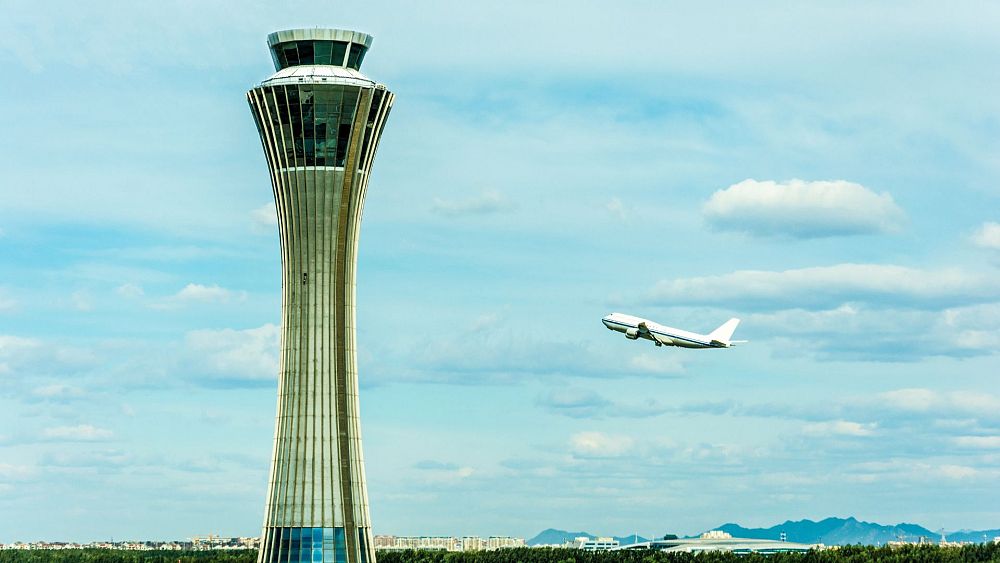
A ‘single European sky’ could slash emissions and reduce delays, the aviation industry says.
But what is it - and just how effective and green would it really be?
At the Airlines for Europe (A4E) summit on Wednesday, Ryanair, Easyjet, Lufthansa and British Airways owner IAG called on the EU to implement airspace reform.
Single European Sky (SES) legislation would streamline the continent’s fragmented airspace into a small number of blocs.
After the easing of pandemic-era restrictions, travel has rebounded across the continent, making the issue “more pressing than ever,” the airlines noted in a joint statement.
So how would it work?
What is the Single European Sky initiative?
With around 30,000 flights per day, Europe’s airspace is some of the busiest in the world.
Keeping passengers safe requires thousands of air traffic controllers, who track flights to prevent congestion.
But the current system is not as efficient as it could be. National borders apply in the sky, meaning planes pass through a patchwork of 27 different air traffic control jurisdictions.
The fragmented airspace means that planes do not always fly the most efficient routes. On average, planes fly 49 kilometres further than strictly necessary, the EC estimates.
Large areas of airspace are reserved for national military use - but often lie empty.
The SES would restructure airspace into nine ‘functional blocks.’ Eurocontrol - the air traffic control body coordinating European flights - calls it "a seamless, pan-European air traffic management system".
Could the Single European Sky Initiative reduce delays?
This could potentially reduce delays for travellers, by minimising communication difficulties between air traffic controllers.
It would also mean industrial action - like the Italian air traffic control strike last year - would potentially cause less disruption, as air traffic controllers from across the bloc could step in.
This is not an unalloyed good, however - minimising the power of striking workers could make it harder for air traffic controllers to protest wage cuts.
Would the Single European Sky initiative benefit the planet?
According to the European Commission and the aviation industry itself, the SES could cut aviation's CO2 emissions by up to 10 per cent, or 50 million tonnes.
This is because it would cut down the unnecessary excess flying.
However, the impact would not be straightforward. The airlines want to streamline European airspace as a means of ‘enhancing growth’.
More flights will mean more carbon emissions.
In their statement calling for the implementation of SES, the airline group also called for enhanced investment in Sustainable Aviation Fuels (SAFs).
However, curb emissions by roughly 80 per cent over the course of the “fuel life-cycle,” because they are made from waste products, where the carbon has already been emitted, or from plants that absorb carbon dioxide while they grow.
However, they still produce emissions when they are burnt. Campaigners have previously called SAFs a ‘get out of jail free tactic’.
How bad is flying for the planet?
An economy class return flight from London to New York emits around 1.48 tonnes of CO2 per passenger, according to Flight Emission Map carbon calculator - more than double the average person in Ghana produces in a whole year.
Shunning air travel is the single biggest action an individual can take to reduce their carbon footprint.
Luckily, this doesn’t mean giving up travel. Check out these amazing train journeys for your next holiday.