

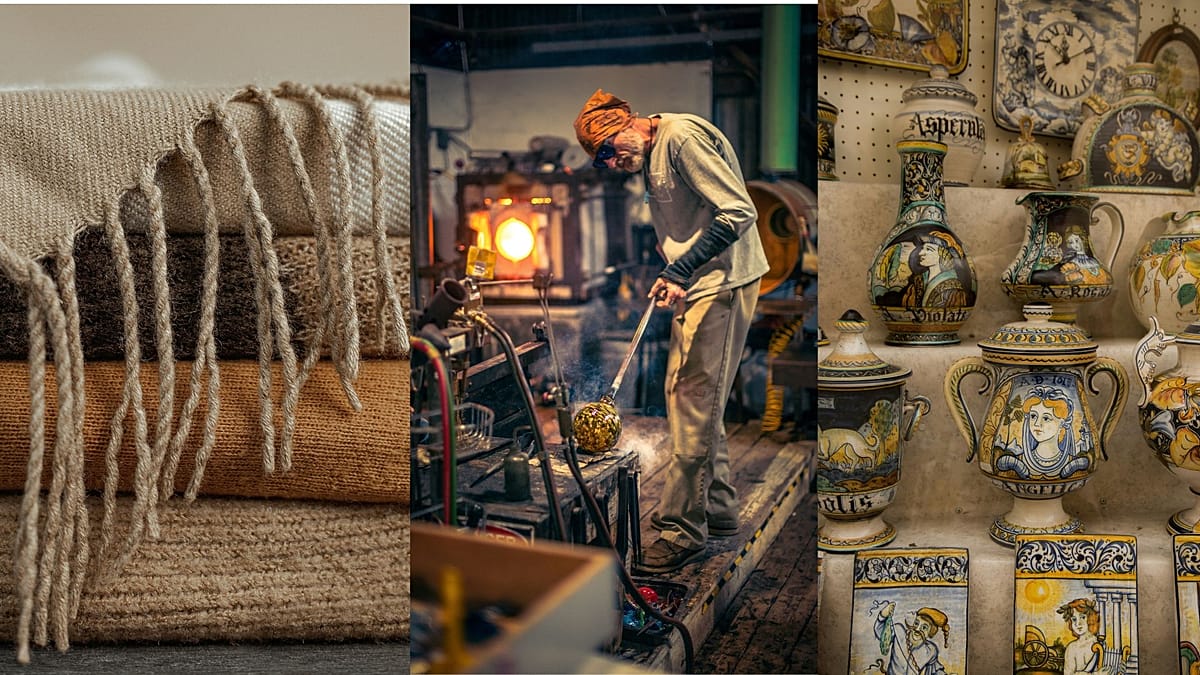
Europe’s vast rail network not only gives travellers access to major cities and their headline attractions, but also smaller towns with hyperlocal crafts and traditions to discover.
 ADVERTISEMENT
ADVERTISEMENT
ADVERTISEMENT
From clay-sculpting to glasswork, here are the ancient skills you can learn about and how to reach where they are still practised by train, according to booking platform Rail Europe.
Faenza: The Italian city that gave its name to European ceramics
In the heart of Emilia-Romagna, Faenza has been associated with ceramics for centuries. Its name even gave rise to the word “faience”, used internationally to describe a type of glazed earthenware.
Today, the city remains one of Europe’s great ceramic centres, home to the International Museum of Ceramics and a network of workshops, studios and schools where traditional techniques continue to evolve.
Faenza can be reached by rail via Bologna, making it an easy stopover for travellers exploring northern Italy beyond the classic Venice-Florence-Rome route.
Thiers: the blade-making capital of France
Set in the Auvergne-Rhône-Alpes region, Thiers has been known for knife-making since the Middle Ages.
For centuries, its steep streets, river valleys and workshops have been home to generations of artisans refining the skills needed to forge, polish and assemble blades.
Today, visitors can explore this heritage through the Musée de la Coutellerie, historic workshops and local makers who continue to work with traditional know-how.
Thiers can be reached by train via Clermont-Ferrand, from where there are direct links to Paris and Lyon.
Nový Bor: Czechia’s glassmaking town where fire becomes art
In northern Czechia, Nový Bor has long been associated with Bohemian glassmaking. The region’s glassmakers are known for their technical precision, decorative skill and ability to turn molten glass into objects of remarkable delicacy.
Visitors can explore the town’s glass museum, workshops and nearby glassmaking communities, where the craft remains both a cultural legacy and a contemporary creative industry. Watching glass being blown, cut or engraved offers a rare insight into a process that depends on heat, timing, patience and extraordinary manual control.
Nový Bor is accessible by rail from Prague, making it a compelling detour for travellers who want to go beyond the capital.
Tönning: German wool, natural fibres and North Sea craftsmanship
On the coast of Schleswig-Holstein, Tönning offers a more contemporary craft story, shaped by wool, natural fibres and the landscape of northern Germany.
Here, the workshop Friesenfaser works with materials connected to Nordfriesland, transforming them into pieces from wool blankets to household goods.
This is not a large museum experience, but the chance to learn about a living craft project connected to the rhythm of the coast, local materials and a slow method of production.
Tönning can be reached by train via Husum, which has direct connections to Hamburg and Westerland (Sylt).