

Microsoft's 38-hour Outage Exposes The Real Cost Of Relying On One Supplier
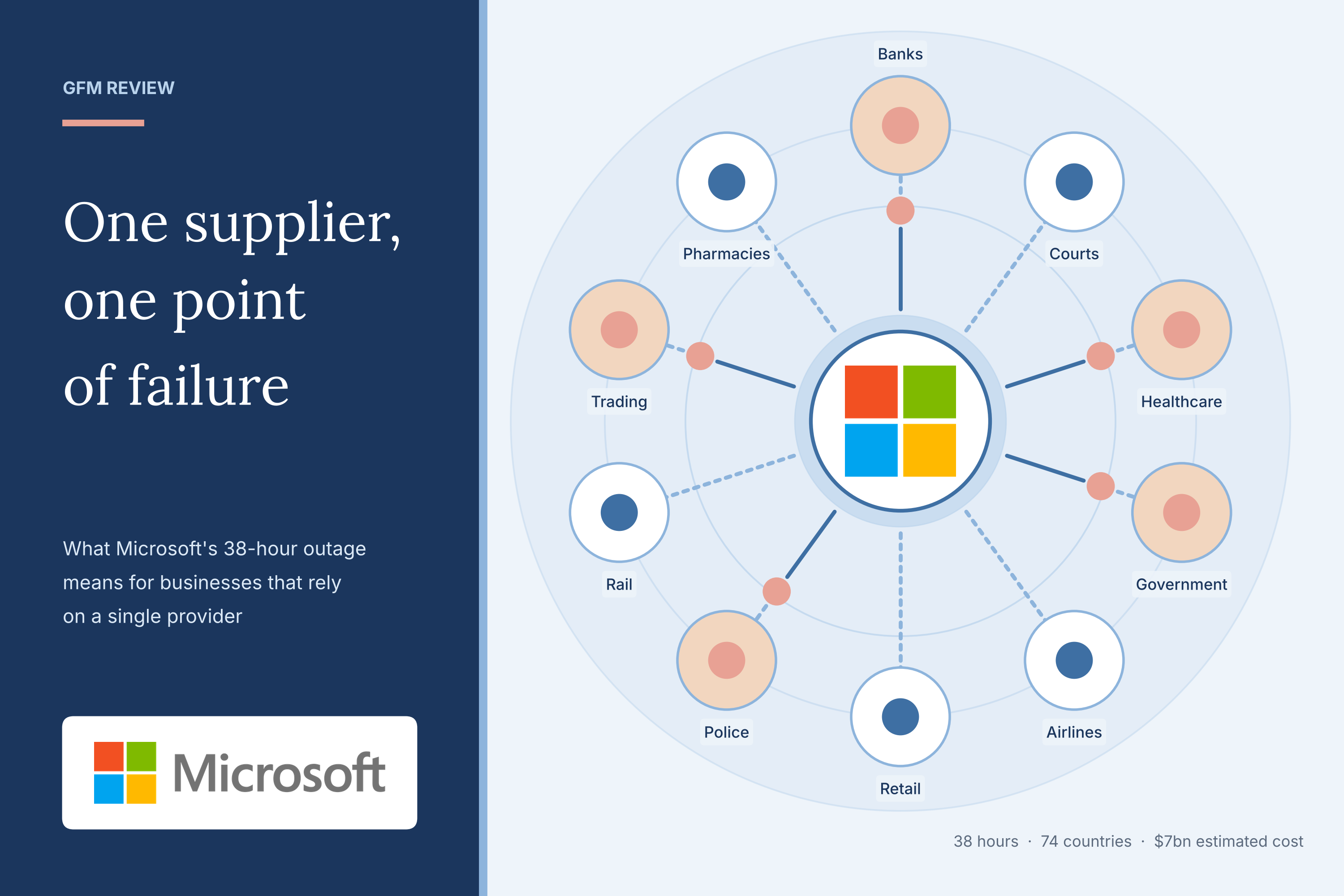
For roughly 38 hours between Thursday and Saturday, a large share of the world's office workers discovered how much of their daily business runs through a single company. Microsoft 365, which Microsoft says is used by more than 430 million people, failed across Outlook, Exchange Online, Teams and the Copilot assistant. The question for businesses is no longer whether Microsoft will fix the fault. It is whether an operating model built on one supplier can still be described as prudent.
Problems emerged around midday Eastern time on Thursday 12 November, shortly before 18:00 in London. Within an hour, Downdetector had received reports from 74 countries and territories, with close to 130,000 Outlook complaints at the peak. Microsoft confirmed full recovery on Saturday. It has attributed the incident to a flaw introduced during an earlier network capacity upgrade, which surfaced after a later network change and left Exchange Online servers unexpectedly unavailable. The company has said the cause was not a cyberattack.
In the UK, the effects reached well beyond inboxes. A trial in Manchester was halted, police forces asked the public to report crimes by telephone, and the National Pharmacy Association warned of prescription delays. The Bank of England confirmed it had been affected, and the Financial Conduct Authority said it was monitoring the impact on the City. NatWest, Asda and Great Western Railway reported disruption. In Tokyo, some traders reverted to phone and fax.
The cost falls on the customer
Anderson Economic Group, a Michigan consultancy known for cautious estimates, has put the lost productivity at up to $7bn, and expects the figure to rise. It judged that perhaps 26 million users on Thursday and 51 million on Friday suffered a genuine economic loss rather than mere inconvenience.
Set against that, the contractual remedy is modest. Microsoft's service level agreement commits to 99.9% monthly availability for Exchange Online and Teams, which allows roughly 43 minutes of downtime in a 30-day month. Below that, customers may claim service credits of 25%, 50% or 100% of the month's fees for the affected service, and the agreement states that credits are the sole remedy. On GFM Review's calculation, a customer offline for the full 38 hours would record availability of about 94.7%, enough to reach the top tier. Even then, the maximum recovery is one month's subscription for that service.
That asymmetry is the central commercial point. Many organisations have bought availability as if it were a commodity and assumed the risk travelled with the contract. It did not. The supplier's exposure is capped at the price of the product; the customer's exposure is its own revenue, reputation and regulatory standing.

A pattern, not an accident
This was not an isolated failure. Microsoft 365 suffered an outage of almost ten hours in January, a bug in Microsoft's automated network maintenance system caused nearly five hours of disruption in July, and Exchange Online failed again at the end of August. Microsoft's published availability for Microsoft 365 fell to 99.526% in the first quarter of 2026, the weakest result since Office 365 for IT Pros began tracking the data in 2013.
The exposure is also concentrated. Microsoft and Amazon Web Services are estimated to hold between 70% and 80% of the UK public cloud market, and research by the Cyber Monitoring Centre and Parametrix found that more than 80% of FTSE 100 companies depend on cloud services for critical functions.
For financial services, the timing is pointed. On 13 July, HM Treasury designated Microsoft Ireland Operations Limited a critical third party, bringing it under direct oversight by the Bank of England, the Prudential Regulation Authority and the FCA. That designation does not transfer accountability. The FCA has been explicit that a firm's failure to remain within its impact tolerances is the firm's own responsibility.
Testing the easy conclusions
Two conclusions are likely to gain currency. The first is that companies should leave Microsoft. That is neither practical nor necessarily wise. Amish Patel of Raymond James has suggested the direct financial impact on Microsoft is likely to be negligible, precisely because switching is so difficult. Unpicking an estate that combines identity, email, documents and, increasingly, AI agents would cost more than most outages.
The second is that a multi-cloud strategy solves the problem. On its own, it does not. Spreading infrastructure across two providers achieves little if email, identity and collaboration all sit inside one productivity suite. As Mark Boost, chief executive of Civo, put it, a "single failure takes everything down together". The gap this week was at the application layer, not only in the data centre.
In my view, the realistic response is narrower and cheaper. Organisations should identify the handful of functions that must continue during a supplier failure and give each an independent route: a secondary email service held with a separate provider, an out-of-band channel for incident management, offline access to critical documents and client contacts, and manual procedures that staff have rehearsed. The Tokyo traders who completed business by phone illustrate the principle. A fallback does not need to be elegant. It needs to exist. Boards should also check whether business interruption insurance extends to a cloud provider's failure, and whether their own client contracts promise service levels that depend on a supplier they do not control.
What remains unclear
Microsoft has yet to publish its post-incident review, so it is not known why a latent fault from an earlier upgrade went undetected, or why restoration took so much longer than the initial failure. The $7bn estimate is preliminary. Nor is there public evidence of how the critical third party regime operated during the incident.
What to watch
The first milestone is Microsoft's final incident review. If it points again to weaknesses in how network changes are tested and rolled out, as the July incident did, customers and regulators will have grounds to treat the problem as systemic rather than unlucky. The second is the response from UK regulators, which will show whether critical third party oversight changes supplier behaviour or simply adds reporting. For every board, the practical test is simpler: could the business keep its most important functions running for two days without its main supplier?
Anthropic's IPO
Why the cash raised matters more than the valuation Read more
Tech Rebound Tests If AI Optimism Has Found Floor
Strong CoreWeave results and talk of a higher Anthropic IPO valuation have pulled investors back into US technology stoc... Read more
Binance Reopens, But Confidence Is Damaged
Binance reopens, but confidence cannot be switched back onThere Read more
Big Techs AI Spending Faces A Commercial Test
The loss of nearly $900bn in market value across the largest Read more
Musks $3.6tn Gamble
Can Tesla and SpaceX Become One Company? Read more