
Anthropic's IPO
Why the cash raised matters more than the valuation
Anthropic's bankers are preparing to lift the price of its stock market debut, and the instinctive reading is that strong demand has vindicated a $1.5tn valuation. The more revealing detail is what the company's backers say it now wants from the deal: not the highest possible price tag, but the largest possible pile of cash.
That distinction matters. A valuation is an opinion about the future. Cash raised is a resource that pays for the computing power Anthropic says it needs, and that bill is extraordinary.
The terms on the table
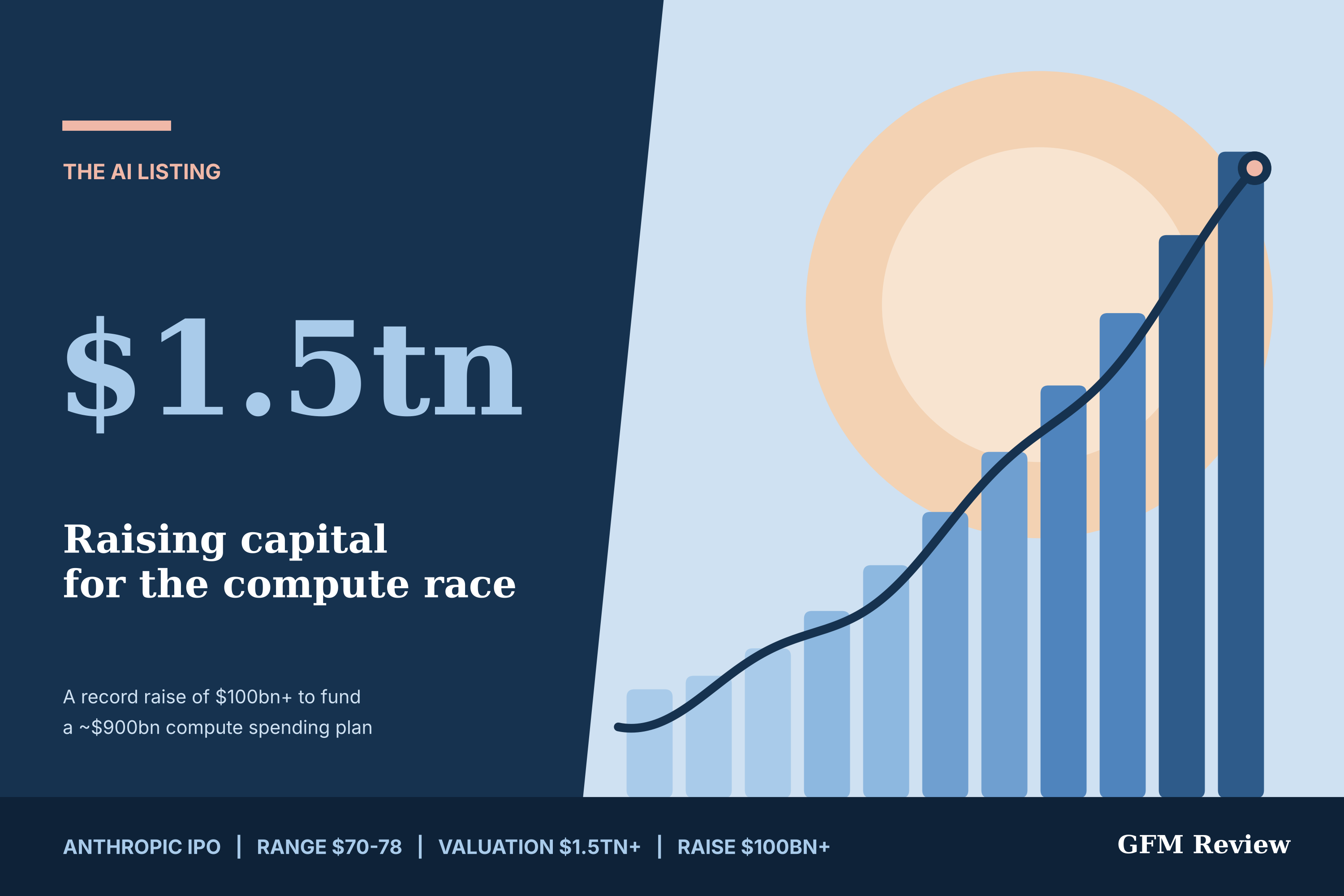
Anthropic, the developer of the Claude models, filed terms on 10 November setting a price range of $70 to $78 a share. On a fully diluted basis, which counts employee options and restricted stock, that implied a value of roughly $1.26tn to $1.41tn. Within a day, people close to the deal told the Financial Times they expected the price to move above that range, taking the valuation to $1.5tn or more.
The structure has three parts. The base offering seeks up to $64bn. An over-allotment, or "greenshoe", option would allow almost $10bn more if orders exceed supply. Alongside the listing, Google, Nvidia and Microsoft have agreed to invest a combined $26bn through a private placement at the IPO price. Taken together, and with a higher share price, the total could exceed $100bn. Goldman Sachs and Morgan Stanley are leading the deal, with trading expected next week.
Why the cash matters more than the headline
The case for prioritising proceeds rests on spending. Anthropic has told investors it plans to commit about $900bn to computing power and infrastructure over the coming years. Even a $100bn raise would cover little more than a ninth of that. The remainder will have to come from revenue, debt and partners, which makes the speed of revenue growth the central variable in the whole story.
That growth has been rapid. Anthropic says its annualised revenue reached $81bn in October, against roughly $9bn at the end of 2025. Its third-quarter revenue was $17bn, compared with $4.6bn for the whole of 2025, according to its registration statement. OpenAI, its closest rival, reportedly told investors this week that its third-quarter revenue rose 50 per cent to $10bn.
The strategic placement also deserves scrutiny. Google, Nvidia and Microsoft are not passive investors. They supply chips and cloud capacity, and money they invest may partly return to them as spending on their services. That is commercially rational for both sides, but it means part of the headline raise reflects supplier relationships as much as independent demand.
How big is this?
By any historical measure, the deal is exceptional. SpaceX set the record in June with a $75bn flotation. Before that, Saudi Aramco's 2019 listing, at $25.6bn rising to about $29.4bn with its greenshoe, had stood as the benchmark for more than six years. An Anthropic raise above $100bn, including the placement, would surpass both.
The valuation step-up is similarly steep. Anthropic raised $65bn privately in May at a $965bn valuation. A $1.5tn listing implies a gain of more than 50 per cent in six months.

Testing the narrative
Strong roadshow demand is not proof that the price is right. At $1.5tn, Anthropic would be valued at roughly 22 times its third-quarter revenue annualised, or about 18 times its October run rate. Run-rate figures extrapolate a short recent period across a full year and flatter companies that are growing quickly. They are not audited annual revenue.
Morningstar's estimate illustrates the uncertainty. Its analysts put fair equity value at $1.7tn, but said the plausible range runs from $500bn to $3tn, depending on how quickly Anthropic's tools are adopted. A sixfold spread is less a valuation than an acknowledgement that the outcome remains genuinely open.
The market backdrop adds risk. Technology stocks shed about $3.2tn after the US midterm elections before recovering, and investors had already scaled back earlier talk of a $2tn listing. Meanwhile, some holders of IPO allocations are reportedly offering shares to other buyers before trading starts, including through special purpose vehicles at a $1.5tn valuation. Anthropic has said it will not recognise certain of these offers. Grey-market activity of this kind can inflate apparent demand and add volatility once dealing begins.
What to watch
The first test is the final price and how much of the greenshoe is exercised, which will show whether demand extends beyond the initial order book. The second is the opening weeks of trading, when holders of side deals may look to sell. The larger test comes later: whether quarterly revenue keeps pace with a $900bn spending plan once public investors, rather than private backers, are asking the questions every three months.
Tech Rebound Tests If AI Optimism Has Found Floor
Strong CoreWeave results and talk of a higher Anthropic IPO valuation have pulled investors back into US technology stoc... Read more
Binance Reopens, But Confidence Is Damaged
Binance reopens, but confidence cannot be switched back onThere Read more
Big Techs AI Spending Faces A Commercial Test
The loss of nearly $900bn in market value across the largest Read more
Musks $3.6tn Gamble
Can Tesla and SpaceX Become One Company? Read more
Riyadh's Investment Showcase Hit By War
Saudi Arabia has postponed its flagship Future Investment Initiative conference until 2027 after Houthi missile and dron... Read more