

UniCredit Is About To Control Commerzbank
Europe's largest banking takeover since the financial crisis is close to completion, but the earnings case rests on cost savings that German labour agreements and political safeguards are designed to slow.
UniCredit expects to take control of Commerzbank before the end of November, completing a pursuit that began with a share purchase from the German government in September 2024. The Milan-based bank plans to install new governance at its target, launch a restructuring programme by the first quarter of 2027 and bring forward a merger between Commerzbank and its existing German subsidiary, HypoVereinsbank (HVB), which it had previously scheduled for after 2028.
That last change matters most. It signals that UniCredit believes the savings case is strong enough to accelerate, and that the political resistance which defined the early stages of the deal has faded. Whether both assumptions hold will decide whether this becomes a template for cross-border banking consolidation in Europe or a cautionary tale.
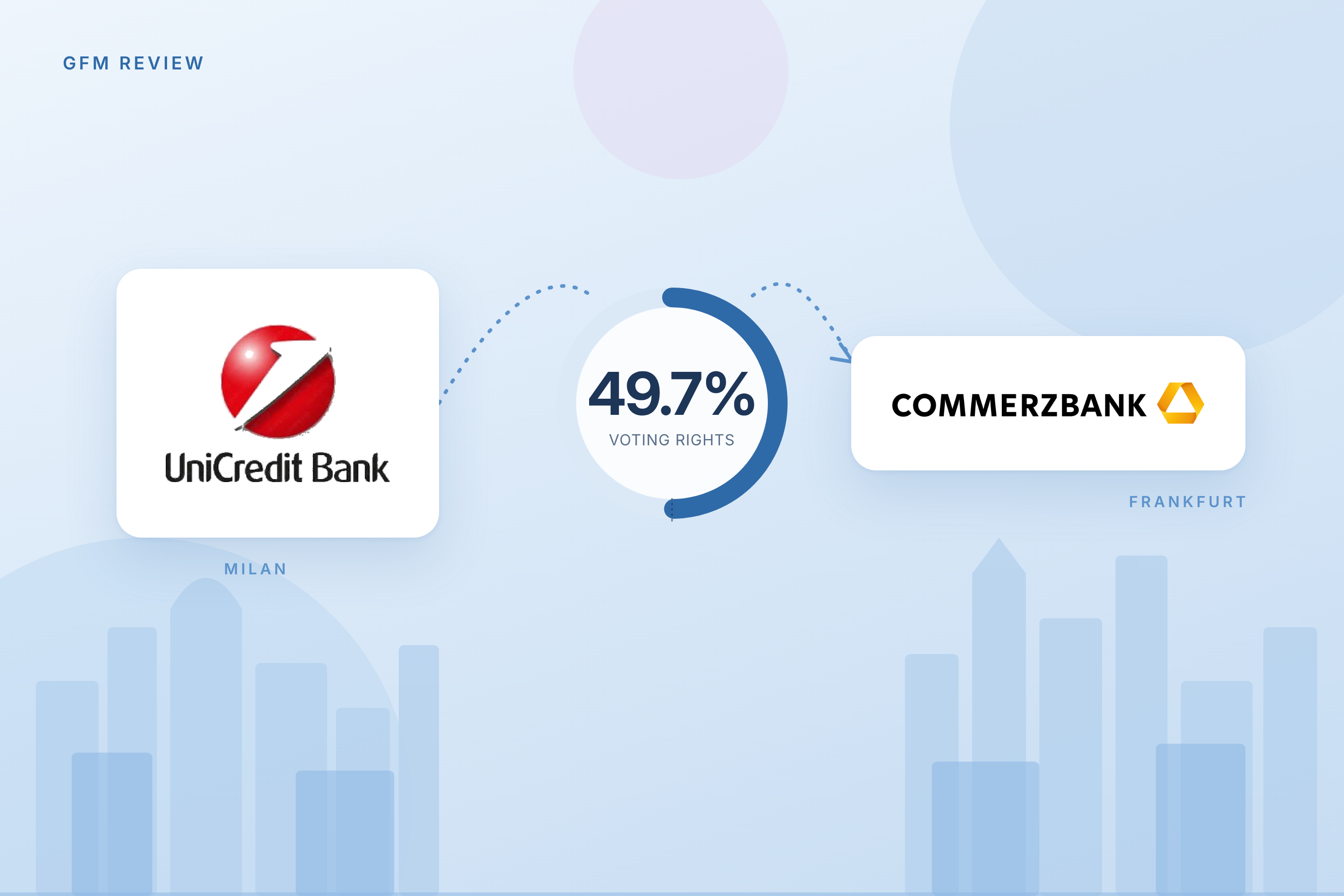
The regulatory path is now largely clear. The European Central Bank approved the acquisition of control on 15 October, and the European Commission is due to rule on competition grounds by 16 November, with people familiar with the matter expecting unconditional clearance. UniCredit holds about 47.6 per cent of Commerzbank's shares, equivalent to roughly 49.7 per cent of voting rights once the German bank's own shares are excluded. Andrea Orcel, UniCredit's chief executive, has said he intends to stay below an outright majority.

UniCredit's route to control of Commerzbank. Sources: UniCredit, Financial Times, Reuters, Euronews, dpa, Commerzbank.
Control at that level has come at a modest price. UniCredit's exchange offer of 0.485 of its own shares for each Commerzbank share carried a premium of only about 4 per cent when it was set in March, and Commerzbank's board urged shareholders to reject it. UniCredit nonetheless gathered enough acceptances to approach half the votes. In effect, it has secured working control of Germany's second-largest private lender without paying the premium a conventional takeover would usually require.
The commercial logic rests on costs. Reports of UniCredit's "Commerzbank Unlocked" plan point to around 7,000 job reductions and a cost base roughly €1.3bn lower, alongside a smaller international network. Commerzbank employs about 38,000 people, so the plan implies removing close to one role in five. Combining Commerzbank with HVB would add further savings by eliminating duplicated branches, technology and head-office functions in the same market.
UniCredit's own record gives the plan credibility. Third-quarter net profit rose 24 per cent to €3.3bn on revenue up 12 per cent to €6.9bn, return on tangible equity reached 25.5 per cent and the cost-to-income ratio fell to 32.8 per cent. The bank has raised its 2026 profit expectation to well above €11.5bn before extraordinary charges. Few European lenders can point to a comparable history of extracting efficiency from large organisations.
The headline earnings promise deserves closer inspection, however. UniCredit says the acquisition will lift earnings per share above €10 by 2028, from €6.97 in 2025. Yet its standalone plan already targets annual earnings per share growth of around 15 per cent between 2026 and 2028, which, compounded from the 2025 base, would reach roughly €10.60 without Commerzbank. The forecast shows the deal is not expected to dilute shareholders. It does not show how much value Commerzbank itself adds. Investors should look for a clear separation of standalone and acquisition-driven earnings when the restructuring plan is published.
The obstacles are equally concrete. Commerzbank agreed an employment pact with the ver.di union and its works council earlier this year, ruling out compulsory redundancies until 2030. Berlin's priorities have shifted from board seats towards protecting jobs, lending to the Mittelstand and the bank's Frankfurt headquarters and stock market listing. Commerzbank's management has also argued that UniCredit underestimates the risk of losing mid-sized corporate clients during integration, and those clients are the core of its franchise.
Nor is the target standing still. Commerzbank reported net income of €2.67bn for the first nine months of 2026 and reaffirmed a full-year target of at least €3.4bn, but it trimmed its net interest income forecast to about €8.5bn as competition for deposits intensified. Restructuring a profitable bank while its largest income line comes under pressure is a delicate exercise.
The wider significance lies beyond Germany. Brussels and the ECB have long argued that Europe's fragmented banking market leaves its lenders too small to compete globally, while national governments have usually resisted. UniCredit's own attempt to buy Banco BPM collapsed under Italian government opposition, and Crédit Agricole is now pursuing BPM instead. Success in Germany would strengthen the case for cross-border consolidation. A stumble would hand sceptics their strongest argument.
The first real test arrives at the extraordinary general meeting at which UniCredit is expected to reshape Commerzbank's supervisory board, followed by the restructuring plan in early 2027. Three questions will matter:
Tech Rebound Tests If AI Optimism Has Found Floor
Strong CoreWeave results and talk of a higher Anthropic IPO valuation have pulled investors back into US technology stoc... Read more
Binance Reopens, But Confidence Is Damaged
Binance reopens, but confidence cannot be switched back onThere Read more
Big Techs AI Spending Faces A Commercial Test
The loss of nearly $900bn in market value across the largest Read more
Musks $3.6tn Gamble
Can Tesla and SpaceX Become One Company? Read more
Riyadh's Investment Showcase Hit By War
Saudi Arabia has postponed its flagship Future Investment Initiative conference until 2027 after Houthi missile and dron... Read more
Airbus Says It Has "Everything In Hand"
Airbus says it will deliver around 870 aircraft this year, and its commercial chief insists the supply chain troubles of... Read more