

Stocks Rebound, But Is It Stabilization Or Pre-Holiday Positioning? Dow, Gold And Silver In Focus

TL;DR: Global markets are showing tentative signs of stabilization after Wednesday’s dramatic Wall Street reversal, but the rebound remains unconfirmed and could reflect pre-holiday positioning more than improved risk appetite, with credit stress and low Treasury yields still sending cautious signals. Monday’s reopening is the first real test, and Dow needs to break above 50,552.05 to make the bullish case.
Are Global Markets Really Stabilizing Ahead of the Thanksgiving Break?
Global markets are showing tentative signs of stabilization after Wednesday’s dramatic intraday reversal on Wall Street and Thursday’s rebound in Asian equities. However, the improvement remains unconfirmed, with pre-holiday positioning offering a plausible alternative explanation to a more durable recovery in risk sentiment. The distinction is particularly important as US markets close for Thanksgiving, leaving Monday’s reopening as the first meaningful test of whether the latest rebound can hold.
Wall Street’s Dramatic Reversal Extends into Asia
Wednesday’s US session saw a substantial recovery from heavy early losses. Nasdaq Composite closed down just 0.62% at 23,585.80 after plunging as much as 4.6% intraday. S&P 500 also recovered most of its losses to finish 0.25% lower at 7,182.78, while Dow reversed its decline to close up 0.33% at 50,188.01.
- Nasdaq: −0.62% to 23,585.80 (after an intraday plunge of as much as 4.6%)
- S&P 500: −0.25% to 7,182.78
- Dow: +0.33% to 50,188.01
The Philadelphia Semiconductor Index staged an even more striking reversal, recovering from an approximately 7% intraday decline to finish just 0.6% lower. Broadcom and CoreWeave recovered to around unchanged after falling sharply earlier in the session, while Nvidia narrowed an intraday loss of 8.5% to finish down 3.9%.
The magnitude of these reversals suggests that immediate selling pressure eased considerably as the session progressed. Importantly, semiconductor shares had been among the hardest hit during the broader AI-related correction, making their recovery a potentially encouraging development for market sentiment.
The improvement extended into Thursday’s Asian session. At around 02:20 GMT, Nikkei was trading approximately 1.5% higher, KOSPI had gained 1.2%, and Hang Seng was up 1.9%. These intraday advances suggest that some investors were returning to risk assets following the steep losses earlier in the week.
- Thursday, around 02:20 GMT: Nikkei about +1.5%, KOSPI +1.2%, Hang Seng +1.9%
Nevertheless, the recovery followed substantial declines across Asian markets during November, while trading conditions were relatively thin with US markets closed for Thanksgiving. The gains therefore provide encouraging follow-through, but do not yet establish a durable change in sentiment.
Follow the equity rebound, Gold and Silver on the ActionForex Telegram channel.
Stabilization or Pre-Holiday Positioning?
The central uncertainty is whether the recovery reflects genuine improvement in risk appetite or primarily a temporary adjustment in positioning ahead of the US holiday.
There are reasons to consider the stabilization case. The scale of Wednesday’s intraday reversal was substantial, semiconductor shares recovered sharply from extreme losses, and Thursday’s Asian rebound indicates that selling pressure was no longer spreading uniformly across markets.
However, the recovery also exposed important weaknesses. Wall Street’s rebound involved rotation toward more defensive sectors, while several major AI-related stocks remained under pressure. Nvidia, Oracle and Amazon still closed substantially lower, suggesting that investors had not decisively regained confidence in the technology companies at the centre of the correction.
Credit markets provided another warning. Reuters reported persistent stress in credit instruments associated with technology-related companies, including elevated credit default swap spreads and CoreWeave bond yields approaching 18%. Such developments suggest that concerns over financing conditions and credit risk have not necessarily eased alongside equity prices.
The divergence matters because an equity rebound without corresponding improvement in credit conditions may prove vulnerable. Share prices can recover rapidly as investors cover short positions or purchase heavily sold stocks, while credit markets may remain focused on financing costs and balance-sheet risks.
The Treasury market offered similarly incomplete confirmation. US 10-year yield remained near 4.85%, close to an 11-week low, even as equities recovered. Swiss Franc also continued attracting haven demand.
These developments are consistent with investors maintaining defensive exposure, although lower yields may also reflect positioning ahead of the long weekend rather than risk aversion alone.
Timing adds another layer of uncertainty. Wednesday’s strongest equity recovery came late in the session, immediately before Thursday’s Thanksgiving closure and Friday’s shortened trading day. Investors facing an extended break may have had incentives to reduce short positions or limit exposure to further volatility.
That makes pre-holiday positioning a credible explanation for at least part of the recovery, without establishing that it was the dominant cause.
Monday’s reopening on November 30 will provide a more meaningful test. Equities holding above Wednesday’s lows, renewed strength in semiconductor shares, easing credit stress and a recovery in Treasury yields alongside stocks would strengthen the stabilization case. A renewed decline toward the recent lows would instead suggest that the rebound had been driven largely by temporary positioning.
Strong US Data and Tariff Proposals Fail to Shift Market Focus
Wednesday’s economic releases offered little resolution to the broader uncertainty.
US Q3 GDP growth was revised up to 4.3%, while core PCE inflation accelerated to 3.3% yoy in October. The combination reinforced the picture of a resilient economy facing persistent inflation pressures.
Yet Treasury yields remained near multi-week lows despite these figures. That suggests the latest data did not displace the broader forces influencing bond markets, including concerns over risk sentiment, the economic outlook and positioning ahead of the holiday.
Washington’s proposed Section 301 tariffs on several trading partners have likewise failed to produce an identifiable sustained repricing across markets so far. The proposals remain subject to consultation, with comments and hearings scheduled for January 2027, and the additional duties are not yet in force.
The Dollar did not stage a sustained rally, Treasury yields declined, and Asian equities rebounded on Thursday despite the proposals remaining on the table.
However, these observations do not establish that the tariff announcements had no effect. Their timing overlapped with an already volatile period, while their potential economic consequences depend on the eventual measures adopted.
For now, the dominant market question remains whether the AI-related selloff is approaching exhaustion, rather than whether the latest economic data or trade proposals have fundamentally changed the outlook.
ActionForex’s Technical View: Dow, Rebound From 48,003.80 Faces 50,552.05 Resistance
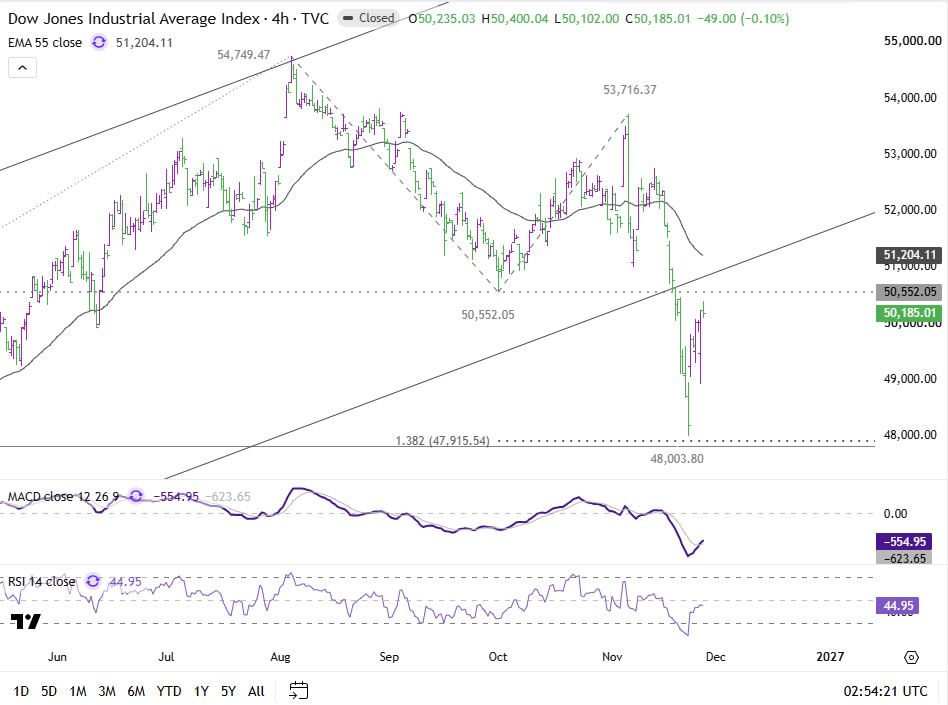
Technically, Dow’s recovery from 48,003.80 came just ahead of a significant support confluence. This includes the 138.2% projection of 54,749.47 to 50,552.05 from 53,716.37 at 47,915.54, the 38.2% retracement of 36,611.78 to 54,749.47 at 47,820.88, and the psychological 48,000 level.
There is prospect for Dow to establish a durable bottom at 48,003.80, completing a three-wave correction from 54,749.47.
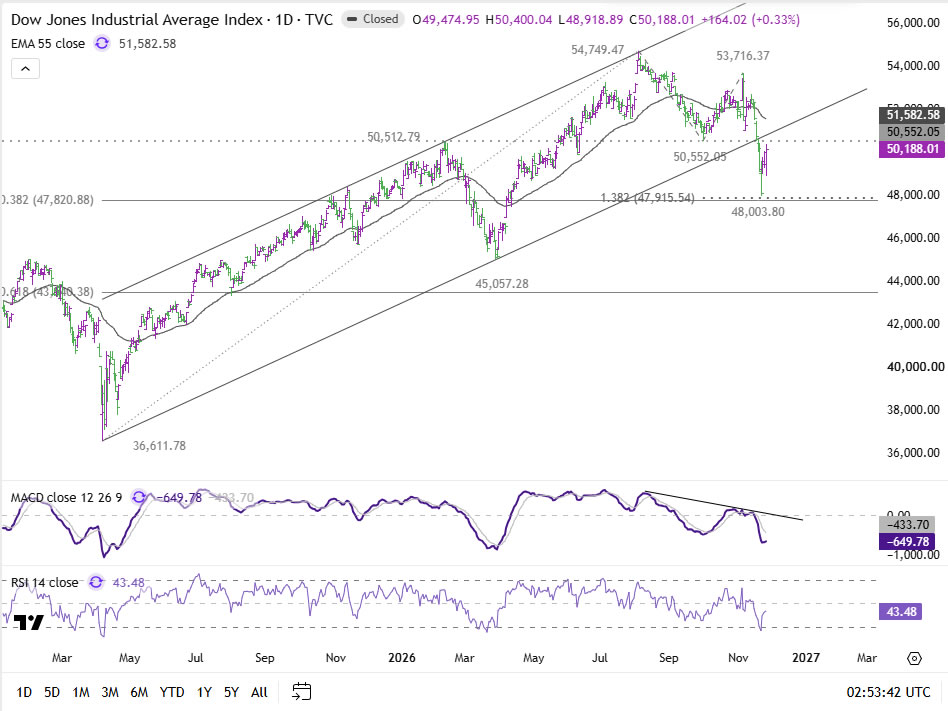
However, the bullish scenario requires a decisive break above 50,552.05 support-turned-resistance and a sustained return above the previous medium-term rising channel floor. Until these conditions are met, the recovery remains vulnerable to renewed selling.
In the bearish scenario, sustained break below the 48,000 support zone would suggest that Dow is undergoing a larger-scale correction, bringing 45,057.28 support into focus.
ActionForex’s Technical View: Gold and Silver, Early Bottoming Signals
The prospects for a recovery in precious metals are also worth watching as market sentiment attempts to stabilize.
Both Gold and Silver have declined alongside equities over the past week despite falling Treasury yields and a broadly steady Dollar. This unusual alignment is consistent with risk sentiment and liquidity pressures playing an important role in their recent weakness, although the metals also retain their own fundamental drivers.
A more durable improvement in equity sentiment could therefore provide support for precious metals, but their respective technical resistance levels must still be overcome before short-term bottoms can be confirmed.
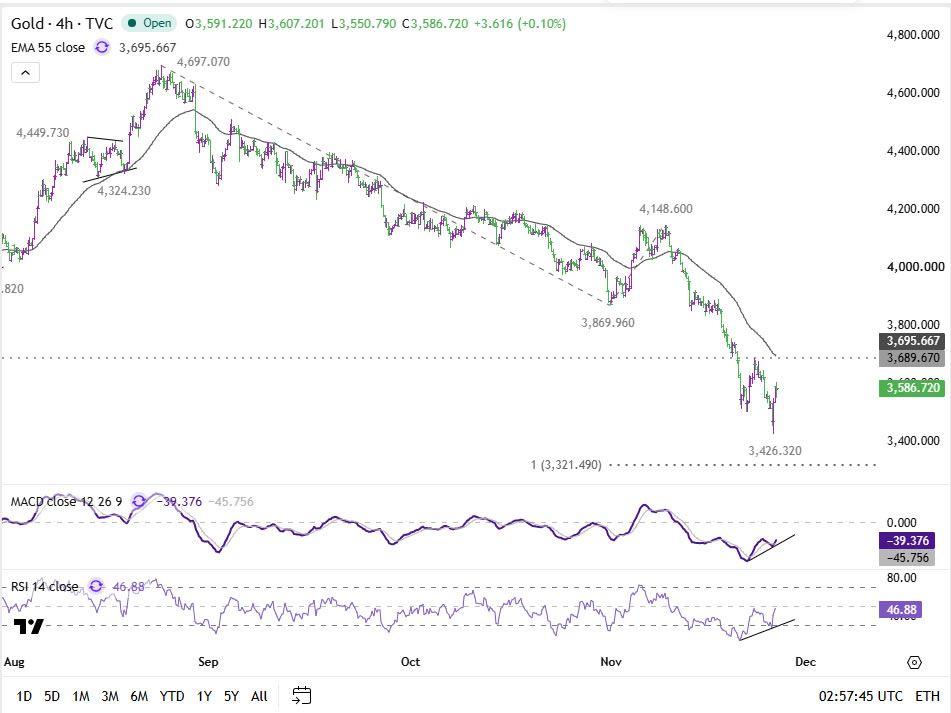
In Gold, bullish divergence in both 4H MACD and RSI suggests that selling momentum is weakening following the decline to 3,426.32. Break above 3,689.67 resistance and the 55-period 4H EMA would indicate short-term bottoming, opening the way for a stronger rebound toward 3,869.96 support-turned-resistance, even if the move remains corrective.
Conversely, break below 3,426.32 would extend the downtrend toward the 100% projection of 4,697.07 to 3,869.96 from 4,148.60 at 3,321.49.
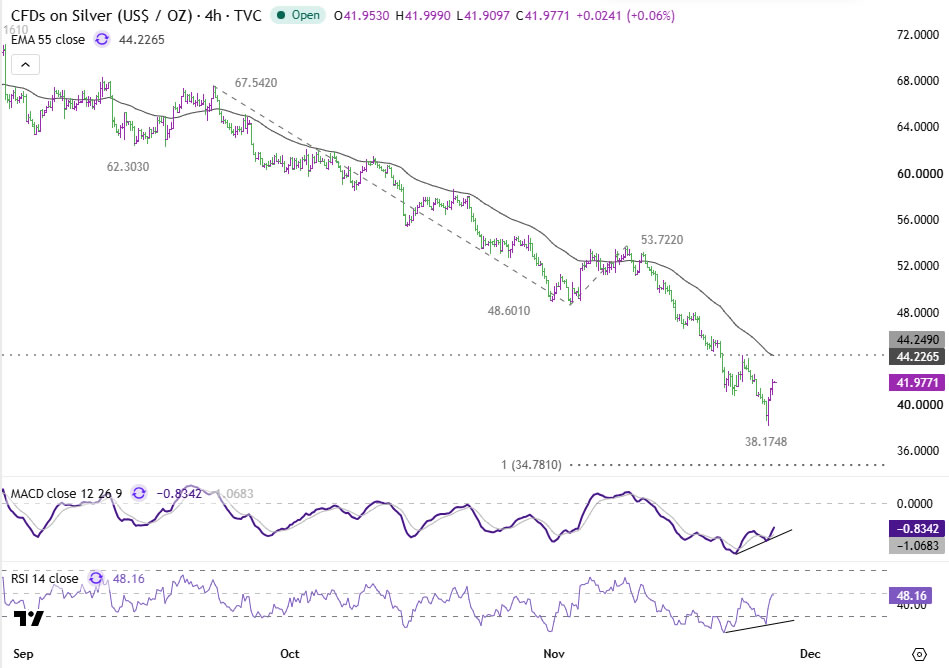
Silver displays a similar technical structure, with bullish divergence developing in both 4H MACD and RSI following the decline to 38.1748. Firm break above 44.25 resistance and the 55-period 4H EMA would indicate short-term bottoming and potentially trigger a stronger rebound toward 48.60 support-turned-resistance.
However, break below 38.17 would resume the decline toward the 100% projection of 67.54 to 48.60 from 53.72 at 34.78.
The emerging recovery across equities and precious metals is encouraging, but technical confirmation remains essential. Dow must reclaim its broken support and channel floor, while Gold and Silver need to overcome their respective resistance levels. Until then, the latest rebound remains a possible stabilization attempt rather than evidence that the broader correction has ended.
Key Takeaways
- Wednesday’s Wall Street reversal was dramatic: Nasdaq closed down only 0.62% after plunging as much as 4.6%, the semiconductor index recovered from an approximately 7% intraday decline, and Asian equities rebounded on Thursday (Hang Seng +1.9%, Nikkei about +1.5%, KOSPI +1.2%).
- The rebound is unconfirmed: Nvidia, Oracle and Amazon still closed lower, CoreWeave bond yields approached 18%, the US 10-year yield stayed near 4.85%, and the late-session recovery came just before the Thanksgiving closure.
- Strong data (Q3 GDP revised to 4.3%, core PCE at 3.3% yoy) and the proposed Section 301 tariffs did not shift markets, so the key question is whether the AI-related selloff is exhausted.
- Dow’s bullish case requires a decisive break above 50,552.05, while a break below the 48,000 zone would bring 45,057.28 into focus.
- Gold needs to break 3,689.67 and Silver 44.25 to confirm short-term bottoms, with breaks below 3,426.32 and 38.17 targeting 3,321.49 and 34.78, and Monday’s November 30 reopening as the first meaningful test.
Stay ahead of Monday’s reopening and the AI selloff’s next move—join the ActionForex Telegram channel for regular market updates and analysis.
What A Rising VIX Means For Pension Funds
Wall Street’s latest selloff has moved beyond a technology-sector wobble and become a broad market event. The Nasdaq C... Read more
Behaviour Cannot Fix A Portfolio Construction Flaw
A Retiree Shouldn't Be Asked to Behave Their Way Out of a Portfolio Construction Problem Why behavioural coaching shoul... Read more
Behavioural & Retirement Portfolio Resilience
Behavioural Survivability and Retirement Portfolio Resilience Why the lived experience of market recovery matters as mu... Read more
Australia's Rate Rise Bites: Highest In 15 Years
The Reserve Bank of Australia has lifted interest rates to their highest level since 2011, and its governor admits the w... Read more
October Retirement Portfolio Resilience Assessment
Markets stabl Read more