

What A Rising VIX Means For Pension Funds
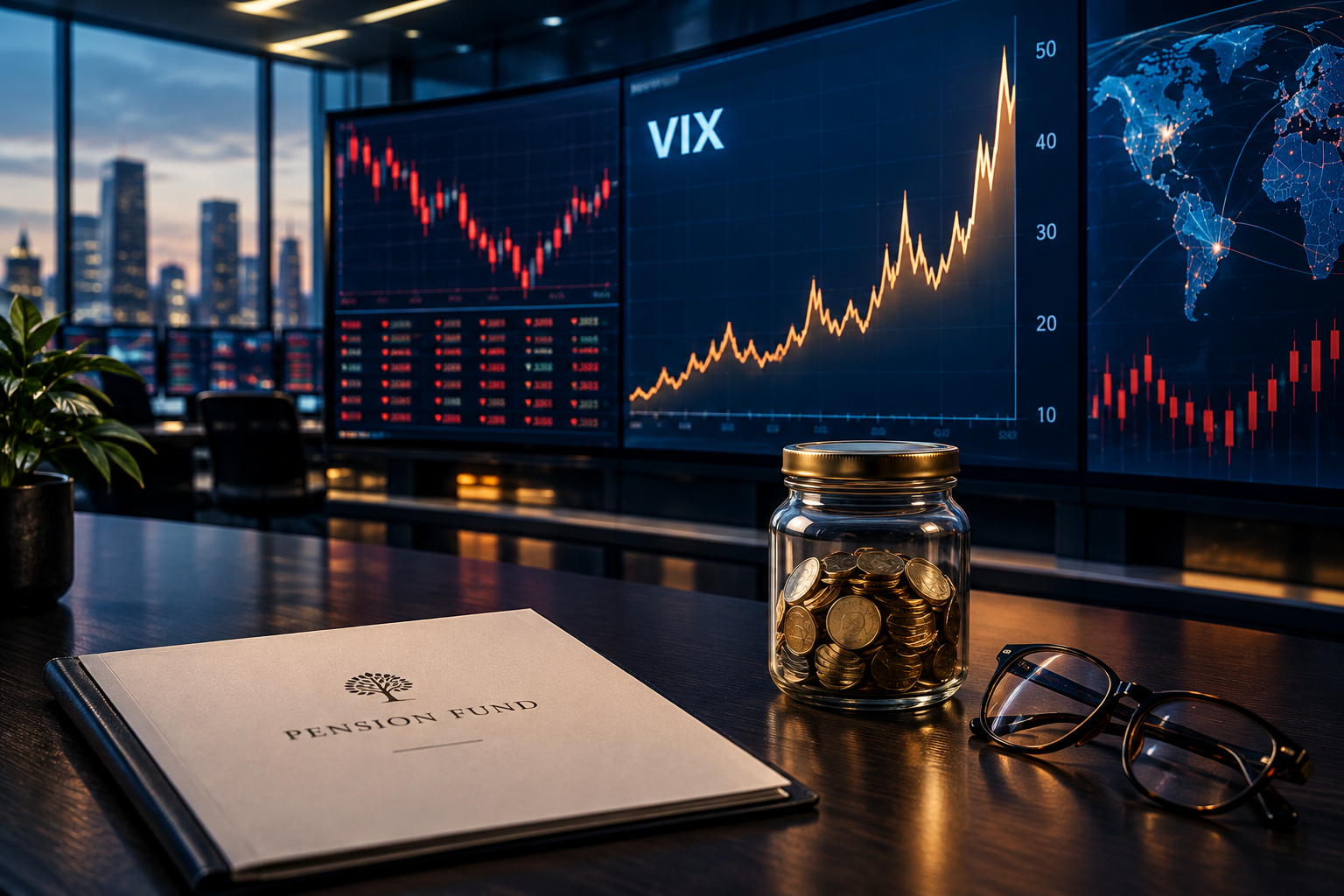
Wall Street’s latest selloff has moved beyond a technology-sector wobble and become a broad market event. The Nasdaq Composite fell 5.5%, pushing the index into correction territory, while the S&P 500 dropped 4.4% and the Dow lost more than 1,800 points. All eleven S&P 500 sectors closed lower, a reminder that although the immediate trigger lay in AI, semiconductors and the reassessment of the technology trade, the consequences were felt across the market.
The more important signal, however, may be the Cboe Volatility Index. The VIX surged roughly 70% to 28.18, its highest level in seven months and its largest one-day rise in almost two years. For investors, that shift matters because it changes not only the price of risk but the behaviour of the systems that allocate capital.
The VIX is often described as Wall Street’s fear gauge, but it is better understood as the market’s price for uncertainty. A reading near 28 implies investors expect materially larger daily swings in the S&P 500 than they did when the index closed at 16.61 the previous day. That matters for anyone with a pension, ISA, workplace scheme or diversified investment fund. Most long-term investors will never trade the VIX, but its rise affects the value of their equity holdings, the cost of portfolio insurance and the behaviour of fund managers who must control risk within tightly defined mandates.
For the average investor, the immediate effect is simple enough: portfolios with meaningful US equity or technology exposure will have fallen. For pension funds, the issue is more structural. A sharp equity decline can reduce funding levels, increase pressure to rebalance and force trustees and investment committees to reconsider how much risk they can comfortably carry. The danger is not necessarily the initial market fall; it is what happens when falling markets begin to change behaviour.
A correction is generally defined as a decline of at least 10% from a recent high. The Nasdaq has now crossed that threshold, while the S&P 500 remains up 7.4% year to date despite Thursday’s fall. That distinction matters. Markets can correct sharply without entering a bear market, and a correction does not automatically signal a systemic crisis. But the speed and breadth of this move have changed the tone of the market.
The VIX at 28 is elevated, but it is not yet in the zone normally associated with full-scale panic. Historical rules of thumb place 30 to 40 in “very high” territory, 40 to 50 at extreme stress and above 50 in crisis conditions. The current reading is therefore best seen as a serious warning shot rather than confirmation of a market breakdown. The question is whether the market is merely repricing risk after an extended AI-led rally, or whether volatility is beginning to feed on itself.

That is where the idea of a volatility spiral becomes relevant. Volatility can create a feedback loop when falling prices force investors and trading strategies to sell, which pushes prices lower, raises volatility further and triggers another round of selling. This is not primarily a story about retail investors panicking. It is about mechanical and risk-controlled selling: volatility-targeting funds reducing equity exposure, leveraged and inverse ETFs rebalancing, options dealers hedging their exposure, and institutional mandates that require de-risking once volatility or drawdowns exceed predetermined thresholds.
There were already signs of that dynamic in Thursday’s session. Retail investors sold more than $1 billion of stock, while leveraged ETFs were estimated to sell around $47 billion into the close as they rebalanced. VIX options volume reached 3.13 million contracts, roughly triple the 20-day average, as investors bought protection or rolled existing hedges. None of that proves a spiral is under way, but it shows how quickly hedging activity can amplify a move once market participants begin to question the durability of the rally.
The VIX futures curve adds to the concern. First-month futures traded above second-month contracts, a condition known as backwardation, reaching its highest premium in almost a year. In plain English, the market is paying more for protection against immediate volatility than for volatility further out. That suggests investors expect the stress to persist rather than fade quickly. It does not tell us the direction of the next move, but it does tell us that market participants are no longer treating volatility as a temporary inconvenience.
For pension funds and long-term investors, the question is not whether equities will be volatile—they will—but whether this correction changes the underlying investment case. The first issue is concentration. Much of the recent market strength has been tied to AI, semiconductors and data-centre investment. Thursday’s selloff was driven partly by a reassessment of AI infrastructure spending and the policy environment, with chipmakers including Nvidia, Micron and AMD among the casualties. If that narrative weakens further, portfolios that look diversified on paper may prove far more concentrated in practice.
The second issue is liquidity. When volatility rises, trading costs rise, bid-offer spreads widen and some assets become harder to exit without moving the price. This is particularly relevant for pension funds holding less liquid private-market assets alongside public equities. Public-market losses can create cash-flow and rebalancing pressures elsewhere in a portfolio, particularly where liabilities are shortening, contributions are constrained or funding levels are sensitive to equity performance.
The third issue is behaviour. The greatest damage in a correction often comes not from the initial fall but from selling after it. A pension fund that abandons a long-term strategy at the point of maximum fear may lock in losses and miss the recovery. Corrections can occur even when the underlying economy remains sound, often because expectations, valuations or policy assumptions change faster than fundamentals. The challenge for trustees is to distinguish between a change in the investment environment and a temporary dislocation in market sentiment.
Should investors be cautious? Yes. Should they panic? No. The sensible response is not to exit equities wholesale, but to test whether a portfolio’s risk assumptions still hold. That means checking concentration in AI and US technology, reviewing leverage and liquidity, ensuring cash and high-quality bonds are available for near-term obligations, and avoiding decisions driven by daily headlines.
The warning signs to monitor are clear. A sustained VIX above 35 would indicate that stress is becoming more entrenched. Continued backwardation in VIX futures would suggest investors still expect near-term turbulence. Deteriorating market breadth, widening credit spreads and evidence that volatility-driven strategies are still forcing sales would add to the concern. Any one of those signals alone is not decisive. Together, they would suggest that the correction is becoming something more damaging.
For now, the market has moved from complacency to caution. Whether it moves from caution to spiral depends less on the VIX headline than on whether selling remains discretionary—or becomes mechanical. For long-term investors and pension funds, the priority is not to predict the next daily move, but to ensure that portfolios are positioned to survive volatility without being forced to make permanent decisions at the worst possible moment.
Behaviour Cannot Fix A Portfolio Construction Flaw
A Retiree Shouldn't Be Asked to Behave Their Way Out of a Portfolio Construction Problem Why behavioural coaching shoul... Read more
Behavioural & Retirement Portfolio Resilience
Behavioural Survivability and Retirement Portfolio Resilience Why the lived experience of market recovery matters as mu... Read more
Australia's Rate Rise Bites: Highest In 15 Years
The Reserve Bank of Australia has lifted interest rates to their highest level since 2011, and its governor admits the w... Read more
October Retirement Portfolio Resilience Assessment
Markets stabl Read more
Gyrostat September Retirement Portfolio Resilience Assessment
September Retirement Portfolio Resilience Assessment Markets have fallen. The price of risk has risen. ... Read more
Does The West Have A Problem With Government Bonds
If you have been following the financial pages over the past few weeks, one theme has begun to stand out from the usual ... Read more