

Stocks And Metals Rally As China Lifts Sentiment, But FX Rebound Defies Monthly Trend

AUD and NZD Led the Recovery While Yen Weakened Broadly, Reversing Much of the Relative Strength Pattern Seen Earlier in November
Today’s themes:
- Equity recovery: The AI-led selloff paused for a second consecutive session, with Nikkei up 2.11%, KOSPI up 4.34% and Nasdaq futures up about 2.2%, though MSCI’s all-world index is still down about 5% for November.
- China support: The State Council’s pledge to strengthen capital-market support sent CSI 300 to its strongest daily gain since October 2024 and STAR 50 up around 15%.
- Metals rally: Gold rose about 2.5% to $3,671, Silver more than 6% to around $43.92 and Copper nearly 3.9%, recovering from Wednesday’s liquidation lows.
- Dollar and yields: Dollar Index held near 103.81 with a monthly gain of about 1.3%, the 10-year yield is near 4.90% and a December Fed hike is 99.2% priced.
- FX counter-trend: AUD led the daily and weekly heat maps, but ranks weakest for November and trades below October’s low against all seven other majors.
Global equities extended their recovery on Friday as the AI-led selloff paused for a second consecutive session, with Beijing’s pledge of stronger stock-market support providing an additional boost to investor sentiment. Asian shares surged, European markets advanced, and US equity futures pointed to further gains, while Gold, Silver and Copper also rallied strongly. In currencies, AUD and NZD led the recovery while Yen weakened broadly, reversing much of the relative strength pattern seen earlier in November. However, the Dollar remained resilient, and the broader monthly trends have yet to reverse. With US trading disrupted by Thanksgiving and Friday’s shortened session, the rebound is showing signs of stabilization but has not yet established a durable bottom.
Follow China’s market support pledge, the metals rally and AUD’s counter-trend rebound on the ActionForex Telegram channel.
Global Equity Recovery Broadens, but November’s Losses Remain
The recovery gathered momentum across Asia, led by technology shares and renewed confidence following China’s policy intervention. Nikkei closed 2.11% higher at 58,711.11, while South Korea’s KOSPI surged 4.34% to 4,915.68 and KOSDAQ jumped 8.13%. China’s CSI 300 gained more than 4%, while Hong Kong’s Hang Seng advanced approximately 2.1%.
European equities also participated, although gains were more moderate. Stoxx 600 rose 1.07% by late morning GMT, putting it on course for a weekly advance of approximately 2.7%, potentially its strongest since late May. FTSE 100 and DAX were up around 0.6%, while CAC 40 posted a smaller gain.
US equity futures pointed to another positive session following Wednesday’s sharp intraday recovery on Wall Street. Nasdaq futures climbed approximately 2.2%, S&P 500 futures gained 1.6%, and Dow futures advanced 1.3% ahead of Friday’s shortened cash trading session.
The improvement follows substantial losses during the AI-driven correction. From the November 20 closing levels to Wednesday’s close, S&P 500 had recovered approximately 3.9%, Nasdaq 4.3%, and Dow 4.2%. Friday’s futures gains suggested that investors were extending their willingness to re-enter equities after the previous week’s heavy selling.
Friday’s Equity Recovery at a Glance
- Nikkei: up 2.11% to 58,711.11
- KOSPI: up 4.34% to 4,915.68, with KOSDAQ up 8.13%
- CSI 300: up more than 4%
- Hang Seng: up approximately 2.1%
- Stoxx 600: up 1.07% by late morning GMT, on course for a weekly gain of approximately 2.7%, potentially its strongest since late May
- FTSE 100 and DAX: up around 0.6%, with CAC 40 posting a smaller gain
- Futures: Nasdaq up approximately 2.2%, S&P 500 up 1.6%, Dow up 1.3%
- From November 20 closes to Wednesday’s close: S&P 500 up approximately 3.9%, Nasdaq up 4.3%, Dow up 4.2%
- MSCI all-world index: still down approximately 5% for November
Nevertheless, the recovery remains significant mainly in relation to the depth of the preceding decline. MSCI’s all-world index was still down approximately 5% for November, despite the recent rebound.
Some evidence of stabilization is emerging. Major equity indices have held above Wednesday’s lows, while Treasury yields have recovered alongside stock prices. However, the condition of corporate credit markets remains less clear, and the latest advance has yet to establish that the selling pressure on major US semiconductor and AI-related companies has fully subsided.
Evidence of Stabilization vs Reasons for Caution
| Signs of stabilization | Reasons for caution |
|---|---|
| Major equity indices have held above Wednesday’s lows | The condition of corporate credit markets remains less clear |
| Treasury yields have recovered alongside stock prices | The advance has yet to show that selling pressure on major US semiconductor and AI-related companies has fully subsided |
| Gains have broadened across Asia, Europe and US futures | MSCI’s all-world index is still down about 5% for November, and Thanksgiving thins US trading |
The Thanksgiving holiday adds another qualification. US markets were closed Thursday, while Friday’s shortened session limits the opportunity to assess the rally under normal trading conditions. Monday’s return to a full US session will therefore provide a more meaningful test of whether buyers are prepared to sustain the recovery.
Beijing’s Market Support Pledge Fuels China Technology Surge
China provided one of Friday’s strongest catalysts after the State Council pledged to strengthen support for domestic capital markets.
The announcement outlined measures to reinforce the role of state-backed investment institutions, including the so-called national team, while encouraging greater equity participation from insurance and social-security funds. Authorities also emphasized dividends, share buybacks and stronger measures against financial misconduct.
The readout, released during Chinese trading hours, contributed to a sharp acceleration in equity buying, particularly among technology companies that had suffered heavy losses during the preceding correction.
CSI 300 recorded its strongest daily advance since October 2024, while Shanghai Composite gained approximately 3.7%. The rally was especially pronounced in China’s technology sector, with STAR 50 rising around 15% and semiconductor shares advancing roughly 17–19%, depending on the index. Hang Seng Tech also jumped more than 6%.
China’s Rally at a Glance
- CSI 300: strongest daily advance since October 2024
- Shanghai Composite: up approximately 3.7%
- STAR 50: up around 15%
- Semiconductor shares: up roughly 17–19%, depending on the index
- Hang Seng Tech: up more than 6%
The magnitude of the technology rebound suggests that investors interpreted Beijing’s announcement as a stronger commitment to preventing further disorderly market declines, particularly in sectors exposed to AI infrastructure investment.
The policy intervention comes after substantial weakness in Chinese growth and technology shares. Some technology-focused indices had lost roughly half their value since July, leaving them particularly sensitive to any change in expectations for official support.
However, there is an important distinction between a policy-driven rebound and a sustainable improvement in market fundamentals.
The announcement strengthens confidence that authorities are prepared to provide support, but it does not directly resolve questions about corporate earnings, valuations or the eventual profitability of AI-related investment.
The durability of the rally will depend on whether policy commitments translate into sustained investment demand and whether the underlying technology sector outlook improves sufficiently to support the rebound beyond its initial momentum.
Beijing’s Pledge: What It Does vs What It Leaves Open
| What the pledge does | What it does not resolve |
|---|---|
| Reinforces state-backed investment institutions, including the national team, and encourages insurance and social-security funds to buy equities | Questions about corporate earnings and valuations |
| Emphasizes dividends, share buybacks and stronger measures against financial misconduct | The eventual profitability of AI-related investment |
| Strengthens confidence that authorities will prevent further disorderly declines in technology shares that had lost roughly half their value since July | Whether policy commitments translate into sustained investment demand beyond the initial momentum |
Gold, Silver and Copper Join the Recovery
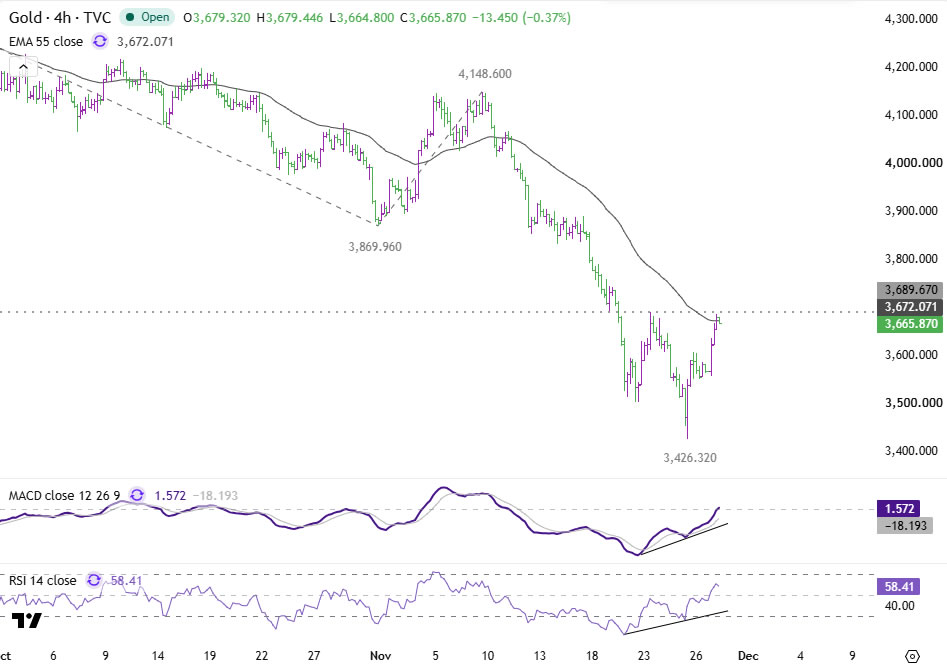
The improvement in sentiment extended into commodities, producing substantial gains across precious and industrial metals.
Gold rose approximately 2.5% to $3,671, while Silver surged more than 6% to around $43.92. Platinum advanced 3.1%, and Copper gained nearly 3.9%.
Metals Rally at a Glance
- Gold: up approximately 2.5% to $3,671, after falling to approximately $3,426 on Wednesday
- Silver: up more than 6% to around $43.92, after briefly trading near $38.17 on Wednesday
- Platinum: up 3.1%
- Copper: up nearly 3.9%
- SGX iron ore: down approximately 0.9%
The move was notable because precious metals and economically sensitive industrial metals strengthened together, rather than following the more conventional pattern of investors shifting decisively between defensive and cyclical assets.
Part of the rally reflected recovery from the sharp liquidation earlier in the week. Gold had fallen to approximately $3,426 on Wednesday, while Silver briefly traded near $38.17, leaving both metals substantially below their recent levels before the rebound began.
Friday’s gains also coincided with renewed confidence in Chinese equities, potentially providing additional support for industrial metals and broader commodity sentiment.
However, the reaction was not uniform. SGX iron ore declined approximately 0.9% even as Copper advanced strongly, suggesting that the rally was not simply a broad reassessment of Chinese industrial demand.
Meanwhile, the Dollar remained broadly unchanged, indicating that the strength in Gold and Silver could not be attributed primarily to a substantial decline in the US currency.
The simultaneous recovery in equities, precious metals and industrial metals is therefore consistent with a wider rebuilding of risk appetite following heavy selling, although the differing performance among commodities suggests that market positioning and sector-specific developments also played important roles.
Treasury Yields Recover as Dollar Holds Firm
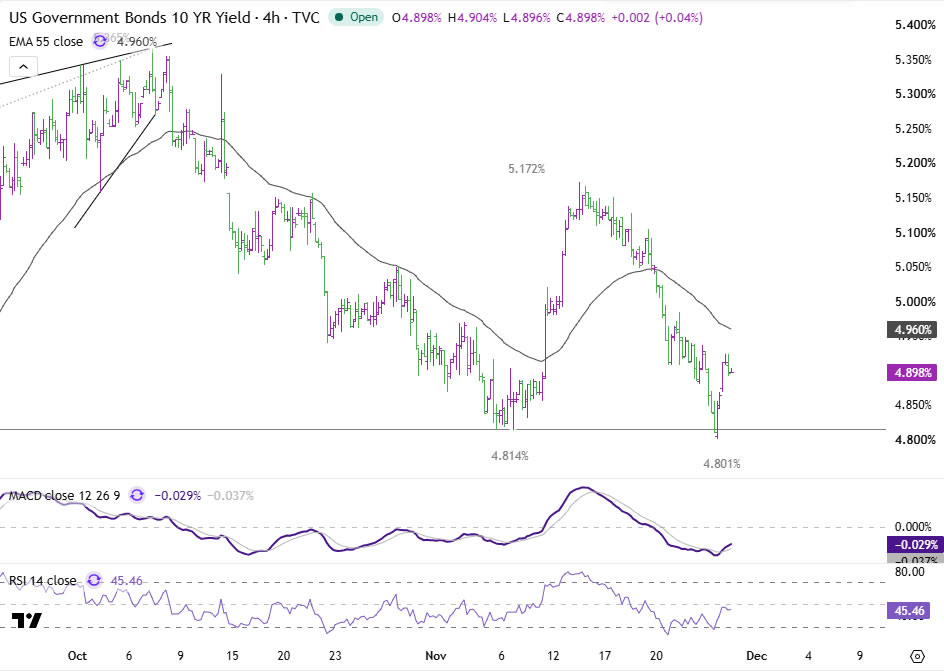
Bond markets provided another indication that investors were becoming less defensive.
US Treasury yields rebounded alongside equities, with the 10-year yield trading around 4.90%, having reached approximately 4.92% earlier in the session. The recovery followed a period in which demand for government bonds had strengthened during the equity selloff.
However, the foreign exchange market showed little corresponding weakness in the Dollar.
Dollar Index hovered near 103.81, virtually unchanged on the day, while retaining a monthly gain of approximately 1.3%.
The combination of rising equities, recovering Treasury yields and a broadly stable Dollar points to improving risk appetite without a decisive reversal in the underlying US currency trend.
Federal Reserve expectations also remained firmly tilted toward additional tightening. CME FedWatch indicated approximately 99.2% probability of a 25bps rate increase at the December 9 meeting, leaving limited uncertainty over the immediate expected policy move.
Rates and Dollar at a Glance
- US 10-year yield: around 4.90%, after reaching approximately 4.92% earlier in the session
- Dollar Index: near 103.81, virtually unchanged on the day, with a monthly gain of approximately 1.3%
- CME FedWatch, 25bps hike on December 9: approximately 99.2%
With a December increase already heavily priced, changes in broader financial conditions and expectations for the subsequent rate path could become more important than the next decision itself.
The key question is whether recovering asset prices can coexist with relatively elevated bond yields and expectations for further monetary tightening.
For now, Friday’s trading suggests that investors are reassessing the severity of the recent risk-asset selloff rather than making a wholesale shift in expectations for the Dollar or Fed policy.
FX Heat Maps Show Counter-Trend Rotation Led by AUD
The clearest evidence that Friday’s recovery is moving against November’s broader market trends comes from the currency heat maps.
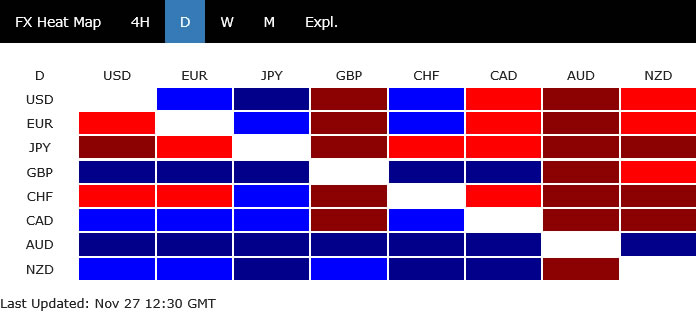
On the daily timeframe, AUD strengthened against all seven other major currencies, followed by NZD and GBP. At the opposite end, Yen weakened against every other major currency.
AUD/USD rose approximately 0.5% to 0.6670, while NZD/USD gained around 0.3% to 0.5485. AUD/JPY advanced 0.6%, and NZD/JPY rose around 0.4%.
The Dollar’s performance was mixed. It strengthened against Yen, Euro and Franc but weakened against AUD, NZD, Sterling and CAD. This reinforces the view that Friday’s FX movements were driven more by changes in relative risk appetite than by broad Dollar selling.
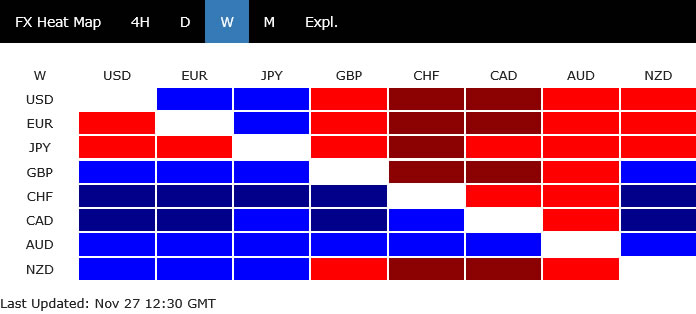
The weekly heat map showed a similar, though not identical, pattern. AUD led against all seven counterparts, with CAD and CHF also displaying relative strength. Yen remained the weakest currency over the week, while the Dollar ranked near the bottom.
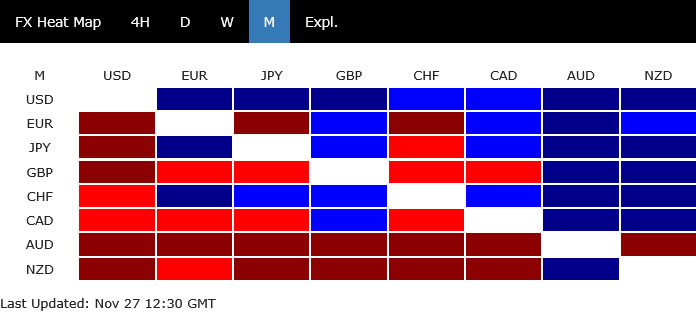
However, the monthly heat map presents almost the opposite picture.
Dollar remained the strongest major currency for November, followed by Yen and Franc. AUD ranked weakest, with NZD and Sterling also underperforming.
Heat Maps by Timeframe: Daily and Weekly vs Monthly
| Timeframe | Heat map picture |
|---|---|
| Daily | AUD strongest against all seven other majors, followed by NZD and GBP, while Yen weakened against every other major |
| Weekly | AUD led against all seven counterparts, with CAD and CHF also showing relative strength, while Yen was weakest and Dollar ranked near the bottom |
| Monthly | Dollar strongest, followed by Yen and Franc, while AUD ranked weakest, with NZD and Sterling also underperforming |
Most notably, AUD was trading below October’s low against all seven other major currencies, despite its strong daily and weekly performance. This suggests that the latest recovery has not yet reversed the underlying weakness established during November.
The contrast is particularly important for interpreting Friday’s moves. The currencies leading the rebound are among those that suffered the greatest pressure earlier in the month, while previously resilient currencies have become short-term laggards.
The Franc offers another example. Despite weakening on Friday, it remained relatively strong over the week and month, consistent with earlier safe-haven demand not having been completely unwound.
The developing rotation therefore looks more like a counter-trend recovery than an established change in the broader FX regime.
That distinction remains provisional. November’s monthly currency bars will not be complete until Monday, leaving the current monthly breakout and breakdown signals subject to change.
The Bottom Line: A Broad Rebound, Not Yet a Confirmed Bottom
The rebound has become broader and more convincing than the initial recovery from Wednesday’s equity lows, but several important questions remain unresolved.
China’s intervention has strengthened confidence in policy support, yet the durability of the technology rally will depend on whether investors see improvements extending beyond official announcements.
In the US, the rebound needs confirmation from normal trading activity, particularly among semiconductor and AI-related companies. Corporate credit conditions also remain an important indicator of whether concerns about the financing and profitability of AI investment are easing.
In currencies, sustained strength in AUD and NZD would provide further evidence that investors are moving away from the defensive positioning that dominated much of November. However, a few sessions of gains would not by themselves overturn the month’s broader Dollar-led trends.
The most constructive development is that the recovery now extends across equities, Treasury yields, metals and risk-sensitive currencies. The unresolved question is whether this represents the beginning of sustained stabilization or a powerful rebound from oversold conditions amplified by holiday-thinned trading.
Monday’s return to a full US session, together with the completion of November’s monthly currency bars, should provide a clearer assessment of whether the market’s latest improvement is strong enough to challenge the prevailing trends.
Related Coverage
Eurozone
- Eurozone Inflation Expectations Rise Sharply, Five-Year Outlook Stays at Record High: Eurozone households raised their inflation expectations sharply in October, according to the ECB’s latest Consumer Expectations Survey. Median expectations for the next 12 months jumped from 3.1% to 3.5%, while perceived inflation climbed to 4.1%, its highest since July 2024. Three-year expectations increased to 3.0%, and five-year expectations remained at a series high of 2.5% for a third consecutive month. Consumers became slightly less pessimistic about growth and unemployment, although expected nominal income growth weakened significantly, highlighting persistent inflation concerns despite a modest improvement in the economic outlook.
- Eurozone Sentiment Falls to 95.8 as Industrial Confidence and Hiring Outlook Weaken: Eurozone Economic Sentiment fell from 96.5 to 95.8 in November, missing expectations of 97.2 as industrial confidence deteriorated sharply. Manufacturing sentiment dropped to -5.1, reflecting weaker production expectations and unfavorable inventory assessments, while services and consumer confidence remained broadly stable. The Employment Expectations Indicator also declined from 98.1 to 96.8, suggesting businesses are becoming more cautious about hiring. Across the wider EU, confidence weakened particularly in France and Italy, although Germany registered a modest improvement, and the survey points to persistent industrial weakness with limited evidence of a broad-based recovery.
Asia-Pacific
- NZ Hung Parliament Adds Slow-Burning Risk to NZD/USD as Dollar Remains in Control: New Zealand’s official election count left the incumbent National–ACT–NZ First coalition with 65 seats, one short of a parliamentary majority. Yet NZD/USD edged higher to around 0.5491, showing little immediate concern over the political deadlock. Prolonged coalition negotiations could gradually weigh on investor confidence and introduce a New Zealand-specific risk premium, although no such effect has been clearly established. For now, Dollar movements, global risk sentiment and RBNZ–Fed expectations remain the dominant influences, and technically NZD/USD’s rebound from 0.5432 remains corrective, with 0.5467 historic support under pressure and resistance at 0.5564.
- Tokyo Core CPI Hits 16-Month High at 2.9%, but Underlying Inflation Eases: Tokyo Core CPI accelerated from 2.6% to 2.9% yoy in November, reaching a 16-month high but slightly missing expectations of 3.0%. The increase was driven primarily by energy inflation, which surged from 2.2% to 9.5% as electricity and gas costs climbed sharply. Core-Core CPI, excluding fresh food and energy, eased from 2.6% to 2.5%, while its seasonally adjusted monthly increase slowed to 0.1%. The divergence suggests that inflation remains elevated without a broad acceleration in underlying momentum, keeping price risks in focus ahead of the BoJ’s December meeting.
- IMF Backs RBA Tightening Bias as Inflation Risks Persist Despite Slowing Growth: The IMF has endorsed the RBA’s recent interest rate increases and supported maintaining a tightening bias until inflation is firmly returning to target. Its latest Article IV assessment forecasts Australian headline inflation averaging 4.0% in 2026 before easing to 3.1% in 2027, with upside risks from energy prices and potential second-round effects. Economic growth is projected to slow from 1.9% to 1.6%, while unemployment rises to 4.9%. The IMF emphasized that monetary policy should remain flexible and data dependent, supporting continued restraint without calling for an immediate additional hike.
FAQ
Why did stocks and metals rally on Friday?
The AI-led selloff paused for a second consecutive session, and Beijing’s State Council pledged stronger support for domestic capital markets, sending CSI 300 to its strongest daily gain since October 2024 and STAR 50 up around 15%. Asian shares surged, Nasdaq futures rose approximately 2.2%, and Gold, Silver and Copper also rallied, partly recovering from sharp liquidation earlier in the week.
Does China’s market support pledge mean the rebound is durable?
Not necessarily. The announcement strengthens confidence that authorities will support markets, but it does not directly resolve questions about corporate earnings, valuations or the profitability of AI-related investment. Durability depends on whether the policy commitments translate into sustained investment demand and an improving technology sector outlook.
Does AUD’s rally signal a reversal in the FX trend?
Not yet. AUD strengthened against all seven other majors on the daily chart and led on the weekly one, but it ranks weakest for November and was trading below October’s low against all seven other majors. Dollar remains the strongest major for the month, so Friday’s move looks like a counter-trend recovery, with monthly signals still subject to change until the bars complete on Monday.
Key Takeaways
- Global equities extended their recovery as the AI-led selloff paused for a second consecutive session, with Nikkei up 2.11%, KOSPI up 4.34%, Nasdaq futures up approximately 2.2% and Stoxx 600 on course for a weekly gain of approximately 2.7%.
- MSCI’s all-world index is still down approximately 5% for November, and Thanksgiving-thinned trading means Monday’s full US session is the more meaningful test.
- Beijing’s pledge of stronger capital-market support drove CSI 300 to its strongest daily advance since October 2024 and STAR 50 up around 15%, though it does not resolve questions about earnings, valuations or AI profitability.
- Gold rose approximately 2.5% to $3,671 and Silver more than 6% to around $43.92 after Wednesday’s lows of approximately $3,426 and $38.17, while Copper gained nearly 3.9% and SGX iron ore fell approximately 0.9%.
- The 10-year Treasury yield rebounded to around 4.90% while Dollar Index held near 103.81, retaining a monthly gain of approximately 1.3%, and CME FedWatch shows approximately 99.2% for a 25bps December hike.
- AUD strengthened against all seven other majors on the daily chart, followed by NZD and GBP, while Yen weakened against every other major.
- The monthly heat map shows the opposite picture, with Dollar strongest and AUD weakest and trading below October’s low against all seven other majors, so the rotation looks counter-trend until November’s monthly bars complete on Monday.
What to Watch Next
Monday’s return to a full US session is the main test of whether buyers will sustain the recovery, particularly in semiconductor and AI-related shares. Corporate credit conditions are another indicator of whether concerns about the financing and profitability of AI investment are easing.
In currencies, sustained AUD and NZD strength would point to a move away from defensive positioning, but it would take more than a few sessions to overturn November’s Dollar-led trends. The completion of the monthly currency bars on Monday will show whether the current breakout and breakdown signals hold.
Stay ahead of Monday’s full US session, the close of November’s monthly currency bars and the next test for AUD—join the ActionForex Telegram channel for regular market updates and analysis.
What A Rising VIX Means For Pension Funds
Wall Street’s latest selloff has moved beyond a technology-sector wobble and become a broad market event. The Nasdaq C... Read more
Behaviour Cannot Fix A Portfolio Construction Flaw
A Retiree Shouldn't Be Asked to Behave Their Way Out of a Portfolio Construction Problem Why behavioural coaching shoul... Read more
Behavioural & Retirement Portfolio Resilience
Behavioural Survivability and Retirement Portfolio Resilience Why the lived experience of market recovery matters as mu... Read more
Australia's Rate Rise Bites: Highest In 15 Years
The Reserve Bank of Australia has lifted interest rates to their highest level since 2011, and its governor admits the w... Read more
October Retirement Portfolio Resilience Assessment
Markets stabl Read more