

Golds AI Paradox — Four Long-Term Forces And A Fifth Shaping Its Selloff

TL;DR: AI’s direct impact on Gold demand is small, but its more immediate effect may be coming through the equity-market turmoil it has generated, a fifth channel alongside the four long-term forces identified by the World Gold Council. Gold’s failure to follow Tuesday’s Asian equity rebound keeps the outlook bearish below 3,869.96.
Is AI Driving Gold’s Selloff Through Equity-Market Turmoil?
Gold’s sharp decline has exposed a less obvious connection between artificial intelligence and precious metals. While AI is reshaping demand for computing infrastructure and influencing longer-term economic expectations, its more immediate impact on Gold may be coming through the equity-market volatility it has helped generate. Recent AI-led stock market swings have coincided with sharp movements in Gold that are difficult to explain through Treasury yields or Dollar alone.
Gold is trading around 3,622 at the time of writing, approximately 35% below its January record of 5,598.75. The metal rebounded alongside equities on Monday following last week’s severe selloff, but has struggled to sustain that recovery despite strong gains in Japanese and South Korean stocks during Tuesday’s Asian session.
The contrast raises an important question: how much of Gold’s recent weakness reflects persistent monetary policy pressures, and how much stems from the broader market instability surrounding AI-related investments?
Follow Gold and the AI-driven equity swings on the ActionForex Telegram channel.
AI’s Direct Impact on Gold Demand Is Relatively Small
In a November 23 analysis of AI’s implications for Gold, World Gold Council strategist Joseph Cavatoni outlined how the technology could influence Gold through several economic and financial channels.
AI has a direct connection to Gold consumption. The metal is used in advanced chips, memory components, connectors and networking equipment because of its conductivity and resistance to corrosion.
However, the WGC estimates that total technology demand amounted to 323 tonnes in 2025, virtually unchanged from the previous year and representing only around 6–7% of annual Gold demand.
Even within electronics manufacturing, AI-related growth faces an offsetting force. High Gold prices encourage manufacturers to reduce the amount used in individual components or seek substitutes where possible.
The direct contribution of AI infrastructure to Gold consumption is therefore too small to explain major price movements on its own. The potentially greater consequences come from how AI changes inflation, economic growth, interest rates and geopolitical uncertainty.
Four Indirect Channels Could Pull Gold in Opposite Directions
The WGC identifies four broader mechanisms through which AI could influence Gold, and they do not necessarily point in the same direction.
The first is energy demand and inflation. Expanding AI data centres requires substantial electricity generation, infrastructure and capital investment. Competition for energy and other resources could add to inflationary pressures, potentially increasing demand for Gold as protection against uncertainty over purchasing power.
The second is productivity and real interest rates, which could work against Gold. If AI improves productivity, strengthens economic growth and reduces unit labor costs, real interest rates could rise. Higher real yields would increase the opportunity cost of holding a non-yielding asset.
The third involves geopolitical and economic uncertainty. Competition over advanced semiconductors, export restrictions and the changing nature of employment could reinforce demand for wealth preservation. The WGC also sees this environment as supporting the rationale for central banks to diversify reserves into Gold, although such demand predates AI.
The fourth concerns mining productivity and supply. AI could improve exploration, mine planning and operational efficiency, potentially reducing production costs and modestly increasing supply over time. However, geological constraints, permitting requirements and capital intensity limit how quickly these improvements can translate into additional output.
These mechanisms operate over different horizons. Energy costs and expectations for real yields can influence markets relatively quickly, while changes in mining productivity and some geopolitical consequences may unfold more gradually.
Crucially, their effects can offset one another. AI could be inflationary during the infrastructure buildout but disinflationary if subsequent productivity gains become substantial. The WGC does not identify a single channel that will necessarily dominate Gold prices.
The Fifth Channel: AI-Led Equity Turmoil and Risk Sentiment
Recent trading suggests another transmission mechanism deserves attention: the effect of AI-related equity volatility on broader market sentiment and potential liquidity pressure.
Unlike the four channels discussed by the WGC, this fifth mechanism does not depend on AI directly changing Gold demand or the economy’s productive capacity. It begins with the repricing of AI-related equities and passes through financial-market risk appetite.
Friday’s selloff illustrated the connection. Nasdaq plunged 5.28%, substantially exceeding S&P 500’s 3.70% decline, as concerns about technology valuations and AI investment spread across markets. Gold fell 2.41% during the same session.
Yet US two-year Treasury yield declined nearly 12bps, while Dollar was little changed. Falling yields would ordinarily reduce the opportunity cost of holding Gold, but the metal declined anyway.
Monday brought the opposite pattern. Nvidia’s powerful rebound helped lift Nasdaq 6.51% and S&P 500 4.73%, while Gold futures also climbed approximately 4%. Treasury yields, meanwhile, recovered modestly and Dollar strengthened.
- Friday: Nasdaq −5.28%, S&P 500 −3.70%, Gold −2.41%; US 2-year yield down nearly 12bps, Dollar little changed
- Monday: Nasdaq +6.51%, S&P 500 +4.73%, Gold futures up about 4%; Treasury yields modestly higher, Dollar stronger
Across these two sessions, Gold moved alongside equities rather than responding in the direction normally associated with changes in Treasury yields.
One plausible explanation is that the equity correction generated broader pressure to reduce risk exposure, including potential selling of Gold to raise liquidity. When equities rebounded, some of that pressure may have eased.
However, the evidence does not establish forced liquidation. Without sufficiently detailed positioning, fund-flow or margin data, the mechanism remains an interpretation of observed price behavior rather than a confirmed explanation of investor transactions.
Nor does the relationship establish that equities have replaced rates as Gold’s dominant driver. The observations cover only a short period, and the broader decline began before the most intense phase of the equity selloff.
Tuesday’s Divergence Tests Whether the Fifth Channel Persists
Tuesday’s Asian trading already provides a counterpoint to the recent Gold-equity relationship.
Japanese and South Korean equities are rebounding strongly, but Gold has slipped back toward 3,622. Silver, Platinum and Copper are also declining, while Dollar and short-term Treasury yields have shown relatively limited changes.
The divergence suggests that Gold is not simply tracking the latest improvement in equity sentiment.
This makes the next market movements particularly informative.
If renewed equity selling is accompanied by another Gold decline despite lower Treasury yields and a relatively stable Dollar, it would strengthen the interpretation that risk sentiment or liquidity pressure is influencing the metal.
Conversely, if equities weaken while Gold stabilizes or rises, the argument that AI-led equity volatility is driving its immediate price action would weaken.
A closer relationship between Gold and real yields would instead suggest that traditional monetary policy transmission is regaining prominence.
Investment flows and central-bank purchases would provide further evidence about underlying demand, but the recent price movements alone cannot establish whether those sources of support have strengthened or weakened.
Wednesday’s US core PCE inflation release could also influence the balance between these mechanisms by changing expectations for Fed policy and real interest rates.
ActionForex’s Technical View: Gold, Bearish Below 3,869.96 With 3,321.49 Next
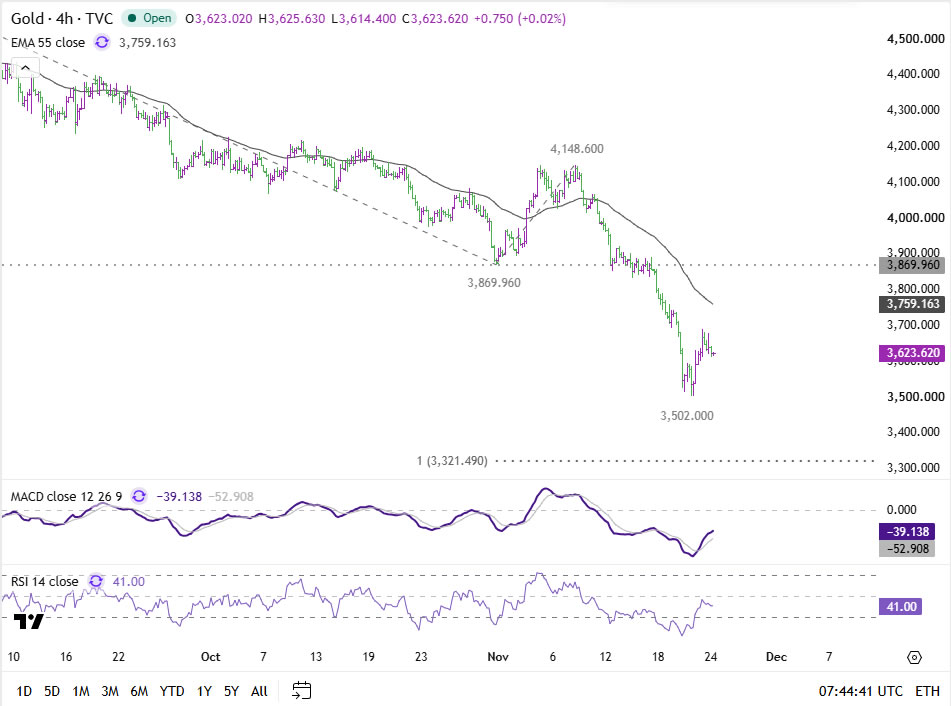
Gold has recovered after falling to 3,502.00 last week. With the 4-hour MACD moving above its signal line, RSI recovering from oversold territory to around 40, and psychological support near 3,500, some near-term consolidation is likely.
However, the outlook will remain bearish as long as 3,869.96 support-turned-resistance holds, with risks still heavily skewed to the downside.
A further rebound could ease immediate selling pressure, but would not establish that the decline has completed. The key question is whether stabilization can develop into a sustained recovery or merely interrupt the existing downtrend.
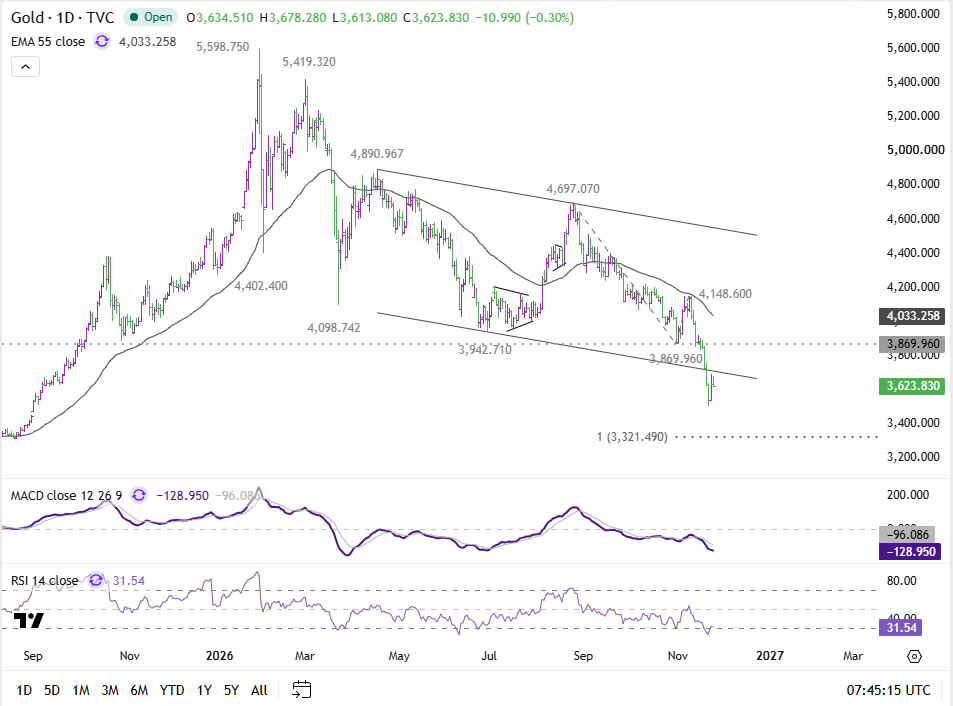
The broader daily structure remains bearish. Gold has fallen below the lower boundary of its descending channel and continues trading beneath its 55-day EMA, indicating that the medium-term decline has not been reversed.
On resumption, the current downtrend is expected to extend toward the 100% projection of 4,697.07 to 3,869.96 from 4,148.60 at 3,321.49.
The technical picture therefore leaves Gold vulnerable even if the immediate equity-market turmoil subsides.
The next decisive test may come during another period of equity weakness. If Gold can hold firm despite renewed selling in technology stocks, the recent relationship with risk sentiment may be fading. If both fall together again despite declining yields, the additional financial-market transmission channel would gain credibility, potentially accelerating Gold’s move toward its next downside objective.
Key Takeaways
- The WGC estimates technology demand at 323 tonnes in 2025, only about 6–7% of Gold demand, so AI’s direct effect on consumption is too small to explain major price moves.
- The WGC’s four indirect channels (energy and inflation, productivity and real rates, geopolitical uncertainty, mining supply) can offset one another, and none is identified as dominant.
- A fifth channel, AI-led equity turmoil, fits recent trading: Gold fell 2.41% on Friday despite a near 12bps drop in the 2-year yield, then rose about 4% on Monday as Nasdaq jumped 6.51%.
- Tuesday’s slip back toward 3,622 despite strong Japanese and South Korean equity gains shows Gold is not simply tracking stocks, so the link remains unproven.
- Gold stays bearish below 3,869.96, with 3,321.49 as the next downside target and 3,502.00 as last week’s low.
Stay ahead of Gold’s next move as AI-driven equity swings continue—join the ActionForex Telegram channel for regular market updates and analysis.
What A Rising VIX Means For Pension Funds
Wall Street’s latest selloff has moved beyond a technology-sector wobble and become a broad market event. The Nasdaq C... Read more
Behaviour Cannot Fix A Portfolio Construction Flaw
A Retiree Shouldn't Be Asked to Behave Their Way Out of a Portfolio Construction Problem Why behavioural coaching shoul... Read more
Behavioural & Retirement Portfolio Resilience
Behavioural Survivability and Retirement Portfolio Resilience Why the lived experience of market recovery matters as mu... Read more
Australia's Rate Rise Bites: Highest In 15 Years
The Reserve Bank of Australia has lifted interest rates to their highest level since 2011, and its governor admits the w... Read more
October Retirement Portfolio Resilience Assessment
Markets stabl Read more