

EUR/CHF Breakdown As Safe-Haven Demand Outweighs ECB–SNB Rate Repricing

TL;DR: EUR/CHF’s breakdown looks driven mainly by Swiss Franc safe-haven demand during the global equity selloff, not by Euro weakness, with the narrowing ECB–SNB rate gap only a supporting factor. The pair stays bearish below 0.9274, and whether the Franc keeps gaining as risk appetite improves will show whether Swiss-specific factors are taking over.
Why Is EUR/CHF Breaking Down: Safe-Haven Demand or ECB–SNB Repricing?
EUR/CHF extended its decline from 0.9485 this week, breaking below 0.9122 low and briefly reaching 0.9070 before recovering to around 0.9153. The breakdown appears to have been driven primarily by broad Swiss Franc strength amid global risk aversion, rather than a deterioration in the Euro’s overall performance. Narrowing expectations for the interest-rate differential between ECB and SNB have provided additional support for CHF, but the scale and timing of the currency movements suggest that shifting risk sentiment has been the more influential force.
Swiss Franc Outperforms as Global Risk Aversion Deepens
The Franc’s broad strength stands out against a week of substantial equity-market losses. Over the rolling week, Nasdaq declined approximately 3.7%, KOSPI dropped 7.4%, and VIX climbed nearly 17%. During the same period, EUR/CHF and USD/CHF both fell around 1.1%, while CHF/JPY gained approximately 1.1%.
- Rolling week: Nasdaq about −3.7%, KOSPI −7.4%, VIX nearly +17%
- EUR/CHF and USD/CHF both about −1.1%; CHF/JPY about +1.1%
The cross-currency comparison is particularly revealing. EUR/USD was virtually unchanged over the week, while EUR/GBP gained 0.3% and EUR/AUD rose 1.2%. The Euro was therefore not experiencing broad-based weakness. Instead, the Franc was strengthening across major currency pairs, consistent with increased demand for defensive assets during the global equity selloff.
Thursday’s European market rebound offered further evidence of this relationship. As DAX advanced approximately 1.9% and CAC 40 gained 1.6% in intraday trading, CHF reversed some of its recent gains. EUR/CHF and USD/CHF both recovered around 0.4%, while CHF/JPY declined approximately 0.3%.
Notably, the Franc weakened even as OIS-implied expectations for SNB tightening increased slightly during the same period. This divergence reinforces the view that near-term movements in risk appetite have been more influential than incremental changes in interest-rate expectations.
Nevertheless, safe-haven demand does not fully explain the Franc’s performance. CHF also strengthened against JPY over the week, even as USD/JPY remained broadly unchanged. This relative outperformance leaves room for Swiss-specific support, particularly the repricing of SNB policy expectations following stronger inflation data.
Follow EUR/CHF and the Swiss Franc’s safe-haven moves on the ActionForex Telegram channel.
ECB–SNB Rate Expectations Narrow, but Remain a Secondary Driver
Interest-rate markets have gradually reduced the expected tightening advantage of ECB over SNB, providing an additional tailwind for the Franc.
At the November 26 morning snapshot, OIS pricing implied approximately 23bps of additional ECB tightening by December, compared with around 8bps for SNB. The resulting gap of approximately 16bps had narrowed from about 20bps a week earlier.
The convergence was more pronounced at longer horizons. By March 2027, the implied tightening gap had narrowed from approximately 22bps to 14bps, while the June gap declined from around 19bps to 10bps. By September 2027, the difference had compressed to roughly 4bps, compared with 13bps a week earlier.
- December: gap of about 16bps, down from about 20bps a week earlier
- March 2027: 22bps to 14bps
- June 2027: 19bps to 10bps
- September 2027: 13bps to about 4bps
The diminishing relative interest-rate advantage of the Euro is directionally supportive of CHF, but it does not adequately explain the full exchange-rate movement.
Over approximately three weeks, EUR/CHF first recovered from 0.9122 to 0.9274 before reversing sharply to 0.9070. Meanwhile, the ECB–SNB pricing gap narrowed comparatively gradually. The substantial round trip in spot prices, despite a more consistent trend in relative rate expectations, suggests that other influences have dominated short-term trading.
The policy repricing is therefore best viewed as a supporting factor rather than the principal driver of the latest breakdown.
Swiss Inflation Supports SNB Repricing, While ECB Remains Hawkish
Stronger Swiss inflation has helped shift expectations toward additional SNB tightening. October headline CPI inflation accelerated from 1.0% to 1.5% yoy, although underlying inflation remained considerably more subdued.
OIS pricing has consequently moved toward a more restrictive SNB outlook. By approximately 12:35 GMT on Thursday, markets implied around 8bps of tightening for the December 10 meeting, increasing to roughly 28bps by March, 44bps by June and 54bps by September 2027.
- SNB tightening priced: about 8bps by December 10, 28bps by March, 44bps by June, 54bps by September 2027
However, the ECB’s own policy outlook remains hawkish.
Accounts of the October 28–29 Governing Council meeting, published Thursday, revealed that a large number of policymakers could have supported an immediate rate hike, despite the unanimous decision to leave interest rates unchanged. Members emphasized that another increase would likely be necessary unless the inflation outlook improved significantly.
The debate reflected the worsening energy shock, with Eurozone headline inflation accelerating from 3.8% in September to 4.0% in October. Yet policymakers also acknowledged that tighter financing conditions, weaker consumption and increasing concerns about AI-related financial risks were creating additional downside risks to growth.
These competing pressures help explain why markets continue pricing substantial near-term ECB tightening while becoming somewhat less aggressive about the later part of the expected rate path.
The narrowing ECB–SNB differential therefore reflects relative policy repricing, not an abandonment of expectations for further ECB hikes. It provides a more favorable interest-rate backdrop for CHF, but the recent exchange-rate volatility still points to risk sentiment as the dominant immediate influence.
ActionForex’s Technical View: EUR/CHF, Bearish Below 0.9274 With 0.8979 in Focus
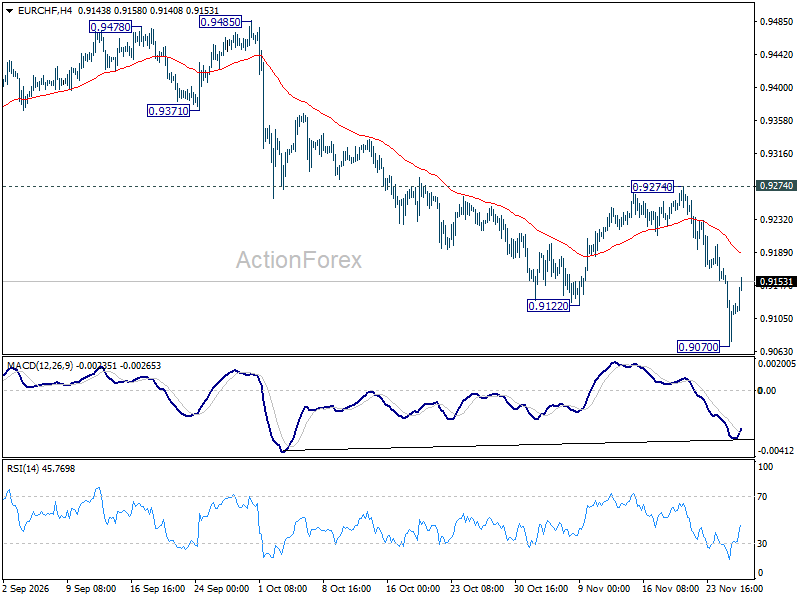
EUR/CHF’s decline from 0.9485 resumed this week and extended to 0.9070, before staging a notable recovery from the new low.
Current development suggests that some consolidation could emerge above 0.9070 first, with scope for a stronger short-term rebound as risk aversion eases.
Nevertheless, the near-term outlook will remain bearish as long as 0.9274 resistance holds. Recovery below this level would still be consistent with consolidation within the broader decline rather than a confirmed bullish reversal.
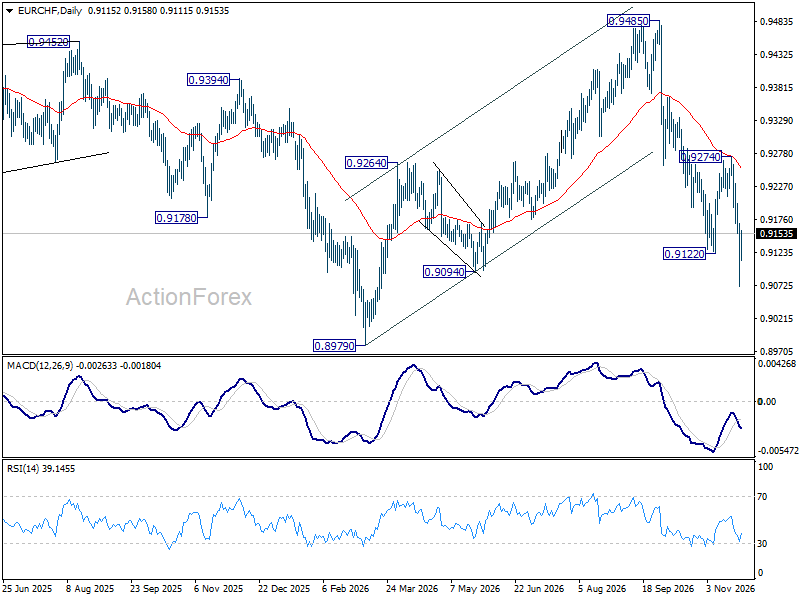
On the daily chart, prior rejection by the falling 55-day EMA reinforces the bearish outlook. The decline from 0.9485 is seen as reversing the entire advance from 0.8979 to 0.9485. Upon resumption, the next objective would be a retest of 0.8979.
However, firm break above 0.9274 would suggest that the decline from 0.9485 has completed. This would raise the possibility that the broader pattern from 0.8979 has entered its third leg as a rise. Subsequent break below 0.8979 would invalidate that interpretation.
For now, the outlook remains sensitive to broader risk sentiment. A sustained recovery in equities accompanied by EUR/CHF strength would reinforce the safe-haven unwinding scenario, while renewed CHF gains despite improving risk appetite would point toward a larger role for Swiss-specific factors and relative policy expectations.
With US markets returning to normal trading on November 30, followed by SNB’s December 10 meeting and ECB’s December 17 decision, the coming weeks should provide further evidence of whether the Franc’s recent strength is primarily a temporary response to market stress or the beginning of a more persistent repricing.
Key Takeaways
- EUR/CHF fell from 0.9485 to a low of 0.9070 before recovering to around 0.9153, driven mainly by Swiss Franc strength, since EUR/USD was virtually unchanged over the week while EUR/CHF and USD/CHF both fell about 1.1%.
- Risk aversion (Nasdaq about −3.7%, KOSPI −7.4%, VIX nearly +17%) explains the move better than rates, and CHF reversed part of its gains when European stocks rebounded on Thursday.
- The ECB–SNB tightening gap narrowed from about 20bps to about 16bps for December and from 13bps to about 4bps by September 2027, but this is a supporting factor, not the main driver.
- The ECB remains hawkish, with a large number of policymakers able to support an October hike, while Swiss CPI rose from 1.0% to 1.5% yoy and SNB tightening pricing increased slightly.
- EUR/CHF stays bearish below 0.9274, with 0.8979 as the next objective, and the December 10 SNB and December 17 ECB decisions are the next tests.
Stay ahead of EUR/CHF and the SNB and ECB decisions in December—join the ActionForex Telegram channel for regular market updates and analysis.
What A Rising VIX Means For Pension Funds
Wall Street’s latest selloff has moved beyond a technology-sector wobble and become a broad market event. The Nasdaq C... Read more
Behaviour Cannot Fix A Portfolio Construction Flaw
A Retiree Shouldn't Be Asked to Behave Their Way Out of a Portfolio Construction Problem Why behavioural coaching shoul... Read more
Behavioural & Retirement Portfolio Resilience
Behavioural Survivability and Retirement Portfolio Resilience Why the lived experience of market recovery matters as mu... Read more
Australia's Rate Rise Bites: Highest In 15 Years
The Reserve Bank of Australia has lifted interest rates to their highest level since 2011, and its governor admits the w... Read more
October Retirement Portfolio Resilience Assessment
Markets stabl Read more