

CAD Leads Major Currencies As BoC Hike Bets Surge — USD/CAD Turns Lower

TL;DR: Canadian Dollar is leading the major currencies as markets rapidly price in another BoC hike for December, pushing USD/CAD lower as Canadian yields rise. Macklem’s speech accelerated the repricing without committing to a December move, so whether USD/CAD’s slide is a short-term correction or a larger reversal depends on whether the pair breaks decisively below its daily 55-period EMA, currently near 1.4130.
Why Is Canadian Dollar Leading Major Currencies While USD/CAD Turns Lower?
Canadian Dollar has emerged as the strongest major currency this week so far, supported by a sharp increase in market expectations for another Bank of Canada rate hike in December. CAD is outperforming all seven other major currencies on both daily and weekly comparisons, while USD/CAD has retreated as Canadian bond yields rise. The shift in monetary policy expectations was already underway before Governor Tiff Macklem’s Tuesday speech, but accelerated further during the day as he highlighted persistent inflation risks. The combined developments have reinforced CAD buying and triggered a short-term bearish reversal in USD/CAD.
BoC December Tightening Pricing Climbs Sharply
The scale of the repricing has been substantial. OIS data indicate that markets were pricing approximately 46% of a 25bps BoC increase for December 9 early Monday, rising to 62% by early Tuesday. Pricing subsequently climbed to 84% during Tuesday and reached 86% early Wednesday, equivalent to around 22bps of tightening now priced for December.
- Early Monday: about 46% of a 25bps hike priced for December 9
- Early Tuesday: 62%
- During Tuesday: 84%
- Early Wednesday: 86%, equivalent to about 22bps of tightening
The progression shows that expectations were already shifting toward another increase before Macklem’s remarks, although more than half of the overall repricing occurred during Tuesday’s trading. The Governor’s speech was therefore part of a broader adjustment in monetary policy expectations rather than the sole explanation for the move.
CAD’s strength has been broad-based. ActionForex currency heat maps show it leading all major currencies on both daily and weekly measures, with particularly strong gains against several European and commodity currencies. USD/CAD has fallen from around 1.4324 to 1.4265 since Tuesday afternoon GMT, while other major Dollar pairs have changed comparatively little. Canada’s 10-year government bond yield also rose nearly 4bps over the same period, consistent with firmer domestic interest rate expectations.
The combination of broad currency outperformance and higher Canadian yields suggests that BoC repricing is an important contributor to CAD’s recent strength, rather than the move being driven primarily by general USD weakness.
Follow USD/CAD and Bank of Canada rate expectations on the ActionForex Telegram channel.
Macklem Highlights Inflation Persistence Without Committing to December
Speaking at the Economic Club of Canada on Tuesday, BoC Governor Tiff Macklem warned that second-round effects from earlier cost increases would add to inflation persistence.
He noted that businesses have so far absorbed much of the increase in their costs, but historical experience and business surveys suggest that more of those pressures could be passed through to customers over the coming year.
Macklem also acknowledged that the Canadian economy has demonstrated greater resilience than the Bank previously expected. He described October’s rate increase as reflecting both more persistent inflation pressures and somewhat stronger economic performance.
These observations reinforce the case for maintaining a restrictive policy stance while inflation remains elevated.
However, the speech was not an explicit signal of another December hike. Macklem also indicated that inflation might finish the year somewhat below the Bank’s October forecast of around 3.5%, providing a counterweight to his warnings about persistence.
His remarks therefore presented a two-sided assessment: underlying inflation risks remain important, but the near-term price outlook may be slightly less severe than previously projected.
The market nevertheless moved further toward pricing another December increase during the same trading day, while CAD strengthened across the currency complex.
The next immediate test will come from Wednesday’s US October PCE inflation, personal income and revised third-quarter GDP releases. These could influence USD/CAD through changes in US interest rate expectations, independently of the Canadian policy outlook.
For CAD, the more important question is whether December BoC tightening pricing can remain near its current level ahead of the December 9 decision.
ActionForex’s Technical View: USD/CAD, Short-Term Top at 1.4383
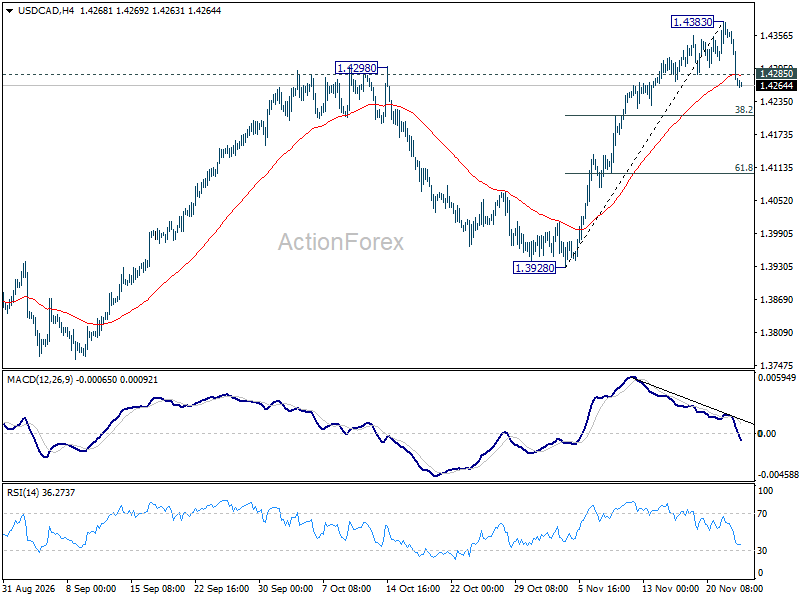
USD/CAD’s extended decline this week and break of 1.4285 minor support suggest short-term topping at 1.4383, supported by bearish divergence in the 4-hour MACD.
A deeper retreat is mildly favored toward the 38.2% retracement of 1.3928 to 1.4383 at 1.4209, with scope for further weakness.
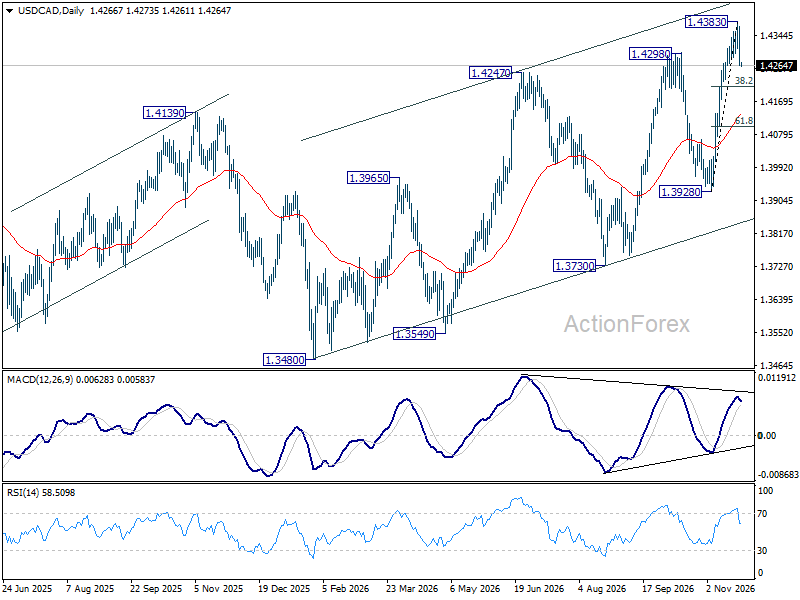
However, strong support is likely around the 55-day EMA, currently near 1.4130, which could contain the downside and trigger a rebound.
A move above 1.4383 would invalidate the immediate topping scenario and extend the larger rally from 1.3480 toward 1.4791, the 2025 high.
Larger Recovery from 1.3480 Remains Technically Uncertain
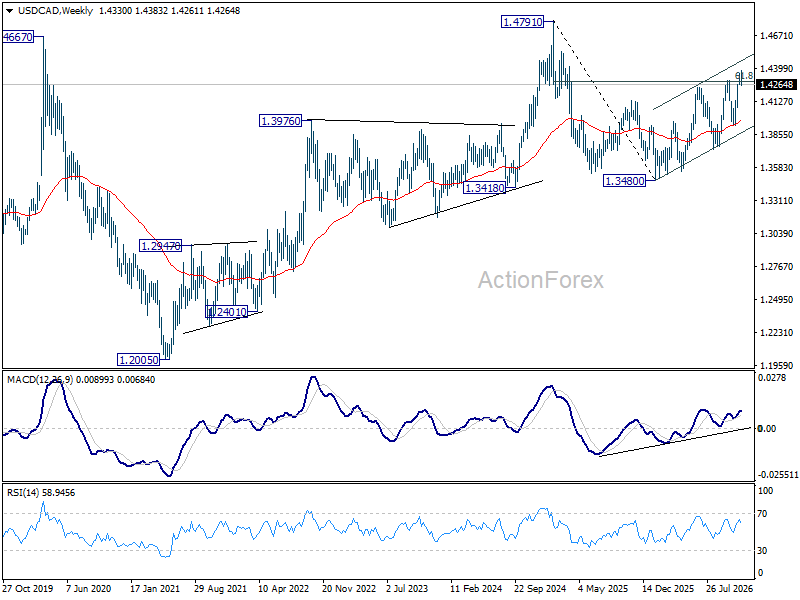
The broader technical outlook requires more caution. Although USD/CAD has recovered substantially from 1.3480, the advance is not clearly impulsive. Instead, it appears more likely to represent the second leg of a corrective pattern originating from 1.4791.
This distinction matters because the current retreat could initially remain a correction within the recovery, without confirming that the entire advance from 1.3480 has ended.
A sustained break below the daily 55-period EMA would provide the first indication that the rise from 1.3480 has completed. A subsequent break of 1.3928 support would strengthen that interpretation and bring the 1.3480 low back into focus.
Conversely, a recovery through 1.4383 would indicate that the near-term correction has ended and revive the prospect of a further advance toward 1.4791.
For now, CAD’s broad strength and the sharp repricing of BoC tightening expectations favor further near-term USD/CAD weakness. However, the distinction between a short-term correction and a larger bearish reversal will depend on whether the pair breaks decisively below its daily moving-average support.
With significant US economic data due Wednesday and the BoC decision approaching on December 9, both sides of the exchange rate face further tests before the medium-term direction becomes clearer.
Key Takeaways
- CAD is the strongest major currency, outperforming all seven peers on daily and weekly measures, as OIS pricing for a December 9 BoC hike rose from about 46% early Monday to 86% (around 22bps) early Wednesday.
- Macklem warned of second-round inflation effects but did not signal a December hike, and said inflation might finish the year below the Bank’s October forecast of around 3.5%.
- USD/CAD fell from around 1.4324 to 1.4265 since Tuesday afternoon GMT, while Canada’s 10-year yield rose nearly 4bps.
- USD/CAD has broken 1.4285 and is mildly favored toward 1.4209, with strong support likely at the daily 55-period EMA near 1.4130. A decisive break below it would be the first sign that the rise from 1.3480 has completed, while a move above 1.4383 would invalidate the topping scenario.
- Wednesday’s US PCE, personal income and revised GDP data, and whether BoC pricing holds ahead of December 9, are the next tests.
Stay ahead of the BoC’s December decision and USD/CAD’s next move—join the ActionForex Telegram channel for regular market updates and analysis.
What A Rising VIX Means For Pension Funds
Wall Street’s latest selloff has moved beyond a technology-sector wobble and become a broad market event. The Nasdaq C... Read more
Behaviour Cannot Fix A Portfolio Construction Flaw
A Retiree Shouldn't Be Asked to Behave Their Way Out of a Portfolio Construction Problem Why behavioural coaching shoul... Read more
Behavioural & Retirement Portfolio Resilience
Behavioural Survivability and Retirement Portfolio Resilience Why the lived experience of market recovery matters as mu... Read more
Australia's Rate Rise Bites: Highest In 15 Years
The Reserve Bank of Australia has lifted interest rates to their highest level since 2011, and its governor admits the w... Read more
October Retirement Portfolio Resilience Assessment
Markets stabl Read more