

AUD Faces Asymmetric CPI Downside Risk As RBA Rate-Cut Expectations Shift — AUD/JPY Eyes Further Fall

TL;DR: Australian Dollar is stabilizing after last week’s selloff, but the risks ahead of Australia’s October CPI look skewed to the downside, because little easing is priced and a soft reading could bring the first RBA cut forward. That leaves AUD/JPY vulnerable to further falls unless it can recover the 108.52–108.62 resistance area.
Is Aussie’s Rebound Just a Pause Before a Soft CPI Brings Rate Cuts Closer?
Australian Dollar is digesting last week’s heavy losses, trading firmer against all major currencies on Monday as markets await Wednesday’s October CPI release. Despite the stabilization, the balance of risks ahead of the inflation data appears skewed to the downside. Australia’s disappointing employment report has already triggered a fundamental shift in RBA expectations, from a small possibility of further tightening toward eventual rate cuts. With little near-term easing currently priced, a soft inflation reading could bring forward the expected timing of the first cut more substantially than a firm reading would push it back.
At the time of writing, AUD/USD is up 0.27% at 0.6638, while AUD/JPY has gained 0.57% to 105.56. Aussie is also firmer against New Zealand Dollar, Canadian Dollar, Euro and Sterling. However, these gains follow a week in which Australian Dollar was the weakest major currency. Monday’s advance is therefore better viewed as consolidation following the recent selloff rather than evidence of a sustained recovery.
Follow AUD/JPY and the RBA rate-cut outlook on the ActionForex Telegram channel.
Employment Shock Shifts RBA Debate from Further Hikes to First Cut
RBA’s November rate hike brought the cash rate to 4.85%, with the decision supported by a 6–3 vote. Although markets subsequently retained a small possibility of additional tightening, Australia’s October employment report fundamentally altered that outlook.
Employment fell by 43,500, while unemployment rose to 4.9%, reinforcing concerns that restrictive monetary policy was weighing on economic activity. The disappointing figures prompted markets to abandon the remaining expectation of further hikes and move toward pricing eventual easing.
The cash rate of 4.85% now appears to represent the peak of the current tightening cycle in market expectations. The central question has shifted from whether RBA will raise rates again to when it will begin cutting.
Nevertheless, the expected easing timetable remains relatively distant. OIS-implied pricing currently indicates only around 1.2bps of cuts for the December 8 meeting, with approximately 37bps of net easing expected over the following 12 months.
- Cash rate: 4.85% after November’s 6–3 vote hike
- October employment: −43,500; unemployment rate 4.9%
- OIS pricing: about 1.2bps of cuts for December 8; about 37bps of net easing over 12 months
The October employment report has therefore completed the first major repricing, but Wednesday’s CPI could determine whether a second adjustment follows. With almost no easing priced for December, a sufficiently soft inflation reading could encourage markets to bring forward the first cut. Conversely, a firm reading would largely reinforce expectations that RBA will maintain restrictive rates for longer, without necessarily reviving the prospect of additional tightening.
This creates a potential asymmetry in the scale of policy repricing, although it does not establish that a downside inflation surprise is more likely.
October CPI: Trimmed Mean Inflation Holds the Key
Australia’s headline CPI accelerated from 4.0% to 4.3% yoy in September, while trimmed mean inflation rose to 3.6%. Wednesday’s October figures will provide an important test of whether underlying price pressures are becoming more persistent or approaching a turning point.
Westpac forecasts headline inflation to rise 0.41% mom to 4.8% yoy, which it expects to mark the peak. Much of the anticipated increase reflects higher fuel costs, with automotive fuel prices projected to jump 8.2% mom and transport contributing around 0.35 percentage points to monthly inflation.
- Headline CPI (Westpac forecast): +0.41% mom, 4.8% yoy, expected to be the peak
- Fuel: automotive fuel prices projected +8.2% mom; transport adds about 0.35 percentage points
- Trimmed mean (Westpac forecast): +0.42% mom, 3.7% yoy
The more consequential figure for RBA expectations will be trimmed mean CPI, which Westpac forecasts to increase 0.42% mom and 3.7% yoy. Although the bank sees risks to its October forecasts as slightly tilted to the upside, it expects underlying monthly inflation to moderate to around 0.2% in both November and December. Its assessment is that the recent acceleration in trimmed mean inflation has been driven substantially by supply-side pressures that could eventually subside.
Against this backdrop, a trimmed mean increase around 0.3% mom or lower would provide a potential catalyst for markets to bring forward expected RBA cuts. Such a reading would suggest underlying inflation is moderating sooner than anticipated, reinforcing the message from weakening employment and business activity.
By contrast, a reading around 0.4% or higher, broadly consistent with Westpac’s forecast, would provide less reason for an immediate adjustment toward easing. A stronger outcome accompanied by persistent services-related inflation could challenge expectations that price pressures are approaching a peak, potentially delaying the anticipated first cut.
The risks are not one-sided. Westpac’s forecast carries a slight upside bias, while RBA’s recent rate hike demonstrates its continued concern about inflation. Even a softer monthly reading would need to be assessed against the broader inflation trend before policymakers could confidently shift toward easing.
Weakening Business Activity Reinforces the Case for Eventual Cuts
Australia’s latest business surveys add weight to concerns that economic activity is deteriorating under restrictive monetary conditions.
November’s flash PMI Composite fell from 48.2 to 46.1, its lowest reading since August 2021. PMI Services declined from 48.5 to 46.2, while PMI Manufacturing slipped from 49.6 to 48.7. Private sector output contracted at its fastest pace in more than five years, with weakness spreading across both major sectors.
- PMI Composite: 48.2 to 46.1, lowest since August 2021
- PMI Services: 48.5 to 46.2
- PMI Manufacturing: 49.6 to 48.7
The deterioration was particularly evident in demand. New orders fell for the first time in five months and at their fastest pace since August 2021, while export orders also contracted. Employment declined for the second time in three months, and business confidence weakened to a three-year low.
There were also tentative signs of easing inflation pressure. Input cost inflation moderated for the first time in four months, while firms raised selling prices more slowly. However, both measures remained above their historical averages, indicating that weakening demand has yet to eliminate persistent price pressures.
Despite the weak PMI results, OIS-implied RBA rate expectations showed virtually no immediate adjustment. The amount of net easing priced over the following 12 months stood at approximately 37.3bps before the release and 37.1bps afterward.
This limited reaction suggests that the deterioration in business activity alone was insufficient to trigger further policy repricing. Wednesday’s CPI could therefore be more decisive. If underlying inflation begins to moderate alongside weakening employment and demand, markets may become more confident that RBA can begin easing sooner. If inflation remains stubborn, the central bank could face a prolonged period of weak activity without sufficient room to cut.
Equity Weakness Provides a Second Downside Risk
Deteriorating risk sentiment presents another potential challenge for Australian Dollar, separate from domestic monetary policy expectations.
Friday’s Wall Street selloff saw S&P 500 fall 3.70% and Nasdaq plunge 5.28%, while VIX surged to 35.90. Selling pressure has persisted in parts of Asia on Monday, with South Korea’s KOSPI down 3.53% and Hong Kong’s Hang Seng losing 0.64% at the time of writing.
Nevertheless, AUD’s gains against all major currencies indicate that regional equity weakness has not translated into renewed currency selling during Monday’s session.
A further acceleration in equity losses could reinforce any CPI-driven AUD decline. Conversely, stabilization in risk sentiment could help cushion the currency even if Australian interest rate expectations become less supportive.
ActionForex’s Technical View: AUD/JPY, Bearish Below 108.62 With 101.30 Next
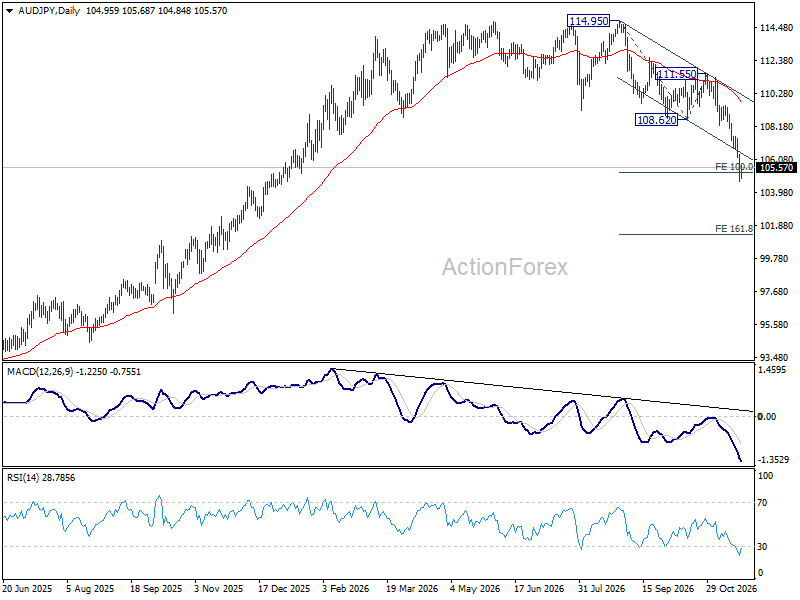
AUD/JPY’s fall from 114.95 accelerated lower last week and met the 100% projection of 114.95 to 108.62 from 111.55 at 105.22.
Oversold conditions in daily RSI might stabilize the selloff temporarily and allow some consolidation. However, the near-term outlook will remain bearish as long as 108.62 support-turned-resistance holds.
On further decline, the next target is the 161.8% projection at 101.30. A softer-than-expected October trimmed mean CPI reading could provide a catalyst for renewed downside momentum if it prompts markets to bring forward the expected timing of RBA easing.
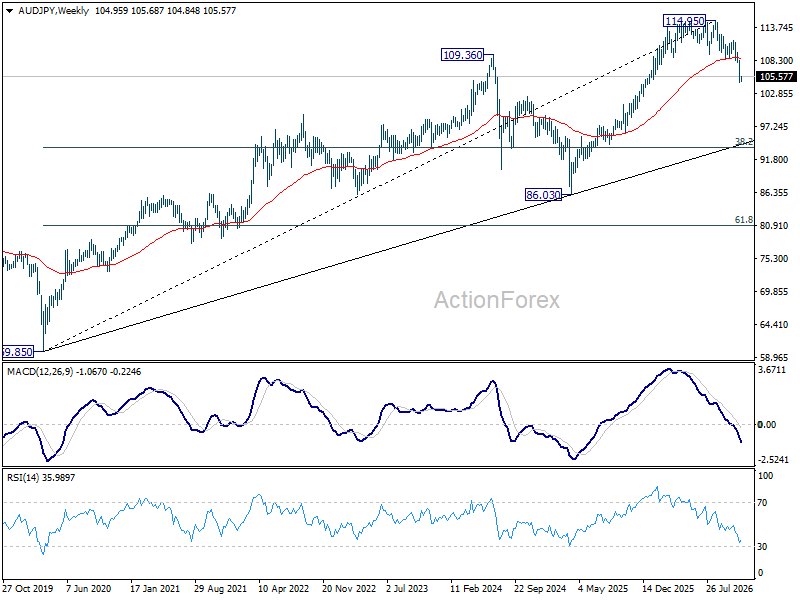
The larger question is whether AUD/JPY’s fall from 114.95 represents a correction of the rise from 86.03 only, or a larger-scale correction of the entire uptrend from the 2020 low at 59.85.
Downside risk will persist as long as the 55-week EMA, currently around 108.52, caps recovery. This moving average closely aligns with the 108.62 former support level on the daily chart, creating an important resistance area.
Any further downside acceleration could push AUD/JPY toward the 38.2% retracement of 59.85 to 114.95 at 93.90 before a durable bottom develops.
With the current tightening cycle increasingly viewed as having peaked, Wednesday’s CPI will help determine whether markets have sufficient evidence to accelerate expectations for the first RBA cut. A soft reading could reinforce AUD/JPY’s bearish technical structure, while firm underlying inflation and stabilizing risk sentiment would make a near-term consolidation more likely. A sustained recovery above the 108.52–108.62 resistance area would be needed to materially improve the technical outlook.
Key Takeaways
- October employment fell 43,500 and unemployment rose to 4.9%, shifting the RBA debate from further hikes at the 4.85% cash rate to when cuts begin.
- OIS pricing shows only about 1.2bps of cuts for December 8 and about 37bps over 12 months, so a soft CPI could bring the first cut forward more than a firm one would push it back.
- Westpac forecasts October trimmed mean CPI at 0.42% mom and 3.7% yoy; a reading near 0.3% mom or lower would be the downside catalyst.
- PMI Composite fell to 46.1, its lowest since August 2021, yet RBA pricing barely moved, leaving CPI as the more decisive event.
- AUD/JPY stays bearish below 108.62 (55-week EMA near 108.52), with 101.30 and then 93.90 as downside targets.
Stay ahead of Australian CPI and the next move in AUD/JPY—join the ActionForex Telegram channel for regular market updates and analysis.
What A Rising VIX Means For Pension Funds
Wall Street’s latest selloff has moved beyond a technology-sector wobble and become a broad market event. The Nasdaq C... Read more
Behaviour Cannot Fix A Portfolio Construction Flaw
A Retiree Shouldn't Be Asked to Behave Their Way Out of a Portfolio Construction Problem Why behavioural coaching shoul... Read more
Behavioural & Retirement Portfolio Resilience
Behavioural Survivability and Retirement Portfolio Resilience Why the lived experience of market recovery matters as mu... Read more
Australia's Rate Rise Bites: Highest In 15 Years
The Reserve Bank of Australia has lifted interest rates to their highest level since 2011, and its governor admits the w... Read more
October Retirement Portfolio Resilience Assessment
Markets stabl Read more