

Israeli Finance AI Firms Court Foreign Banks As Capital Chases Cyber
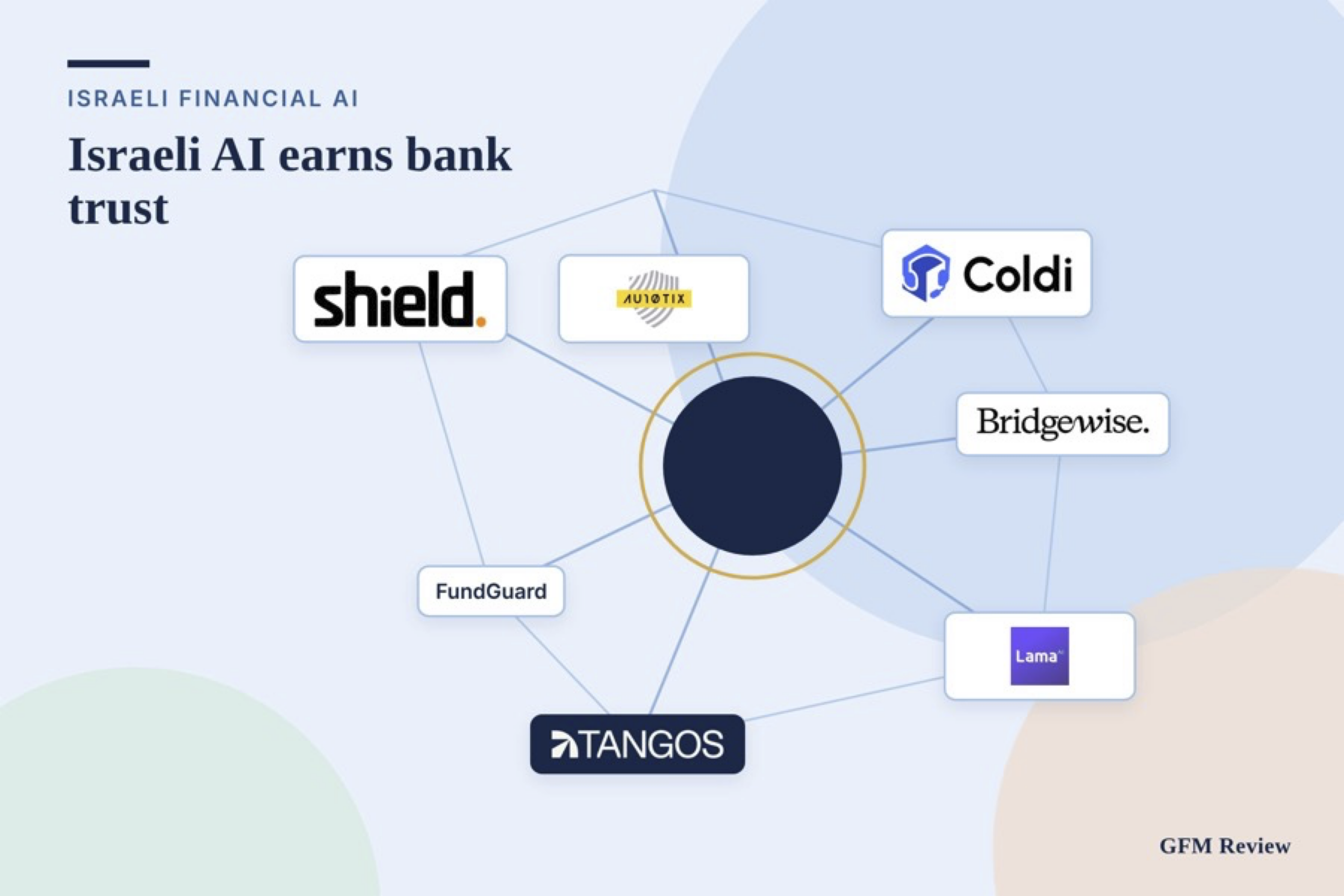
Israeli start-ups have already raised more in 2026 than in the whole of 2025, but little of the money is reaching AI built for banks. The firms selling to lenders, asset managers and compliance teams are leaning on partnerships, client wins and senior hires to build credibility abroad.
Israel's technology investors are having a strong year, but the money is not spreading evenly. Private Israeli technology companies raised $11.9bn in the first ten months of 2026, according to IVC-LeumiTech data reported by Globes, already more than the $10.7bn raised in the whole of 2025. Most of the largest cheques have gone to cybersecurity and AI security. For the smaller group of Israeli firms that build artificial intelligence for banks, asset managers and compliance departments, growth is coming from a different direction: integrations, client wins and experienced hires from the institutions they hope to sell to.
That distinction matters. A firm asking a bank to let software analyse its customers' portfolios, draft its credit memos or monitor its traders needs something capital alone cannot buy: the confidence of risk committees and regulators.
Where the money went
October illustrated the pattern. Globes counted more than $900m raised by Israeli start-ups in the month, led by cloud security company Upwind at $400m. Capitolis, a capital markets technology company whose backers include Citi, Bank of America and UBS, was the only fintech among the largest rounds, with $220m. Even that figure needs unpacking.Finance Magnates reported that it combined a $120m Series E led by Citi with about $100m of debt, raised to fund a $200m purchase of securities lending business eSecLending.
The broader data point the same way. Preliminary LeumiTech and IVC figures published in September put cybersecurity at 38 per cent of the year's funding to that point. Maya Eisen Zafrir, chief executive of LeumiTech, cautioned that "growth is uneven: deal numbers remain relatively low". The totals also need perspective. Israeli private tech funding peaked at $25.6bn in 2021 and fell to $6.9bn in 2023, so this year's recovery restores activity without returning to the peak.

Israeli private tech funding, US$ billions. Source: Globes, IVC-LeumiTech data, 1 October and 1 November 2026; the 2026 figure covers January to October and includes Globes' own October tally.
Selling credibility, not only code
Bridgewise, which supplies investment research AI that banks and brokers embed in their own apps, said on 11 November that Emirates NBD had added its market insights to the ENBD X digital banking platform, starting with a limited group of customers. Emirates NBD is also an investor through its innovation fund, and Bridgewise holds a licence in the Dubai International Financial Centre. FinTech Global reported that its technology is used by more than 100 financial institutions.
Lama AI is pursuing US community and regional banks. In June it raised a $12m Series A led by EJF Ventures, taking total funding above $20m, and on 3 November it announced a partnership with Tax Guard to bring verified IRS tax transcripts into its AI loan origination workflow. The tie-up targets a practical bottleneck: lenders cannot rely on automated credit analysis unless the underlying records are verified.
In asset management, FundGuard said in October that Meeder Investment Management, which reports more than $190bn of assets under advisement, will replace its legacy fund accounting system with FundGuard's cloud platform. Mondrian Investment Partners chose the company in February. Citi and State Street are listed as strategic partners, which gives a young vendor useful standing when it asks a manager to move its books of record.
Hiring the buyer's experience
Compliance technology shows a second route to credibility: recruiting people who once ran the functions being automated.
Tangos, which builds AI to carry out financial crime investigations, raised a $20m seed round led by Red Dot Capital Partners in July, when it had about 20 staff in Israel. In October it named Oonagh van den Berg, who previously worked at HSBC and Citi and founded the RAW Compliance community, as chief evangelist.
Shield, whose platform captures and monitors employee communications for signs of market abuse, hired Michelle Clark, formerly HSBC's global head of communications surveillance capability, in October. The company says it ingests more than 5.5 million communications a day. AU10TIX, an identity verification provider, appointed Nadav Atar, who spent about 12 years at PayPal, as vice president of product as it extends beyond one-off identity checks. "As fraud grows more sophisticated, our customers need more than a point-in-time identity check," said chief executive Yair Tal.
At the earlier end, Coldi, which runs AI voice agents for brokers, insurers, digital banks and collections firms, is raising a $2m seed round, CTech reported on 1 November. It had raised $500,000, employed 15 people and launched a Hebrew-language service in September.
The regulatory pull
Much of the demand behind these products is regulatory. US regulators fined financial firms more than $2.5bn for failing to keep records of staff communications between December 2021 and August 2023, and TD Bank's guilty plea in 2024 over anti-money laundering failures cost it more than $3bn. Penalties on that scale moved surveillance, investigations and identity checks from back-office cost to board-level risk.
That pressure is not moving in one direction. In May, SEC chair Paul Atkins sharply criticised the off-channel communications enforcement campaign, which may soften one source of US demand. In Europe, lawmakers have moved to delay the AI Act's obligations for stand-alone high-risk systems, a category that includes credit scoring, from August 2026 to December 2027, subject to Council approval. Delay gives vendors more time to prepare, but it also gives buyers less urgency.
A home market in motion
The domestic market is shifting too. On 10 November the Bank of Israel granted Revolut a conditional banking licence, the third new bank licence since 2019, although Revolut cannot yet serve customers and must first meet milestones. In September US lender Valley National agreed to buy Bluevine, a small business banking platform with research and development staff in Tel Aviv, for about $340m, describing the deal as an accelerator for its digital and AI strategy. Completion is expected in early 2027.
Both developments show that foreign institutions value Israeli financial technology. For most of the firms above, though, the larger buyers sit abroad.
What remains uncertain
Partnerships and hires are signals, not revenue. Emirates NBD's rollout began with a limited group of customers, Coldi's round has not closed, and the efficiency gains that vendors advertise are their own claims. The Israel Innovation Authority has also warned of strain in the sector, including a fall in research and development employment.
The test over the next year is conversion. Watch whether the wider ENBD X rollout proceeds, whether FundGuard's new clients go live on schedule, and whether compliance AI vendors can give regulators audit trails that explain how their systems reach decisions. Capital is likely to follow evidence that banks are paying for production use rather than pilots.
Insurance AI Moves From Pilots To Production As Buyers Demand Proof
AI specialists took 83.2 per cent of InsurTech funding in the third quarter, and Guidewire has agreed to pay up to $2.1b... Read more
People Power: Building The Future Of Insurance One Career At A Time
The insurance industry is at a pivotal point. As emerging technologies reshape underwriting, claims processing, and cust... Read more
Private Equity's Great Divide: Is The Future Insurance-Funded Or Fee-Driven?
A fundamental shift is taking place at the top of the private equity industry. While firms like Blackstone remain commit... Read more
Japan's Next Battleground: The Insurance Sector Under Activist Pressure
Farallon’s push at T&D Holdings marks a shift in focus for activist capital targeting Japan’s untapped insurance... Read more
Cover And Conflict: Tensions Rise Between Insurers And Litigation Funders
Burford’s clash with Chubb signals a deeper rift in the legal-financial ecosystem A high-profile dispute between li... Read more
Underwater And Uninsured: How Climate Risk Is Reshaping The US Mortgage Market
As climate change intensifies, its effects are no longer confined to coastlines or news reports on extreme weather. In t... Read more