


When a property qualifies as business real property, two key opportunities become available to self-managed super fund (SMSF) trustees. Both depend on the property meeting the requirements explained below.
SMSF trustees are usually prohibited from acquiring assets from fund members or the fund’s related parties. This applies both when the SMSF purchases an asset and when an asset is transferred into the fund as a contribution rather than contributed as cash, known as an in-specie contribution.
Where a property meets the requirements to be business real property, and the transaction is carried out at market value and on arm’s-length terms, an exception to the related-party asset acquisition rule applies.
This allows members of an SMSF to move existing business property that they may own personally, or through other entities like trusts or companies, into their SMSF. This could potentially provide significant tax benefits around the receipt of ongoing rental income and on any future capital gain when the property is sold.
The in-house asset rules contained within superannuation legislation restrict the leasing of super fund assets to related parties of the fund. This is done by applying a 5% limit on the total value of fund assets that are leased to related parties.
However, business real property is excluded from the in-house assets test which means a related party can lease these premises from the SMSF without the need to factor in the 5% limit.
What is business real property?
Business real property refers to freehold or leasehold land that is used wholly and exclusively in carrying on a business.
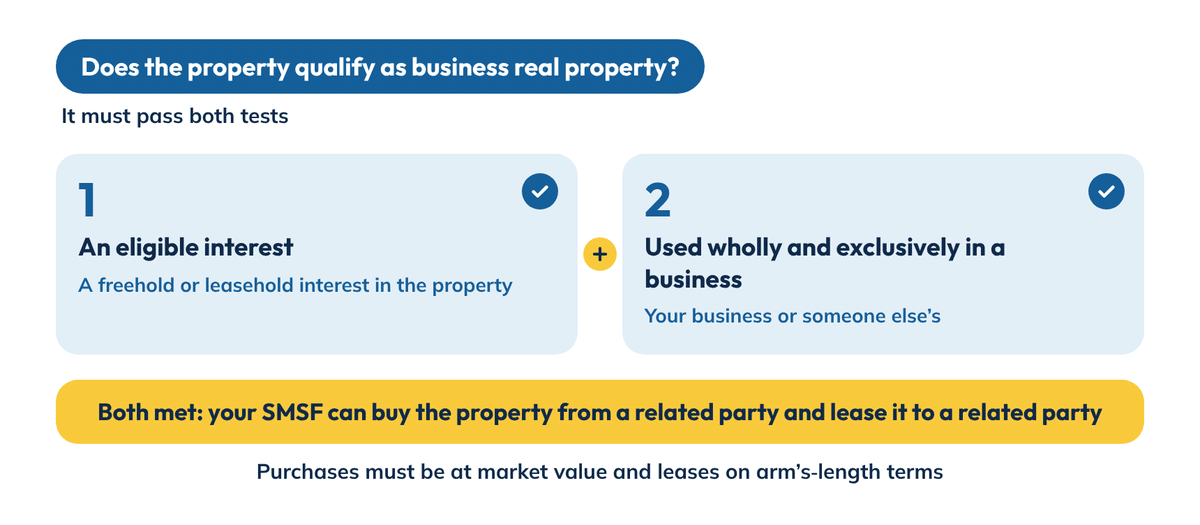
The superannuation legislation provides the following definition:
“Business real property”, in relation to an entity, means:
(a) any freehold or leasehold interest of the entity in real property; or
(b) any interest of the entity in Crown land, other than a leasehold interest, being an interest that is capable of assignment or transfer; or
(c) if another class of interest in relation to real property is prescribed by the regulations for the purposes of this paragraph–any interest belonging to that class that is held by the entity; where the real property is used wholly and exclusively in one or more businesses (whether carried on by the entity or not) but does not include any interest held in the capacity of beneficiary of a trust estate.
When applying the business real property test, we need to look at the underlying land and for what that land is being used. Examples of business real property might include:
- A commercial office space used by a professional to run their business
- A warehouse or factory used entirely in a business
- A rural property on which a primary production or farming enterprise is carried out.
It is important to note that the business use of the property is not limited to businesses owned or operated by the SMSF members. The property could be used by an unrelated party in their business and still meet the requirements to be business real property.

Access practical, independent guides and checklists to help you run your fund with confidence with a free SuperGuide account.
Find out moreWhen residential property meets the brief
A common misconception is that only commercial property can qualify as business real property. This is not always the case.
For residential property, the key question is how the property is used, not simply whether it is described as residential. It can meet the requirements to be business real property when both of the following conditions are met:
- There needs to be an eligible interest in real property, being either a freehold or leasehold interest
- The property must be used ‘wholly and exclusively’ in one or more businesses.
Examples of when residential property could meet these conditions include:
- A residential property used wholly and exclusively by a doctor as their surgery
- A residential property used wholly and exclusively as a real estate agent’s office
- A block of land owned by a property developer currently being held for a future development
- Where the property is one of many other residential properties owned and operated as part of a property management or property investment business.
The following example from the ATO SMSF ruling on business real property illustrates how the scale, repetition and purpose of residential property activities can indicate a property investment business. It explains why Mr Wood’s properties qualify even though his tenants use them as homes.
Benefits worth considering
Owning business real property through an SMSF can offer benefits in several areas: tax treatment, security of business premises, retirement funding, use of business capital and potential protection from creditors. These benefits can be particularly relevant when your own business uses the property.
A tax-effective ownership structure: Super funds receive concessional tax treatment compared to other ownership options. Rental income is usually taxed at a concessional rate of 15% when the property is held in accumulation phase or can be tax free when the super fund is entirely in retirement phase.
Capital gains are also concessionally taxed in a super fund. The rate is 15% in the accumulation phase or a reduced rate of 10% where the property is held for 12 months or more.
Where the super fund is entirely in retirement phase, capital gains are tax free.
Security of lease: When your SMSF owns the property from which you operate your business, you are effectively your own landlord, which can reduce relocation risk often associated with being an unrelated tenant.
Funding your retirement: The rent paid by your business to your SMSF can be used to fund your own retirement.
More effective use of business capital: Money invested in the physical property from which a business operates could instead be used within the business. Rather than having hundreds of thousands of dollars tied up in the premises, that money could fund future growth or provide working capital.
Protection from creditors: Owning assets within super often provides protection from creditors. Having the property ownership separated from the business ownership could, in some cases, provide a level of protection where things go wrong in the business itself.
Risks that need to be considered
Before deciding to hold business real property in an SMSF, trustees need to weigh the potential benefits against the effect on the fund. That assessment needs to cover diversification, cashflow and access to cash, together with the ongoing costs of managing and maintaining the property.
Diversification and cashflow risks: Holding business real property in an SMSF often results in a considerable proportion of the fund assets being invested in the one asset class and, in many cases, the one asset, resulting in a lack of diversification.
Unforeseen tenant vacancies can also strain the fund’s cashflow.
SMSF trustees need to consider both these issues when formulating their overall investment strategy.
Liquidity and divisibility risk: An SMSF that needs access to large amounts of cash quickly can face a liquidity issue when it holds property. Property transactions tend to be slow and usually require an extended period to settle, delaying access to the cash.
Ongoing management and maintenance expenses: Property ownership requires ongoing management. This can be outsourced to professionals but comes with a cost that can eat into profits.
Ongoing maintenance expenses also need to be factored into the SMSF’s cashflow.
Compliance considerations
There are further compliance requirements that need to be considered when holding business real property in your SMSF.
Investment strategy: SMSF trustees need to review and, when needed, update or amend their existing investment strategies when entering into a property purchase.
Valuation requirements: SMSF trustees are responsible for ensuring that the fund’s assets are recorded at market value in its annual financial statements. For direct property assets, trustees may need a professional’s involvement to meet this responsibility.
Arm’s-length dealings: All dealings in relation to the property need to be entered into and maintained on arm’s-length terms, especially when the dealings are with related parties.
The bottom line
The potential benefit of owning business real property in your SMSF needs to be weighed against the risks that often arise, including concentration risk, cashflow pressures, limited access to cash and ongoing property costs.
Trustees also need to ensure that property ownership continues to make sense over time by keeping their investment strategy under review. The key is to consider both what the property offers your business and how it supports the fund’s retirement objectives whilst at all times satisfying the sole purpose test.
Get more guides like this with a free account
Get independent guidance and practical tools to help you manage your SMSF confidently, stay compliant and make informed decisions as a trustee.
Trusted by 5,000+ members · Independent · Ad-free