

NFP Takes Back Seat As Hormuz Clash Keeps Markets On Edge

The US Non-Farm Payrolls report may be today’s headline event on the economic calendar, but markets are behaving as though the real story lies thousands of miles away in the Strait of Hormuz. For much of the past two days, investors had embraced a growing “peace trade,” betting that Washington and Tehran were moving closer to a deal that could end the conflict and fully reopen one of the world’s most critical energy chokepoints. Oil prices plunged, equities surged to record highs, and markets increasingly positioned for a post-conflict normalization phase.
But overnight events served as a reminder that the path toward peace remains highly unstable. Reports emerged that US and Iranian forces exchanged fire directly in the Strait of Hormuz, with both sides accusing the other of triggering the confrontation.
According to US Central Command, three American destroyers — USS Truxtun, USS Rafael Peralta, and USS Mason — intercepted coordinated drone and missile attacks while passing through the Strait late Thursday. Iran, meanwhile, accused Washington of violating the fragile ceasefire by striking multiple targets around the waterway earlier in the day.
The exchange suggests that the current situation is not yet a genuine normalization, but still a highly fragile form of managed confrontation. The deeper disagreement between Washington and Tehran remains unresolved. The core friction is not merely about ending military operations, but about Iran’s nuclear program itself.
Adding to tensions, US President Donald Trump renewed his threat of overwhelming military escalation if Iran refuses to sign the proposed agreement quickly. “Just like we knocked them out again today, we’ll knock them out a lot harder, and a lot more violently, in the future,” Trump warned overnight.
Yet despite the dramatic rhetoric and naval clashes, markets are not fully returning to panic mode. Instead, investors appear stuck between optimism and caution. US stocks only eased modestly overnight after recent record-breaking rallies, while Asian equities traded mildly lower. Major currency pairs also stayed trapped within yesterday ranges. Brent crude rebounded back to $100 after briefly collapsing to $96 yesterday. Gold also remained relatively steady around $4,700.
For the week so far, Kiwi is currently the strongest, followed by Aussie, and then Swiss Franc. Loonie is the worst, followed by Sterling, and then Dollar. Euro and Yen are positioning in the middle.
In Asia, at the time of writing, Nikkei is down -0.47%. Hong Kong HSI is down -1.14%. China Shanghai SSE is down -0.33%. Singapore Strait TImes is down -0.60%. Japan 10-year JGB yield is down -0.002 at 2.481. Overnight, DOW fell -0.63%. S&P 500 fell -0.38%. NASDAQ fell -0.13%. 10-year yield rose 0.03 to 4.39.
Dollar Faces Key NFP Test as Risk Sentiment Threatens Renewed Selloff
Today’s US payrolls report could determine whether the current risk-on rally keeps running. Markets are looking for a “Goldilocks” jobs number—soft enough to ease Fed pressure, but strong enough to avoid recession fears—which may leave Dollar vulnerable to renewed selling. Read More.
Japan Real Wage Growth Extends Gains Despite Slower Nominal Pay Growth
Japan’s real wages rose for a third consecutive month in March, supported by easing inflation and the strongest stretch of base pay growth in more than three decades. Read More.
Japan PMI Services Finalized at 51.0 as Middle East War Fuels Cost Pressures
Japan’s services sector lost momentum in April just as inflation pressures intensified sharply. Rising energy costs linked to the Middle East conflict pushed input prices to a three-and-a-half-year high and selling prices to their steepest increase in nearly two decades. Read More.
USD/CAD Daily Outlook
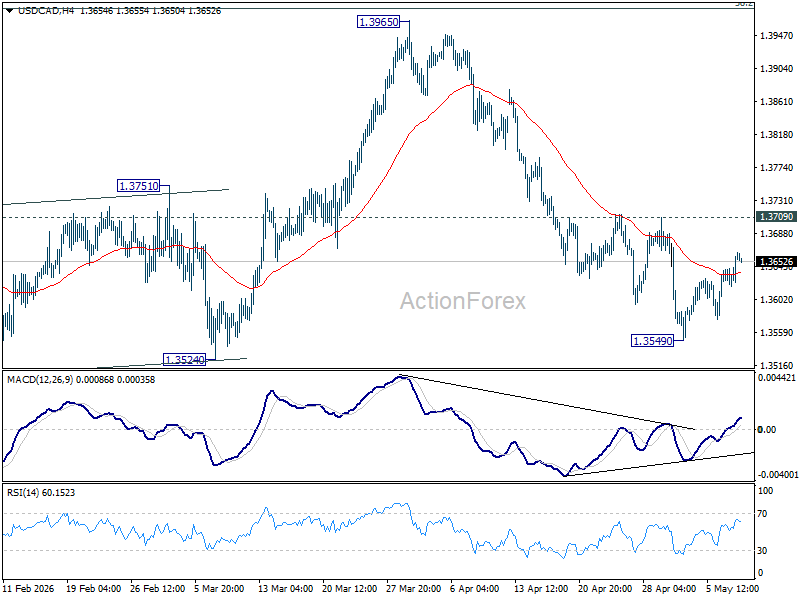
Daily Pivots: (S1) 1.3634; (P) 1.3651; (R1) 1.3683; More…
Intraday bias in USD/CAD remains neutral as consolidations continue above 1.3549. Further decline is expected as long as 1.3709 resistance holds. Below 1.3549 will resume the fall from 1.3965 to retest 1.3480 low. Decisive break there will resume whole down trend from 1.4791. However, firm break of 1.3709 will turn bias back to the upside for stronger rebound.
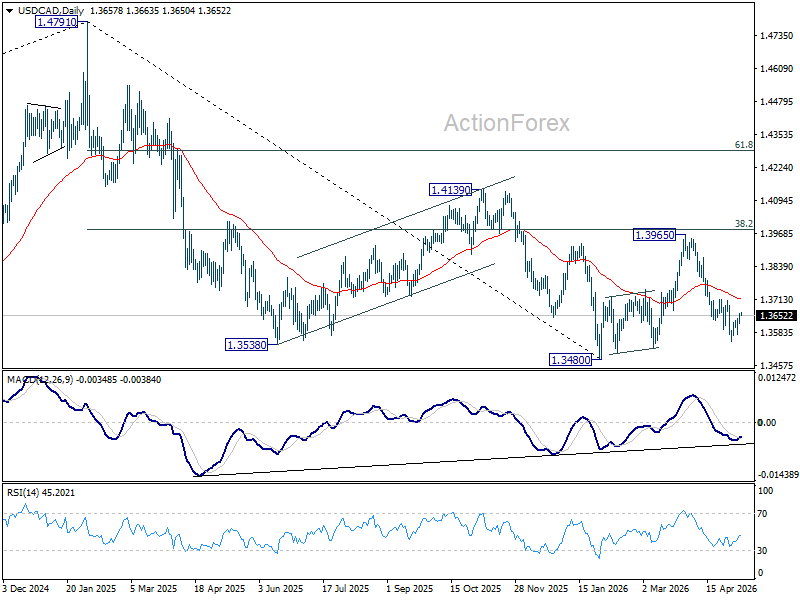
In the bigger picture, price actions from 1.4791 are seen as a corrective pattern to the whole up trend from 1.2005 (2021 low). Deeper fall could be seen, as the pattern extends, to 61.8% retracement of 1.2005 to 1.4791 at 1.3069. However, decisive break of 38.2% retracement of 1.4791 to 1.3480 at 1.3981 will argue that the correction has completed with three waves down to 1.3480 already.
Gyrostat September Retirement Portfolio Resilience Assessment
September Retirement Portfolio Resilience Assessment Markets have fallen. The price of risk has risen. ... Read more
Does The West Have A Problem With Government Bonds
If you have been following the financial pages over the past few weeks, one theme has begun to stand out from the usual ... Read more
August Retirement Portfolio Resilience Assessment
Markets Are Higher. The Price of Risk Is Lower. Retirement invest... Read more
When The Wave Turns
Why Retirement Investing Is Moving Towards Resilience Jeremy Grantham’s latest market warnings have revived an old tru... Read more
Gyrostat Capital Management: July Retirement Portfolio Resilience Assessment
The Market Is Currently Presenting an Opportunity to Strengthen Retirement Portfolio Resilienc... Read more
The Invisible Risk That Decides Your Retirement
Why how investors behave matters more than what markets do and what disciplined port... Read more