

Markets Ignore Geopolitical Risks, Chase AI Rally, And Dump Dollar
Markets spent last week aggressively chasing the AI-driven equity rally while largely ignoring geopolitical tensions in the Middle East. Despite renewed uncertainty over a promised peace deal, stocks surged to new records while Dollar weakened broadly on strong risk appetite. S&P 500 followed NASDAQ to fresh records, while Asia’s major technology-heavy benchmarks exploded higher as well. Japan’s Nikkei, South Korea’s KOSPI, and Taiwan’s TAIEX all surged to new highs as investors doubled down on semiconductor and AI infrastructure themes.
At the same time, the rally underneath the surface was far less broad than headline indices suggested. Traditional industrial and cyclical sectors lagged badly. DOW struggled to break above the 50,000 level, FTSE drifted sideways, and Germany’s DAX actually weakened under the weight of fresh US tariff threats targeting European autos. Investors were not buying “the economy.” They were buying AI.
That distinction is important because it explains the market’s remarkable “geopolitical indifference” throughout the week. Traders appeared willing to ignore Middle East risks unless they directly threatened the AI growth story or caused a full-scale oil shock capable of destabilizing global markets.
Indeed, investors spent much of Thursday and Friday positioning for a potential “peace dividend” after reports suggested Washington and Tehran were discussing a 30-day framework to reopen the Strait of Hormuz. Oil prices fell sharply as traders priced the possibility that commercial shipping could normalize and that Iran might back away from its increasingly aggressive chokepoint strategy.
But reality quickly complicated the optimism. Iranian officials publicly rejected Washington’s timelines for accepting the proposal, while US Central Command confirmed American forces had conducted “self-defense strikes” against Iranian-linked ports after destroyers came under attack in Hormuz.
That disconnect may be the single most important signal from last week. Markets are not reacting to geopolitical instability the way they would earlier in the year. Investors increasingly appear convinced that AI-driven earnings growth and liquidity momentum can absorb almost any macro shock short of outright regional war.
Dollar’s performance captured that shift perfectly. Normally, a week featuring military clashes in Hormuz and a stronger-than-expected US payrolls report would have fueled broad Dollar strength. Instead, the greenback weakened sharply as traders continued rotating into risk-sensitive currencies and equities.
The jobs report itself actually strengthened the bullish macro narrative. April payrolls came in far stronger than expected, confirming that March’s strength was not simply a one-off surprise. At the same time, wage growth remained relatively tame, reinforcing the “Goldilocks” idea that the economy is resilient enough to avoid recession while inflation pressures remain manageable enough for the Federal Reserve to comfortably stay on hold.
That combination effectively removed two major market fears simultaneously: recession panic and hawkish Fed panic. Once those risks faded, investors simply returned to chasing the strongest momentum theme available — AI.
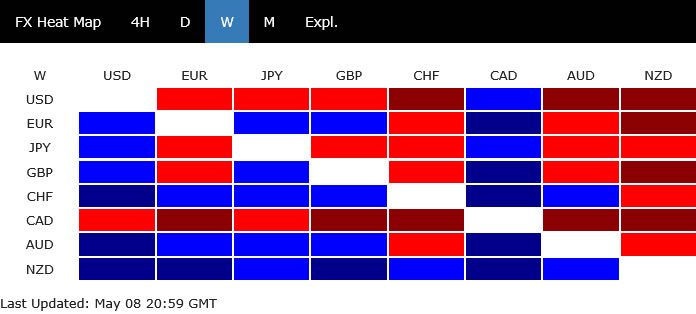
Currency markets reflected that same dynamic. Kiwi and Aussie led gains as Asia’s tech and semiconductor optimism intensified, while Dollar and Yen underperformed amid the broader risk-on environment. Canadian Dollar was hit especially hard as collapsing oil prices and weak domestic labor data undermined the case for Bank of Canada tightening.
The real question now is whether markets have become too comfortable dismissing geopolitical danger altogether. Heading into the weekend, investors are effectively betting that some form of US-Iran agreement will eventually emerge and prevent a full-blown Hormuz catastrophe. For now, traders appear willing to look past the risks and keep chasing the AI-driven rally, leaving Dollar under pressure — at least until those assumptions are proven wrong.
Weekly Currency Performance (May 4 – May 8, 2026)
| Rank | Currency | Performance Driver |
|---|---|---|
| 1 | NZD | Strong risk-on sentiment, AI-led Asia rally |
| 2 | CHF | The odd one out, supported by softer global yields |
| 3 | AUD | Benefited from Asian equity surge and improved risk appetite |
| 4 | EUR | Supported by broad Dollar weakness, capped by tariff concerns |
| 5 | GBP | Neutral performance amid UK political uncertainty |
| 6 | JPY | Intervention effects faded; pressured by risk-on environment |
| 7 | USD | Weakened despite strong NFP as risk appetite dominated |
| 8 | CAD | Hit by oil price decline and weak domestic employment data |
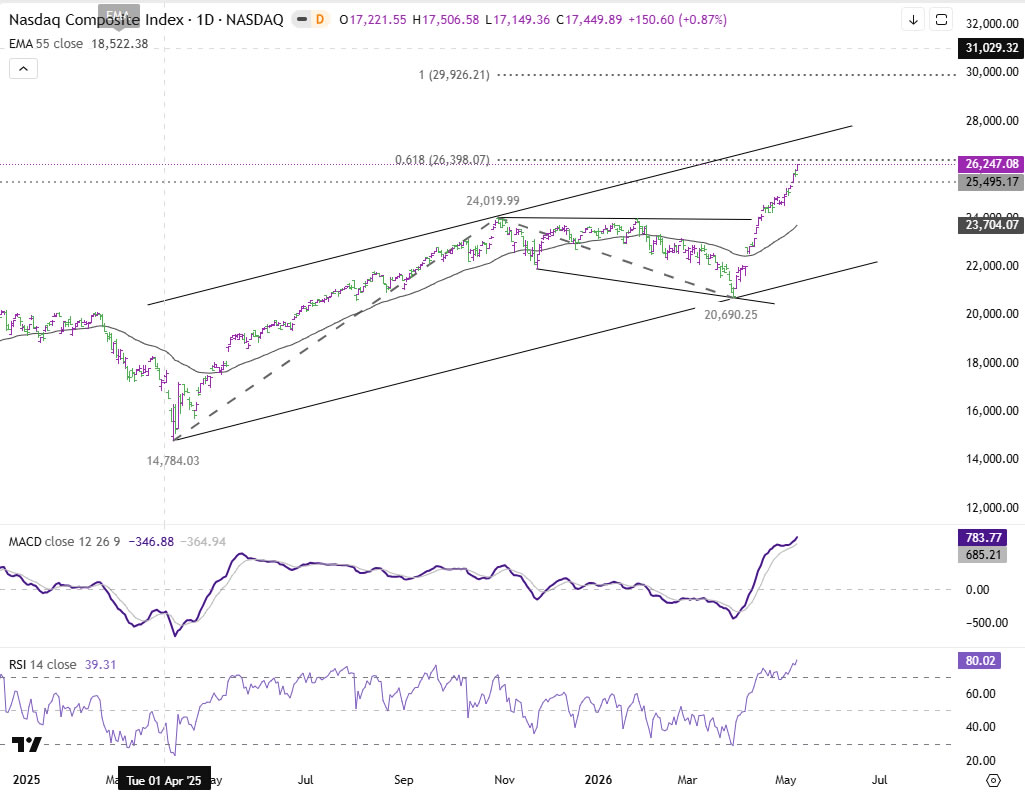
NASDAQ Nears Key Projection as AI Rally Accelerates
NASDAQ’s powerful uptrend extended again last week, bringing the index within striking distance of 61.8% projection of 14,784 to 24,019 from 20,690 at 26,398. The AI-driven rally continues to dominate global equity markets, with momentum remaining firmly bullish for now.
However, technical conditions are becoming stretched. Daily RSI remains in overbought territory, suggesting upside momentum could begin fading after the 26,398 level and especially as NASDAQ approaches the medium-term rising channel ceiling, currently near 27,142. A break below 25495 support would be the first indication of a short-term top and likely trigger a period of consolidation.
Still, there is no confirmed reversal signal yet. If NASDAQ decisively breaks above the channel resistance, the rally could enter another acceleration phase, opening the way toward 100% projection at 29,926.
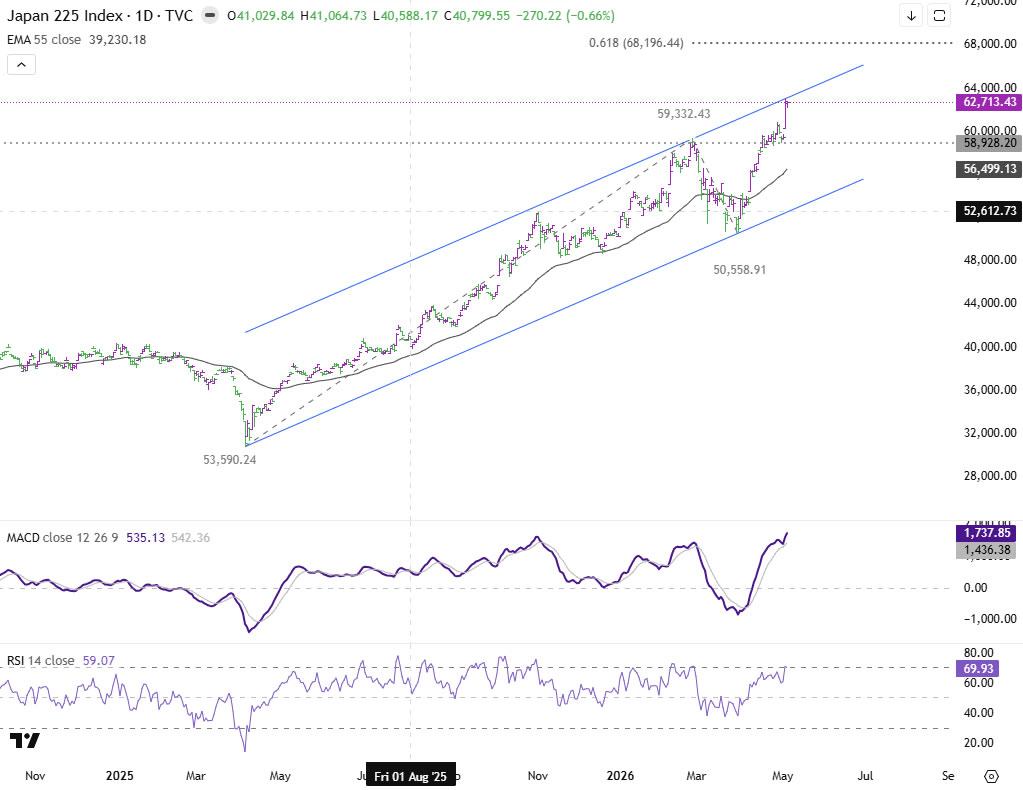
Nikkei Rally Faces Channel Resistance After Record Run
Japan’s Nikkei also extended its strong uptrend last week and is now pressing against medium-term channel resistance. The rally has been fueled by the global AI boom, semiconductor demand, and renewed foreign inflows into Japanese equities.
Short-term conditions are becoming overbought, as reflected in D RSI readings, suggesting the index could struggle to sustain the same pace of gains near current levels. Some pullback or consolidation would not be surprising as the market tests the upper boundary of the channel.
Nevertheless, outlook remains bullish as long as 58,928 support holds. Firm breakout above channel resistance would signal renewed upside acceleration and could quickly drive Nikkei toward 61.8% projection of 53,590 to 59,332 from 50,558 at 68,196.
Dollar Index Remains Under Pressure Despite Stabilization
Dollar Index gyrated lower last week but managed to stay above the 97.63 support. The broader technical outlook remains unchanged, with the rebound from 95.55 likely completed at 100.64, just below 38.2% retracement of 110.17 to 95.55 at 101.13.
Further downside remains favored while 99.34 resistance caps recovery attempts. Decisive break below 97.63 would pave the way for another test of 95.55 low.
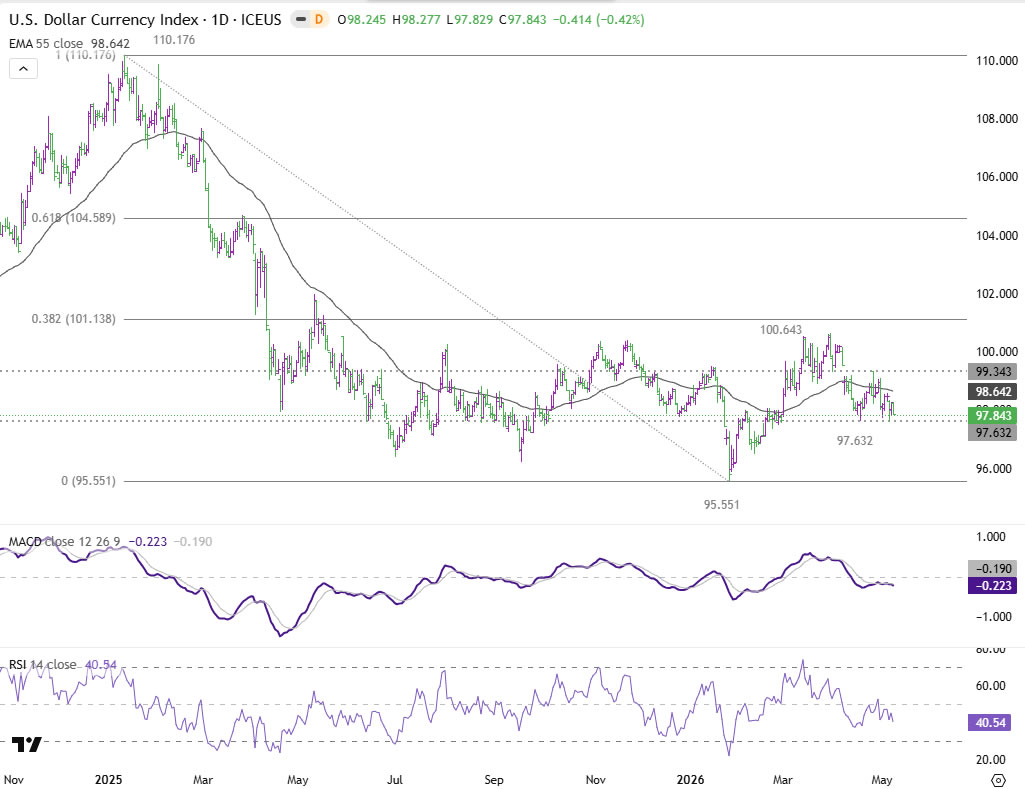
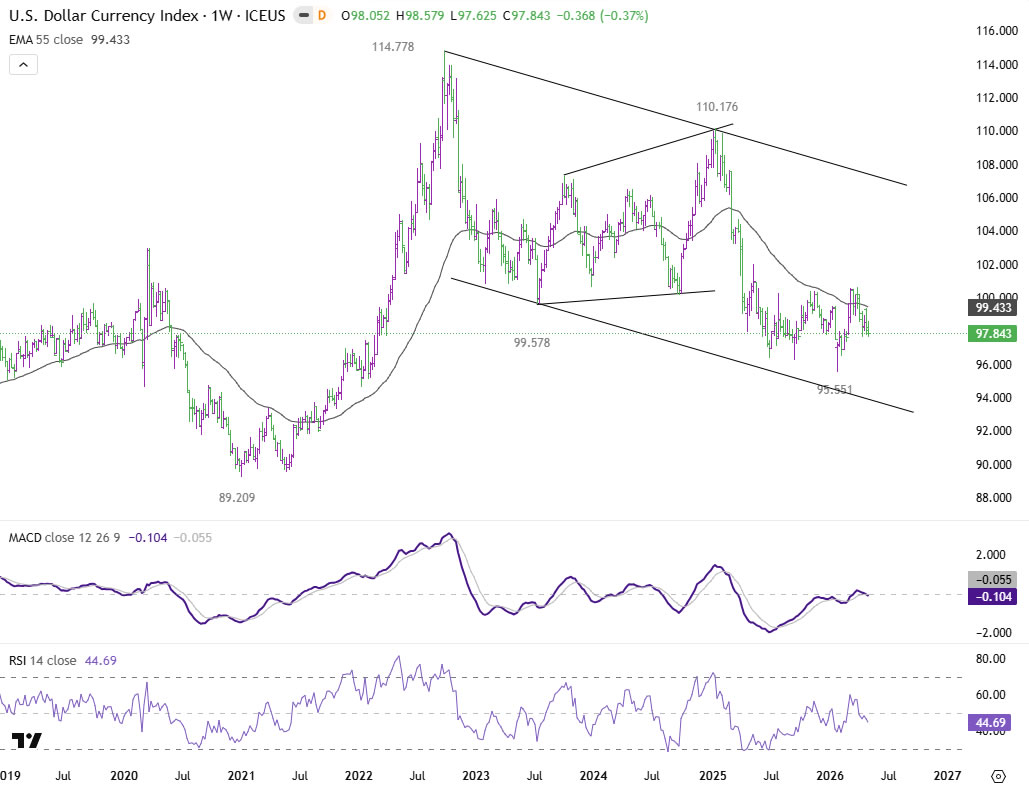
For now, there is still uncertainty over whether the corrective structure from 95.55 could evolve into a more complex consolidation with another rebound leg. However, a firm break below 95.55 would confirm resumption of the broader downtrend from both the 101.17 (2025 high) and the 114.77 (2022 peak).
AUD/CAD Targets Parity on RBA-BoC Policy Divergence
Aussie surged strongly last week after RBA delivered another hawkish rate hike to 4.35% and signaled in updated projections that the cash rate could eventually rise toward 4.7%. The guidance reinforced expectations that Australia’s tightening cycle is not yet complete.
In contrast, weak Canadian employment data sharply reduced expectations for any near-term Bank of Canada tightening despite Governor Tiff Macklem’s warnings about inflation risks. Combined with falling oil prices, the softer Canadian outlook added further support to AUD/CAD’s bullish trend.
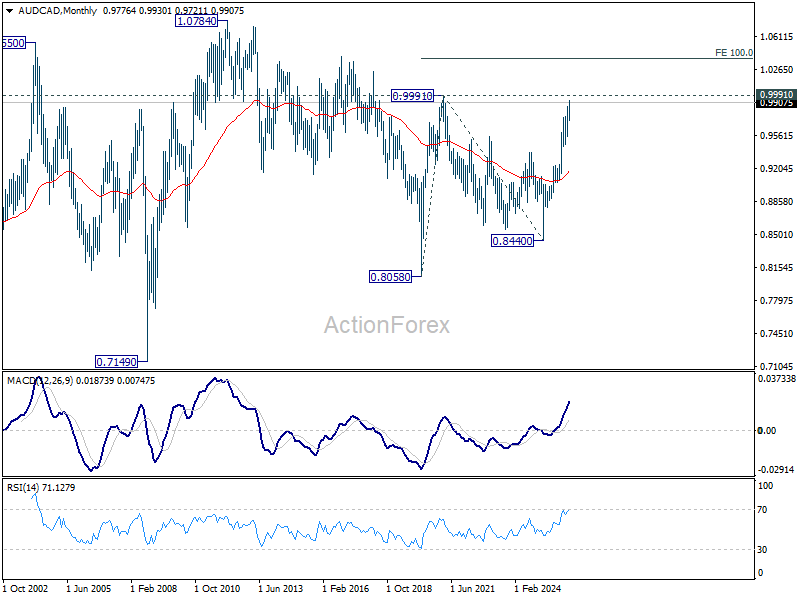
Technically, AUD/CAD is on track to retest the key 0.9991 resistance (2021 high) with parity coming into view. While some resistance could emerge on the first attempt, a decisive break above parity would likely trigger another wave of upside acceleration toward 100% projection of 0.9055 to 0.9749 from 0.9510 at 1.0204. In any case, near term outlook will stay bullish as long as 0.9721 support holds.
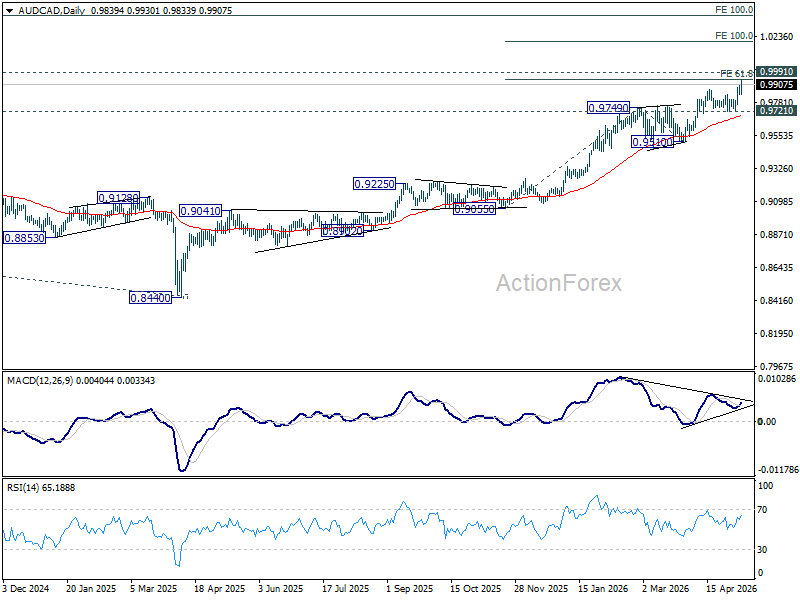
More importantly, sustained break above 0.9991 would confirm resumption of the broader uptrend from the 0.8058 (2020 low). In that scenario, the next medium-term target would come in at 100% projection of 0.8058 to 0.9991 from 0.8440 at 1.0373.
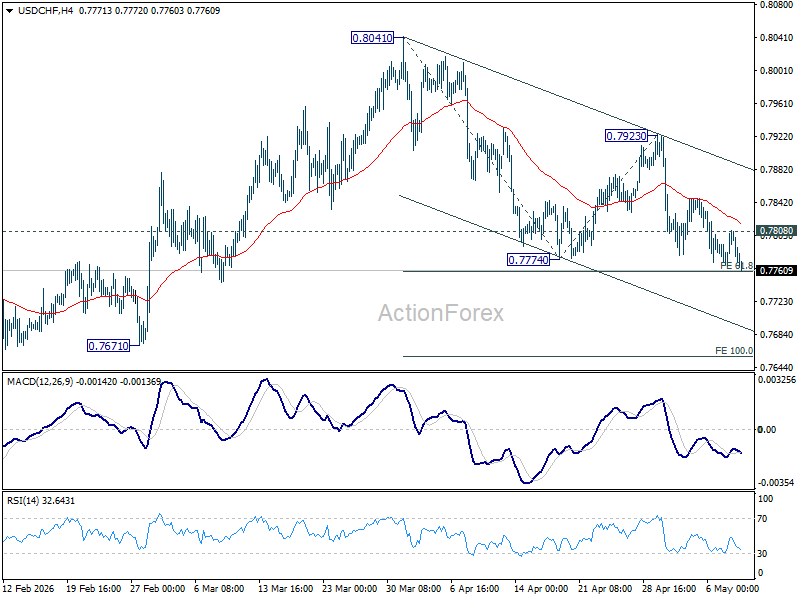
USD/CHF’s decline from 0.8041 resumed last week. Initial bias stays on the downside this week. Firm break of 61.8% projection of 0.8041 to 0.7774 from 0.7923 at 0.7758 will target 100% projection at 0.7656. On the upside, above 0.7808 minor resistance will turn intraday bias neutral again first.
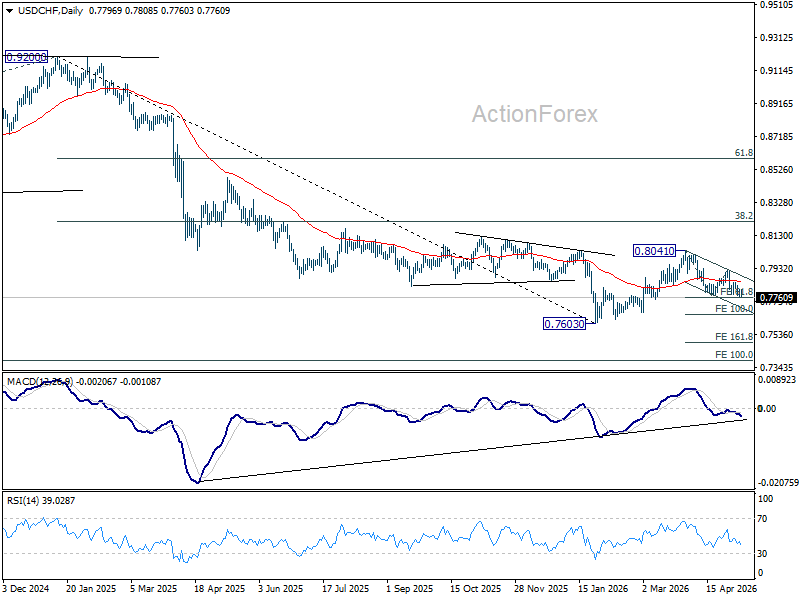
In the bigger picture, as long as 55 W EMA (now at 0.8051) holds, fall from 0.9200 is expected to continue, as part of the larger down trend. Firm break of 0.7603 will target 100% projection of 1.0146 (2022 high) to 0.8332 from 0.9200 at 0.7382.
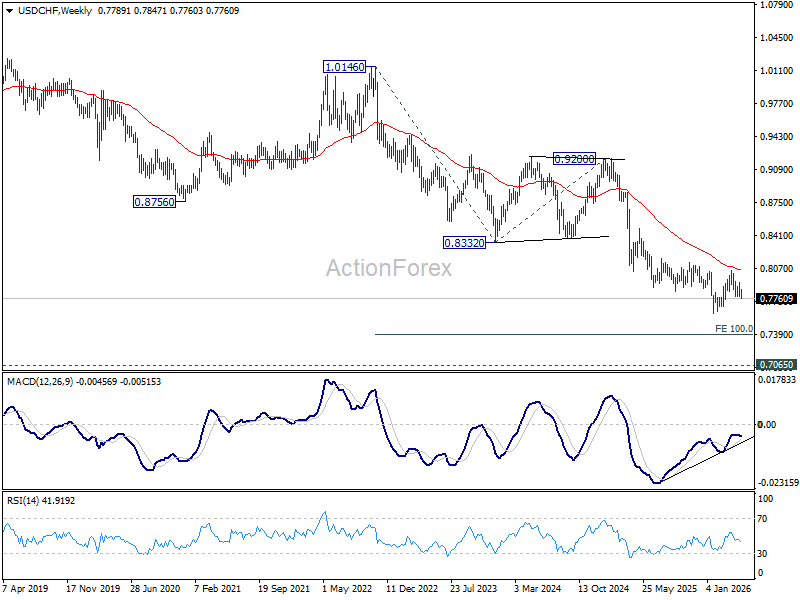
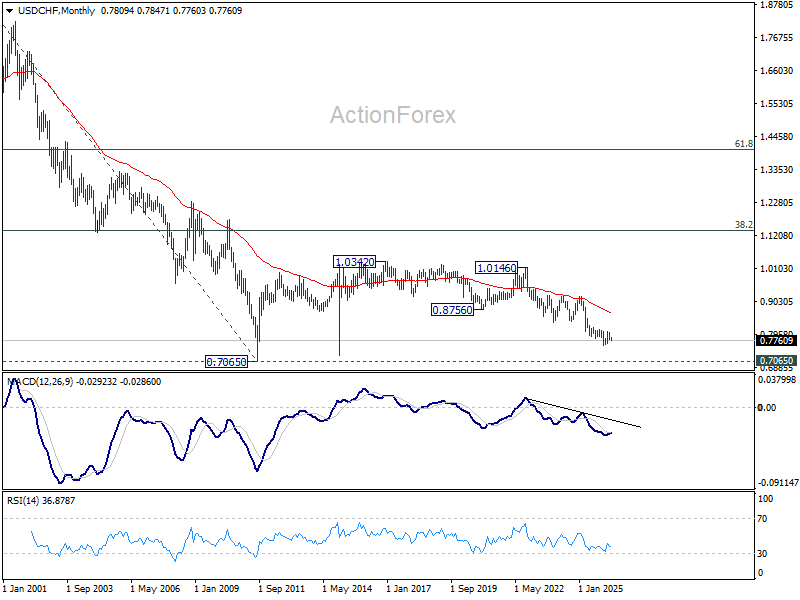
In the long term picture, price action from 0.7065 (2011 low) are seen as a corrective pattern to the multi-decade down trend from 1.8305 (2000 high). It’s uncertain if the fall from 1.0342 is the second leg of the pattern, or resumption of the downtrend. But in either case, outlook will stay bearish as long as 0.8756 support turned resistance holds (2021 low). Retest of 0.7065 should be seen next.
Gyrostat September Retirement Portfolio Resilience Assessment
September Retirement Portfolio Resilience Assessment Markets have fallen. The price of risk has risen. ... Read more
Does The West Have A Problem With Government Bonds
If you have been following the financial pages over the past few weeks, one theme has begun to stand out from the usual ... Read more
August Retirement Portfolio Resilience Assessment
Markets Are Higher. The Price of Risk Is Lower. Retirement invest... Read more
When The Wave Turns
Why Retirement Investing Is Moving Towards Resilience Jeremy Grantham’s latest market warnings have revived an old tru... Read more
Gyrostat Capital Management: July Retirement Portfolio Resilience Assessment
The Market Is Currently Presenting an Opportunity to Strengthen Retirement Portfolio Resilienc... Read more
The Invisible Risk That Decides Your Retirement
Why how investors behave matters more than what markets do and what disciplined port... Read more