

Dollar Is Giving EUR/USD Every Chance To Rally. So Whats Holding Euro Back?

TL;DR: EUR/USD has nearly everything bulls could ask for — a weaker Dollar, fading Fed hike bets, and rising ECB hike odds — yet the pair hasn’t broken out, because Euro itself isn’t confirming the move broadly across its other crosses.
The Dollar Has Given EUR/USD Every Reason to Rise
EUR/USD has been handed almost everything bulls could reasonably ask for over the past week. July payrolls unexpectedly contracted, forcing markets to scale back Fed tightening bets. July CPI then showed core inflation returning to 2.5%, back at its pre-Iran-war level. September Fed hold probability has consequently risen from around 45% a week ago to roughly 60%. The Dollar has given EUR/USD plenty of room to move higher.
The Euro Side Should Be Helping Too
Renewed oil surge has pushed the expected probability of a September ECB hike above 90%, up from around 70% a month earlier. The obvious counterargument is that the ECB may be making a policy mistake by tightening into weak growth, eventually turning higher rates into a negative for the Euro. Yet the latest activity data don’t provide much support for that conclusion — the Eurozone PMI Composite strengthened for a second straight month in July, with Germany also showing improvement. For now at least, the economy doesn’t look weak enough to explain the Euro’s reluctance to rally.
So What’s Actually Holding EUR/USD Back?
There may not be one hidden macro catalyst. The more telling explanation is simpler: Dollar weakness is doing its part, but the Euro itself isn’t attracting enough broad demand to confirm the move. EUR/USD can rise because the Dollar falls, but a durable breakout becomes much easier when the Euro is also strengthening across crosses. So far, that confirmation is missing.
That puts EUR/GBP, EUR/AUD, and EUR/CAD under the spotlight. Declines in those crosses would suggest Euro weakness is broadening beneath the surface and could eventually drag EUR/USD lower even if Fed expectations remain relatively Dollar-negative. Conversely, stabilization or recovery across Euro crosses would make EUR/USD’s current hesitation easier to dismiss as consolidation before another push higher. The question is therefore becoming less about whether the Dollar has weakened enough, and more about whether the Euro can finally take advantage.
ActionForex’s Technical View on EUR/USD
The technical picture captures that uncertainty neatly. The base case remains that the broader decline from 1.2081 completed a three-wave correction at 1.1323, after support emerged around the 38.2% retracement of 1.0176 to 1.2081, at 1.1353. Bullish divergence in the daily MACD reinforces that interpretation.
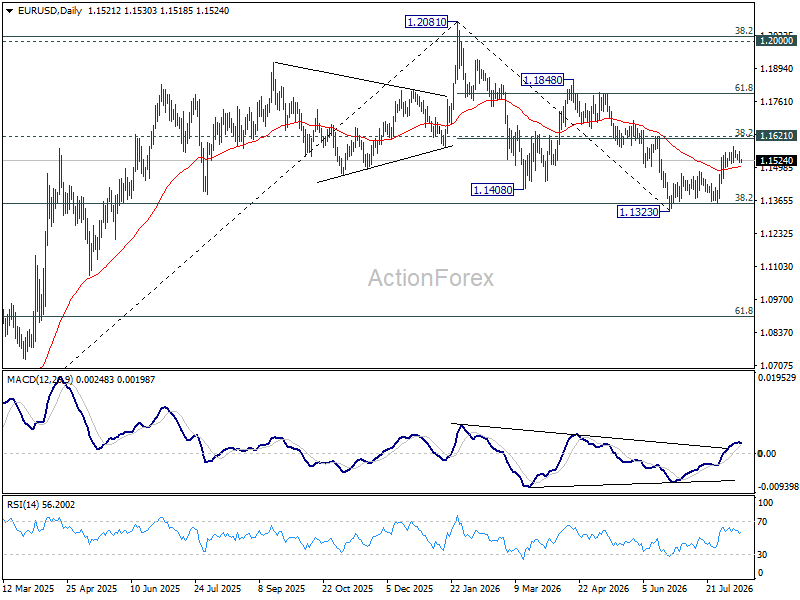
But EUR/USD still has to break the 1.1621 cluster resistance — the 38.2% retracement of 1.2081 to 1.1323, at 1.1613 — decisively. A sustained move through that zone would provide the confirmation price action has so far lacked, strengthening the case that the rebound from 1.1323 is developing into something larger.
Until then, failure matters. Rejection from 1.1613/21, followed by a break of 1.1481, would flip the interpretation, suggesting the rebound from 1.1323 was only corrective and that the larger decline from 1.2081 is ready to resume through 1.1323.
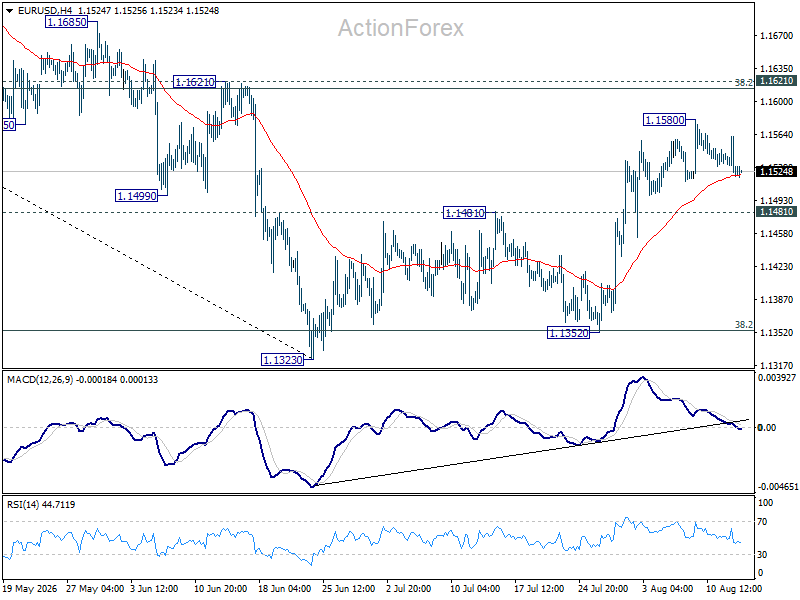
EUR/USD still has a bullish setup, but not yet a bullish confirmation. The Dollar has opened the door; now the Euro has to walk through it.
Key Takeaways
- September Fed hold odds have risen from 45% to 60% in a week, driven by contracting payrolls and core CPI returning to its pre-war 2.5% level.
- September ECB hike odds have risen above 90% on renewed oil strength, with Eurozone PMI data showing no evidence of growth weak enough to undercut that case.
- EUR/USD’s stalled breakout likely reflects a lack of confirmation from Euro crosses (EUR/GBP, EUR/AUD, EUR/CAD) rather than any single hidden catalyst.
- A decisive break above the 1.1613-1.1621 resistance cluster would confirm the rebound from 1.1323 is developing into a larger move higher.
- Rejection at 1.1613/21 followed by a break of 1.1481 would instead suggest the rebound was only corrective, reopening the broader decline from 1.2081 toward 1.1323.
Gyrostat September Retirement Portfolio Resilience Assessment
September Retirement Portfolio Resilience Assessment Markets have fallen. The price of risk has risen. ... Read more
Does The West Have A Problem With Government Bonds
If you have been following the financial pages over the past few weeks, one theme has begun to stand out from the usual ... Read more
August Retirement Portfolio Resilience Assessment
Markets Are Higher. The Price of Risk Is Lower. Retirement invest... Read more
When The Wave Turns
Why Retirement Investing Is Moving Towards Resilience Jeremy Grantham’s latest market warnings have revived an old tru... Read more
Gyrostat Capital Management: July Retirement Portfolio Resilience Assessment
The Market Is Currently Presenting an Opportunity to Strengthen Retirement Portfolio Resilienc... Read more
The Invisible Risk That Decides Your Retirement
Why how investors behave matters more than what markets do and what disciplined port... Read more