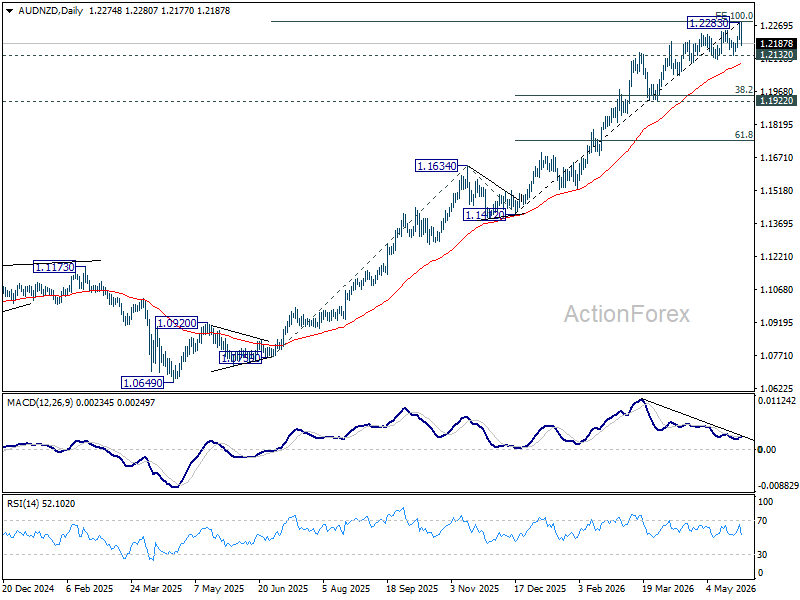

AUD/NZD may finally be running into a wall. After months of powerful upside momentum, today’s combination of a hawkish RBNZ shock and softer Australian inflation data delivered the strongest challenge yet to the pair’s medium-term uptrend. The correction risks are clearly growing — but markets still are not fully convinced the reversal has truly started.
That missing confirmation matters. If AUD/NZD cannot break lower in the next few days through support at 1.2132, traders may need to wait longer for the correction trade to fully develop. In that scenario, markets would likely need additional weak Australian data — softer employment numbers, slower core inflation, or broader evidence that economic slack is opening up more rapidly — before aggressively repricing expectations for the RBA
The bigger surprise came from New Zealand. The Reserve Bank of New Zealand may have kept rates unchanged at 2.25%, but the details underneath were aggressively hawkish. The Committee split 3-3 between holding and hiking immediately, forcing Governor Anna Breman to use her casting vote to leave policy unchanged. More importantly, the RBNZ openly signaled that hikes are likely coming soon. Breman said “OCR increases are likely at coming meetings” and warned that “even if Gulf conflict stops now, we still see inflation effects ahead.” In practical terms, the July meeting is now fully live for a rate hike.
Australia delivered the opposite side of the divergence trade. Headline CPI slowed more than expected from 4.6% yoy to 4.2% yoy, easing some immediate pressure on the Reserve Bank of Australia. While core inflation remains sticky at 3.4%, the recent deterioration in labor market data has increasingly strengthened the case for patience. Markets now see June as effectively locked for a hold, while the RBA may also prefer waiting until August before deciding whether another “insurance hike” is really necessary.
Technically, the charts are also aligning with the macro divergence story. AUD/NZD pushed higher to 1.2283 this week but struggled to sustain gains through the major 100% projection of 1.0759 to 1.1634 from 1.1412 at 1.2287. At the same time, bearish divergence on D MACD continues warning that upside momentum is fading.
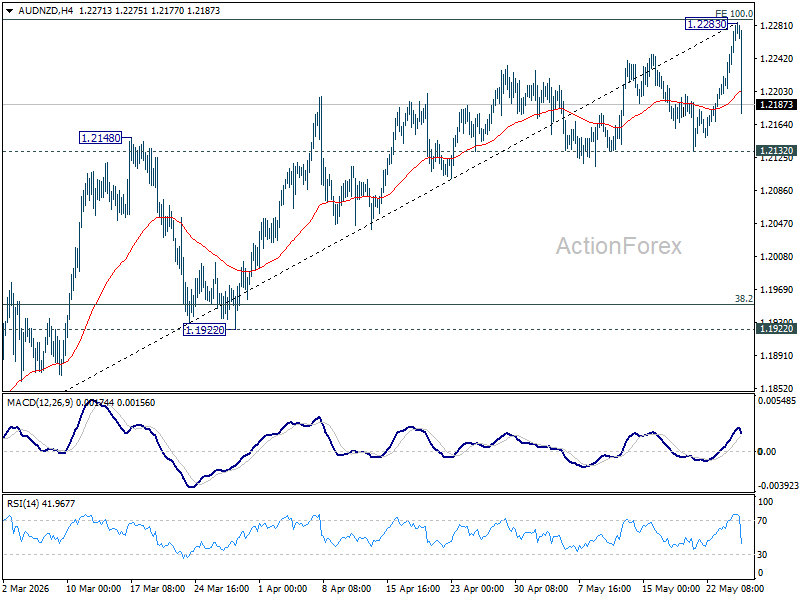
Still, the market has not yet delivered the decisive breakdown bears are waiting for. A firm break below 1.2132 would confirm medium-term topping and expose the 1.1922/50 support zone next. Until that happens, traders may still need more evidence that Australia’s economy is weakening quickly enough to fully justify a larger AUD/NZD correction.