

Online shoppers in China have shattered last year's record by making $30.8 billion in sales on the country's annual buying frenzy Sunday, as the tradition marked its 10th year.
The spending binge has for years eclipsed Cyber Monday in the U.S. for online purchases made on a single day.
This year's tally was 27 percent higher than a year ago. It breaks from gloomy forecasts about the world's second-largest economy, which is struggling with a tariff war with the U.S., a stock market slump and slowing overall growth.
Known as Singles' Day, the clamor for deals and discounts was heralded with characteristic fanfare by Chinese e-commerce giant Alibaba, which has turned an unofficial holiday for people without romantic partners into a yearly windfall for digital retailers.
A massive screen at Alibaba's gala in Shanghai showed the surging sales numbers in real time. Just before 4 p.m. Sunday, the sales reached 168.2 billion yuan ($24.2 billion) — surpassing the total purchases from last year's Singles' Day, according to figures posted online by Alibaba Group.
At the end of the 24-hour spree, Alibaba reported sales totaled up to 213.5 billion yuan ($30.8 billion).
Alibaba Group CEO Daniel Zhang said the results reflected "the strength and rise of China's consumption economy."
Singles' Day began as a spoof event celebrated by unattached Chinese university students in the 1990s. In Chinese, it's called "Double 11," after the numbers in the month and date. The improvised holiday was co-opted by e-retailers in 2009 and transformed into China's version of Cyber Monday, as the Monday after Thanksgiving is known.
Nearly $6.6 billion in sales were made on Cyber Monday in 2017, up about 17 percent from the previous year, according to Adobe Analytics.
Ren Xiaotong, a 27-year-old accountant in Beijing, said she suspected online stores jacked up their prices in the lead-up to Singles Day so they could declare that items were discounted.
But in the end, her skepticism didn't stop her from partaking.
"Singles' Day is different now — it has more tricks than before," Ren said. "You only save a few dozens of yuan at the end. That being said, I still bought a pair of shoes, simply to celebrate the festival."
The Twitter-like Weibo platform was blanketed with Singles' Day-related posts on Sunday, from users proudly proclaiming that they had resisted the shopping urge this year to those who cheerfully listed an array of mundane purchases.
Alibaba founder Jack Ma, who will step down as chairman in less than a year, attended the start of the gala in Shanghai and appeared in a video message in which he wrapped up live hair crabs, a popular online purchase.
Singles Day "is not a day of discounts, but rather a day of gratitude," Ma said in the video. "It's when retailers use the best products and best prices to show their gratitude to our consumers."
Chinese e-commerce platforms have come under fire in the past for peddling low-quality and counterfeit items. Hong Tao, an economics professor at Beijing Technology and Business University, said Singles' Day encourages shoppers to prioritize cheap prices over high quality, causing them to purchase items they don't need.
"People are swept up in the festivities," Hong said in a phone interview. "This burst of consumption, confined to just one day, can be exhausting for both buyers and sellers."
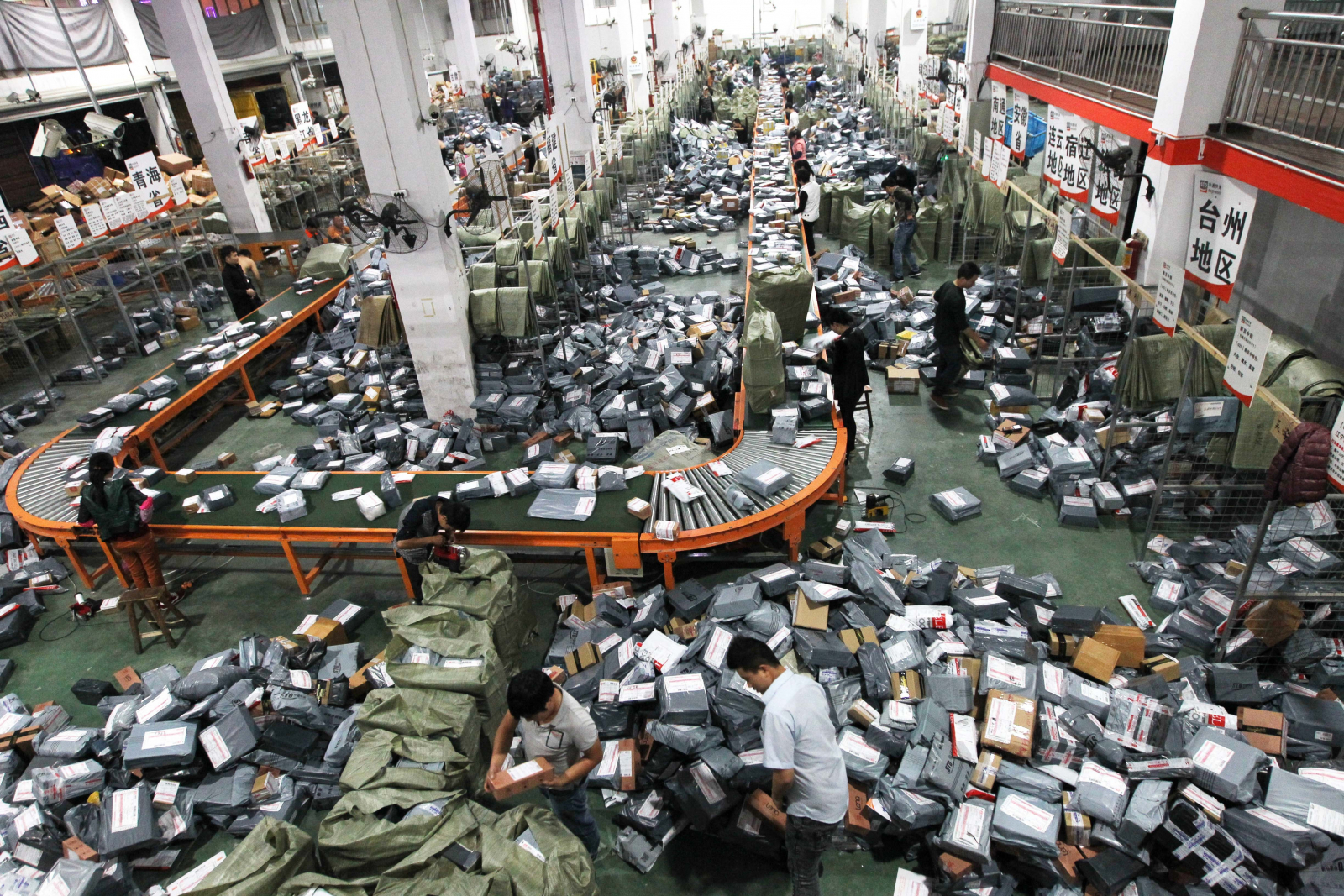
The occasion also has big environmental implications.
While both Alibaba and competitor JD.com have pledged to use biodegradable packaging to cut down on waste, research conducted this month by Greenpeace East Asia said many plastics marked "biodegradable" and used by Chinese e-retailers can break down only under high temperatures in facilities that are limited in number across the country.
Greenpeace estimated that by 2020, "biodegradable" packaging could produce roughly 721 truckloads of trash in China every day.