


It was a November to forget for the crypto market. Bitcoin (BTC) saw its price plunge by 36% from its October peak, swinging from an all-time high above $126,000 to a sharp pullback below $81,000 on the 22nd, before stabilizing around $88,000- $90,000.
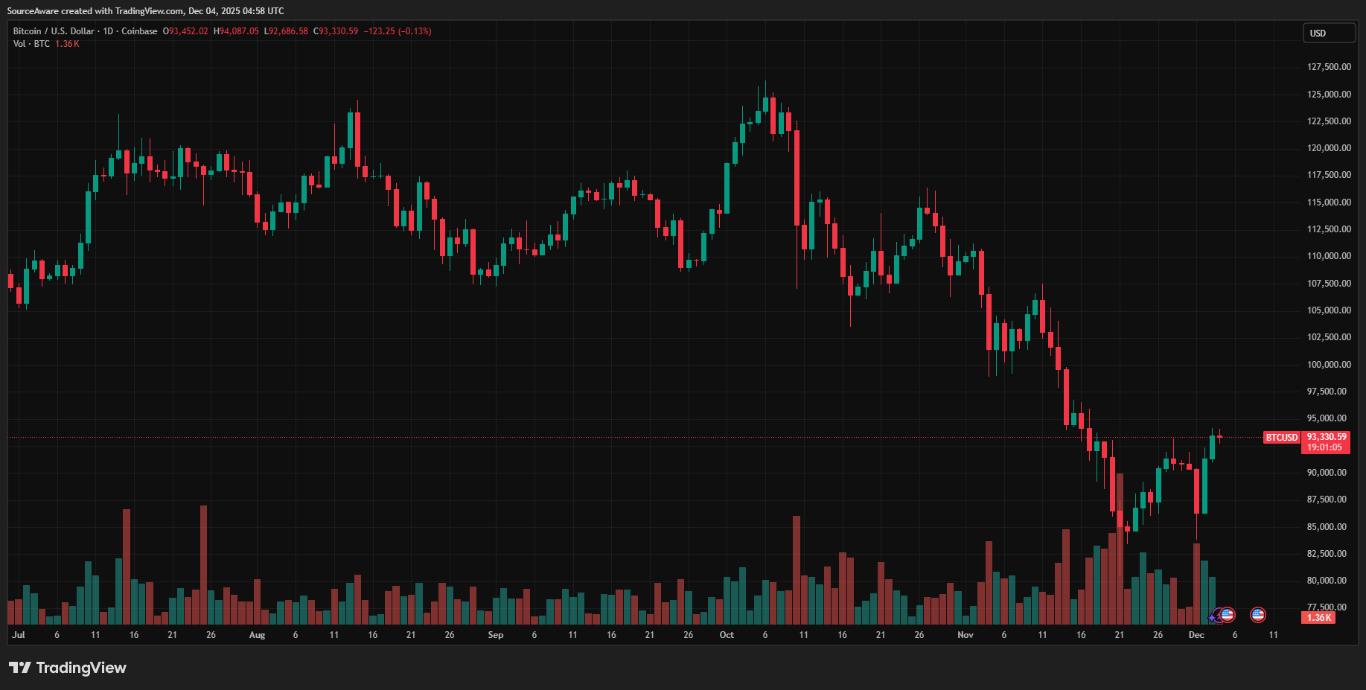
BTC/USD 1-day chart. Source: TradingView
And it wasn’t just Bitcoin. Altcoins were obliterated, with many tokens falling to or below their crypto winter lows. The ultimate result was a decline of more than $1 trillion in total crypto market capitalization.
The carnage led to record-breaking liquidations for derivatives traders and an absolute collapse in sentiment – with the Crypto Fear and Greed Index hitting “Extreme Fear” (11), triggering widespread panic across digital asset markets. Retail capitulated: Spot ETFs shed $3.47 billion in outflows, with BlackRock's IBIT alone losing $2.34 billion.
But beneath the volatility lies a profound shift: Traditional finance (TradFi) is absorbing Bitcoin at an unprecedented pace, transforming it from a speculative outlier into a portfolio staple.
Wall Street Pounces
While retail traders gave in to the FUD (fear, uncertainty, and doubt), some of the financial industry's most prominent players made their move in what has since been recognized as a synchronized push by Wall Street giants. In just nine days, from November 24 to December 2, institutions controlling over $20 trillion in assets deepened their Bitcoin exposure.
JPMorgan kicked off with "Auto Callable Accelerated Barrier Notes," offering 1.5x leveraged upside on BTC with a 30% downside buffer—tailored for conservative investors. Vanguard followed on December 2, opening Bitcoin, Ethereum, XRP, and Solana ETFs to its 50 million clients. Bank of America and Morgan Stanley unleashed their advisors, clearing them to recommend allocations of 1-4%, mirroring BlackRock and Fidelity's guidance.
As average investors dumped Bitcoin ETFs with reckless abandon, institutions were ready and willing to scoop up low-priced BTC. The real game changer came with the release of JPMorgan’s latest model, which pegs King Crypto’s fair value at $170,000 – $68,000 above current levels – factoring in volatility adjustments.
While worried analysts predicted a potential decline to support between $74,000 and $76,000, Bitcoin rapidly bounced back, climbing from $83,832 on December 1 to spike above $94,000 on December 3. Bulls are now eyeing a recovery of the psychologically important $100,000 price level and keeping close tabs on ETF flows for signs that outflows have meaningfully reversed.
There’s also the matter of Bitcoin’s historical performance to consider. In the past, BTC tended to see bullish moves in November, showing either strong double-digit gains or at least mildly positive results in most years.
In the instances where Bitcoin finished November in the red, the selling typically bled into December rather than resolving quickly, as forced liquidations, tax-loss harvesting, and persistent risk-off positioning continued.
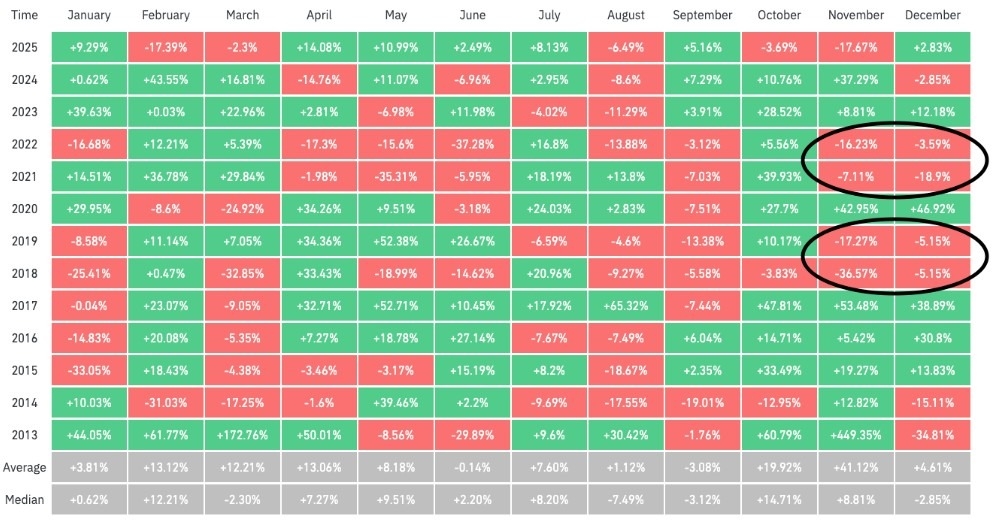
Bitcoin’s Historic Monthly Performance
While a negative November does not automatically guarantee deeper losses ahead, it meaningfully raises the odds that selling pressure persists into December. Previous instances have shown that the crypto market often needs time to stabilize after this kind of late-year pullback, but institutional activity could render historical trends moot.
Bitcoin Has Crossed the Chasm
The developments of the past week have led many to compare Bitcoin to Gold in a new way and recommend that it receive a dedicated portion of a balanced portfolio. For traders, this institutional influx suppresses volatility through gamma hedging and options expansion (IBIT limits up 40x). Bitcoin's role evolves from monetary rebel to commoditized asset, with 0.25% ETF fees generating billions in revenue.
More broadly, as TradFi integrates, Bitcoin's explosive upside may moderate, but stability draws trillions more. BTC has crossed a significant threshold in legitimacy, and the entire asset class is set to transform amid rising global adoption.
From a macro perspective, the outlook remains mixed. Within the next week, we will get two potential policy shifts, with markets pricing a high probability of a Bank of Japan rate hike alongside a Fed rate cut – the exact combination that narrows the carry trade and pressures large allocators to de-risk.
It remains to be seen how these announcements will ripple across financial markets, but one thing is certain: The game has changed for Bitcoin, and institutions have fully embraced the world's youngest asset class.
Ready to trade our Bitcoin news? Here is our list of the best MT4 crypto brokers worth checking out.