

 ADVERTISEMENT
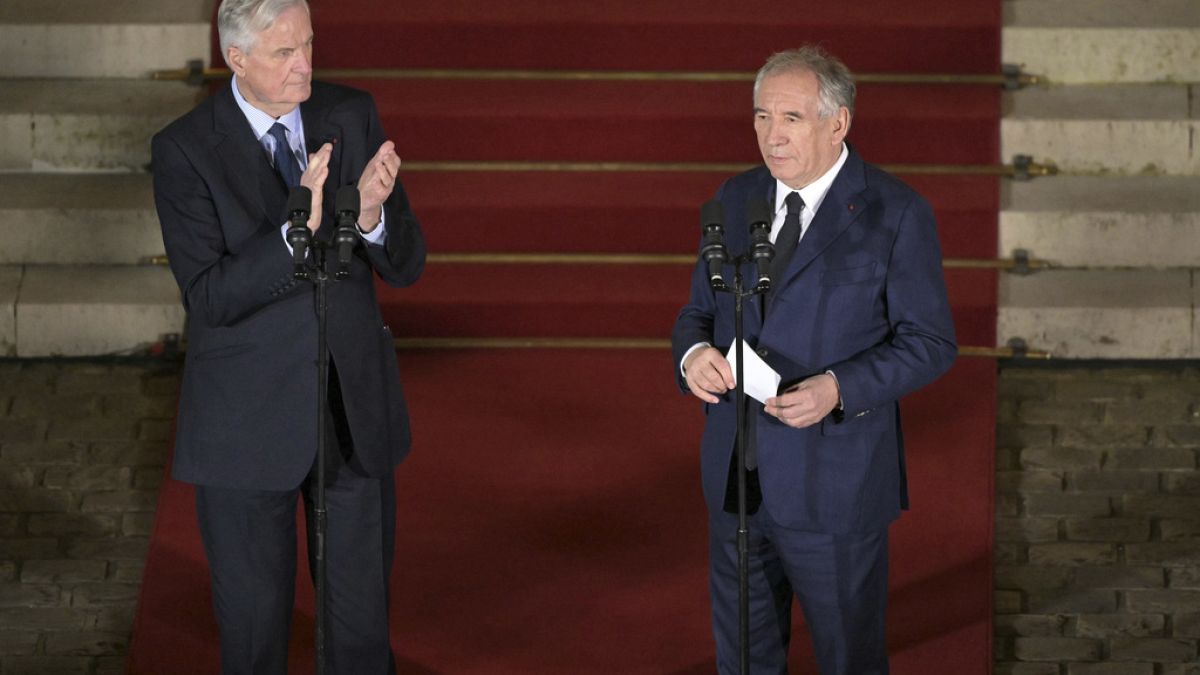
French President Emmanuel Macron named long-time centrist ally François Bayrou as the country’s new prime minister after MPs voted to oust the previous government under Michel Barnier last week.
The 73-year-old is the founder of the centrist Democratic Movement party (MoDem) and mayor of the southwestern town of Pau.
Just like his predecessor, François Bayrou does not have a majority in the National Assembly (the lower house of parliament).
To avoid the same fate as Barnier, he will have to negotiate with other parties in a bitterly divided lower house to avoid being toppled by the MPs.
Aware of the complex situation, Bayrou told reporters on Friday: "It is a long road, everyone knows that… I am not the first to take a long road."
Macron will certainly hope Bayrou can survive until at least July when it will be possible to hold new legislative elections.
Why did Macron pick Bayrou?
According to multiple experts, François Bayrou is the top candidate capable of compromising with most of the parties at play.
“Bayrou is the logical choice because he ticks a lot of boxes,” said Christophe Boutin, a political scientist and professor of public law.
“He’s well known among the general public, he's shown little hostility to most of the political parties, and he's had a vast political career as an MEP, a local mayor, and a former minister. Compared to conservative right-wing Michel Barnier, Bayrou will be more palatable for the moderate left-wing parties,” he told Euronews.
The talks for the future Prime minister reportedly ended in a tug-of-war according to French media.
Multiple MPs from Bayrou’s centrist MoDem movement told journalists that if their leader was not nominated, their party would detach from Macron’s alliance, risking the embattled French leader approximately 36 seats.
“In that case, Emmanuel Macron would have been even more weakened. So he was also forced to choose Bayrou over other candidates,” said Philippe Moreau-Chevrolet, a political communications expert.
What’s next for the new Prime minister?
According to Article 8 of the French Constitution, the French President has the power to appoint new ministers “on the suggestion” of the Prime minister.
Macron and Bayrou will have to work quickly to come up with a cabinet.
Although it’s not mandatory, once the cabinet is chosen, the newly appointed PM can give a general policy speech in front of the National Assembly.
ADVERTISEMENTIt's a highly anticipated and scrutinised event as it tends to reveal the future government's colours.
“Bayrou will have to talk to everyone, to try to give the impression that these discussions are collegial. He will need to step away from Macron’s very top-down style of governing. That's extremely important, given Macron's current unpopularity,” said Philippe Moreau-Chevrolet in an interview with Euronews.
Does Bayrou have a chance of surviving a no-confidence vote?
At this stage, only the hard-left France Unbowed party (LFI) have announced they will push forward a no-confidence vote.
Other parties forming the left-wing coalition NFP had a more moderate response.
ADVERTISEMENTThe Socialist Party (PS) declared they refuse to be part of the new government but insinuated they are ready to cooperate if Bayrou renounces using Article 49.3 of the Constitution to pass laws without a vote in Parliament.
Michel Barnier’s downfall resulted from his use of Article 49.3 to force the adoption of a belt-tightening national budget without a parliamentary vote.
This in turn opened Barnier to a no-confidence vote after the left-wing coalition NFP and the far-right National Rally party decided to join forces.
National Rally’s president, MEP Jordan Bardella, said that this time, his party will not vote against Bayrou as long as he does not cross certain “red lines” on topics such as immigration and pensions.
ADVERTISEMENTWhat are some of the hot topics on the table?
François Bayrou’s immediate priority will be to pass a stopgap law to roll over the budget of this year into 2025.
It allows the government to continue collecting existing taxes until a new budget is voted by MPs. The bill is set to be examined on Monday by the National Assembly.
Then, Bayrou will have the even more complex task of passing a national budget for next year.
With France’s budget deficit having reached an eye-watering 6% of its GDP, the new PM will have to consider serious tax hikes coupled with massive budget cuts.
ADVERTISEMENTWith parliamentary work suspended between 20 December and 14 January, the battle over the budget is not expected to commence until the New Year.
Another hot topic on the table: the new government will be expected to have answers for an angry agricultural sector.
Farmers have been protesting for months over the Mercosur deal that the EU Commission has recently concluded with multiple South American nations.