

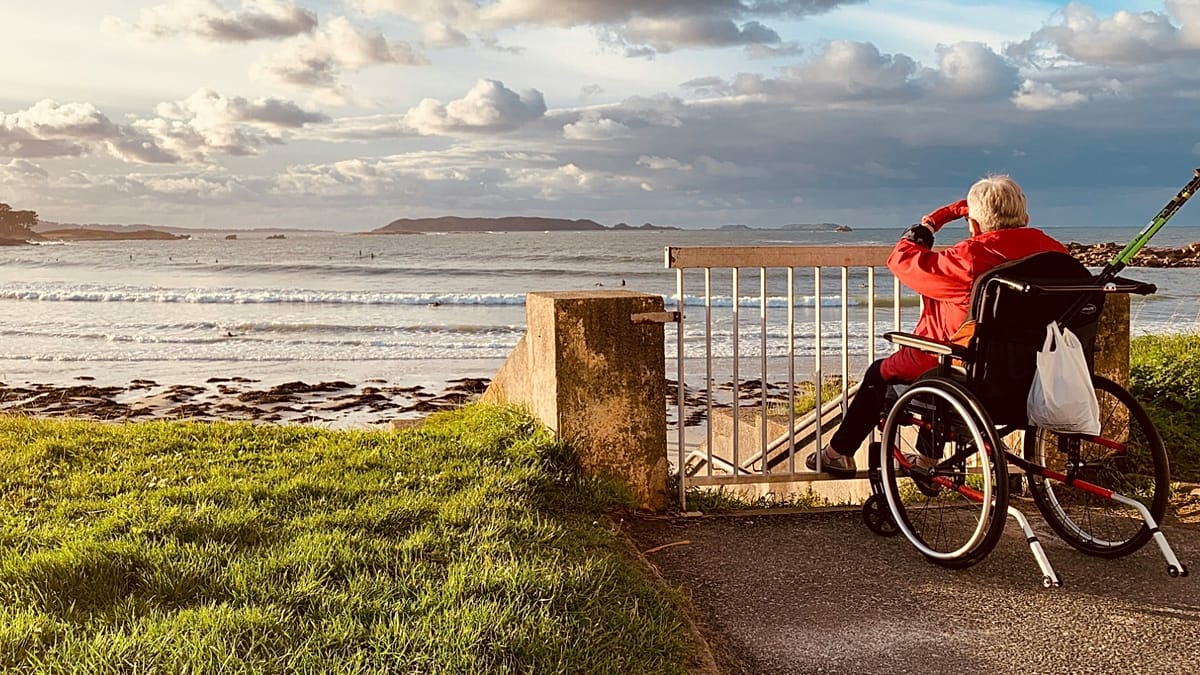
Mountain trail or medieval city? Deciding what to do in Europe isn’t easy. Add in accessibility needs, and the decision-making gets even more complicated.
 ADVERTISEMENT
ADVERTISEMENT
ADVERTISEMENT
It’s no wonder – according to a recent YouGov survey on accessible travel commissioned by Responsible Travel – that after cost, it’s a confidence crisis preventing people with accessibility needs from booking the holidays they want.
Here, disabled travellers and accessible tourism experts share their favourite destinations in Europe; good places to start to build more travel confidence.
The Cairngorms, Scotland: Karen Darke
Adventurer Karen Darke was paralysed in a climbing accident when she was 21. Since then, she’s won a gold medal at the 2016 Rio Paralympic Games, crossed Greenland by sit ski and handcycled from Canada to Mexico, among other adventures.
“The Cairngorms show that outdoor adventure and accessibility can really go together,” Darke says. The National Park is on her doorstep in Scotland, and it’s the perfect place, she says, for inclusive family holidays.
She recommends starting at Rothiemurchus Visitor Centre. “A great hub, with accessible trails through the beautiful Caledonian Pine Forest, and nearby spots like Loch Morlich, Loch Insh and Loch an Eilean that all offer different levels of accessibility while still feeling wild and scenic.”
Darke also highlights Cairngorm Mountain, where a funicular railway makes the mountain environment and views accessible. Or in winter, try adaptive skiing at the ski resort with Disability Snowsport UK.
To stay? She recommends Badaguish Outdoor Centre, where you’ll find large accessible lodges, or Glenmore Lodge, which offers accessible accommodation and tailored activities through its Accessible Adventures programme. Or, try Able2Adventure for adaptive mountain biking, handbiking, paddleboarding and more.
Gothenburg, Sweden: Rachel Nafzger
Rachel Nafzger is blind, but it hasn’t stopped her from exploring all over Europe and beyond. Alongside practicalities, she says, “the vibe of a city is also really important”. And Gothenburg – which was named the EU Access City in 2014 – gets top marks.
”Everywhere just felt so laid back, open and safe,” she says. “I had no hesitation asking questions of random passersby and found they were always willing to help – usually with embarrassingly amazing English.”
She calls Gothenburg’s transport system “fabulous”, saying “its excellent network of trams kept me always oriented and travelling smoothly”.
While Nafzger recommends travelling with a specialist company for tailored support or taking a trusted friend with you, she also encourages travellers to speak with local people if they need help on the go. She says: "Interacting with people when you’re out and about can also help give you a true feel for a place, as well as leading to some of the best travel stories!”
Berlin, Germany: Paul Mahoney
An avid traveller, Paul Mahoney, who uses a wheelchair, was so impressed with Berlin he’s been back three times – and even raced the half-marathon there. A route that was flat and “superbly well set-up” for wheelchair users.
“Berlin really sets the standard for accessibility as a city,” he says. He recommends the Reichstag, where “access was clear with ramps”, the Berlin Wall memorial and the Brandenburg Gate, and while some paths in the Holocaust Memorial’s Field of Stelae can be tricky, the rest of the site is fully accessible, and he encourages others not to be put off.
Mahoney also praises Berlin’s transport infrastructure as “kind to wheelchair users”, noting in particular, “the HoHo (hop-on-hop-off sightseeing bus) is fully accessible with lowered ramp access and good space inside”. A train ride to a concentration camp museum out of the city also posed a few challenges, which he says, “given the historic nature of the buildings, is remarkable”.
Before booking a trip, Mahoney recommends checking out the “especially helpful” visitberlin.de for up-to-date accessibility information.
Rachel Nafzger also sings Berlin’s praises, describing it as the “king of the tactile model”.
“Not only are they dotted around the city, there is a whole exhibition of them called the Stadtmodelle museum,” she said. “It includes a huge 3D tactile map of Berlin so you can feel the layout of the city, plus several smaller tactile exhibitions of famous city landmarks complete with Braille info boards.”
Amsterdam, The Netherlands: Carrie-Ann Lightley
Carrie-Ann Lightley is an award-winning travel writer and a passionate advocate for accessibility. Amsterdam is one of the few cities she returns to because, she says, “accessibility doesn’t feel like an afterthought”.
“It feels genuinely easy,” she says. “It’s flat, compact, and much easier to navigate independently than many historic European cities. The accessible public transport makes a huge difference too, particularly the trams and trains, and travelling there by Eurostar removes a lot of the stress and unpredictability that can come with flying.”
Lightley recommends staying near Amsterdam Centraal for flexibility and taking an accessible canal cruise with the Blue Boat Company for a “brilliant overview of the city without the energy drain of navigating busy streets all day”.
She also recommends the Rijksmuseum and Van Gogh Museum for their strong accessibility provision and clear layouts. If you’re still unsure, Amsterdam is, she asserts, “a great confidence-building destination”.
Catania, Sicily, Italy: Damiano La Rocca
Damiano La Rocca is the founder of Seable, which offers tailored and group holidays for people who are blind or partially sighted. He praises how local tours in Catania “have transformed sightseeing into a completely immersive, multi-sensory and barrier-free experience”.
The city has plenty of sensory offerings: Street food, Sicilian ice cream and crumbly cannoli, wine tasting, or the noise and smell of the fish market. La Rocca particularly recommends the Tactile Museum, which he says is “widely reviewed as one of the best in Europe and features incredibly detailed 3D scale models of Sicily’s historic buildings”.
A must-try, he says, is an accessible Mount Etna tour. “Guides facilitate a truly sensory experience. You can take a cable car and an accessible 4x4 jeep to the summit to literally feel the volcanic soil underfoot.”
A six-day tailor-made trip to Sicily costs from £1,850 (2,134) per person, including B&B accommodation, activities and a Seable-trained sighted guide for up to eight hours per day.
Sarah Faith is senior values writer at activist travel company, Responsible Travel