

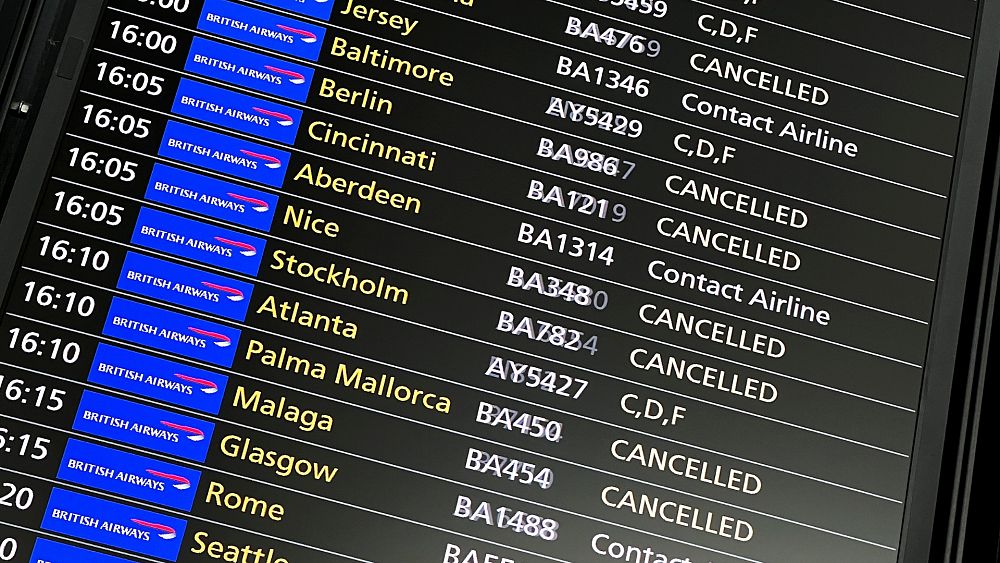
The technical glitch which caused last week’s flight chaos in the UK was a “one in 15 million” event, according to air traffic service NATS.
 ADVERTISEMENT
On 28 August, thousands of passengers were left stranded after 1,500 flights were cancelled during one the busiest parts of the summer season.
The service says the chaos was caused by a single flight plan that wasn’t properly processed by part of its system, causing it to shut down automatically within a matter of seconds.
A new report released on Wednesday (6 September) by NATs outlines how this extremely rare error occurred.
What caused the air traffic control meltdown?
The UK’s National Air Traffic Services (NATS) has confirmed the root cause of the meltdown in the preliminary report released today.
Airlines are required to submit the path of every flight that passes through a country’s airspace to its national control centre. In the UK, these should automatically be shared with NATS controllers who oversee the country’s skies.
The report from NATS found that one flight plan with two identically named but separate waypoint markers outside of UK airspace was behind the technical glitch.
These waypoints, which represent locations along an aircraft’s route, are identified by a series of letters and numbers. The two identical points in the problem flight plan were 4,000 nautical miles (7,408 km) apart but shared exactly the same name, forcing the system to stop working for safety reasons.
“In these circumstances, the system could not reject the flight plan without a clear understanding of what possible impact it may have had. Nor could it be allowed through and risk presenting air traffic controllers with incorrect safety-critical information,” NATS said.
A backup system also failed and no correct information was sent to air traffic controllers. This series of events unfolded in just 20 seconds.
It meant that the service couldn’t process flight plans automatically for several hours and instead had to switch to a slower, manual process. The number of plans NATS could handle dropped from 400 per hour to as low as just 60, causing more than a quarter of flights to be cancelled.
An extremely rare error
Around 250,000 people were affected by the disruption while delays and cancellations continued for two more days as planes and crews were left out of position.
ADVERTISEMENTWhen asked the odds of an incident like this occurring, NATS chief executive Martin Rolfe told the BBC it was around “one in 15 million”. The system that failed has processed 15 million flight plans in the five years it has been operating and this was the first time this set of circumstances has been seen.
This is also why it took engineers a number of hours to figure out how to fix the problem.
Rolfe added that the system did “what it was designed to do” - fail safely when it receives data it is unable to process.
NATS says it has taken measures to ensure that the same glitch doesn’t happen again and emphasised that safety was never compromised during the event.