

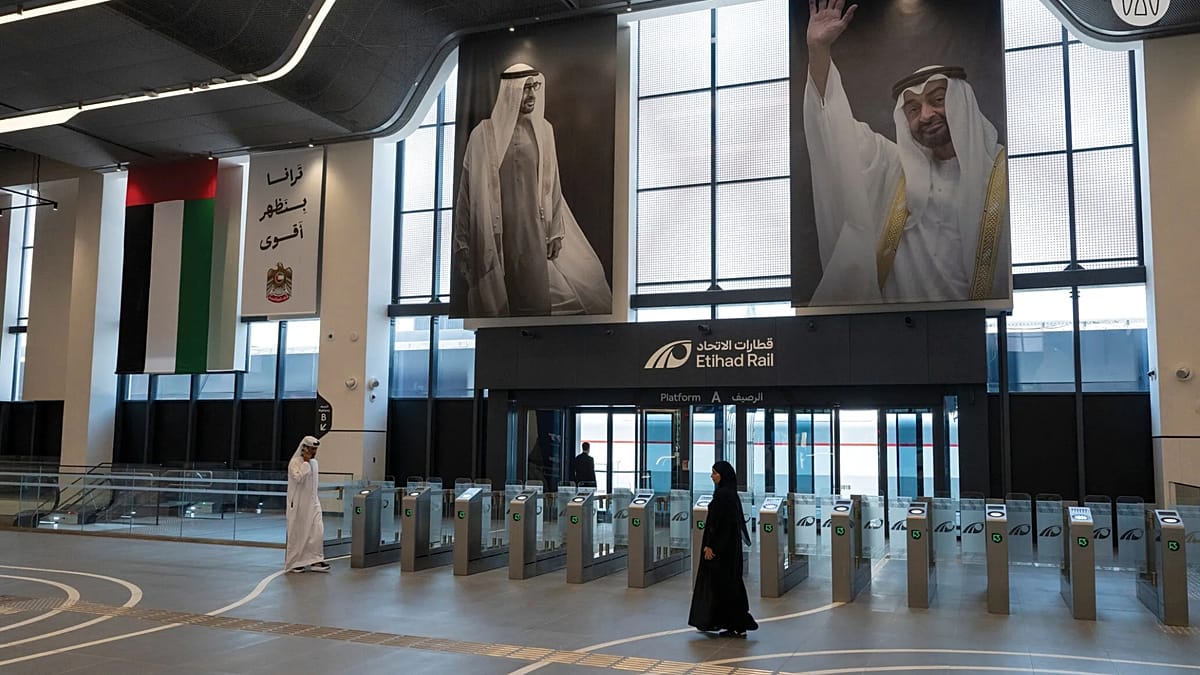
The UAE’s first passenger rail network is set to launch later this month.
 ADVERTISEMENT
Etihad Rail will begin operating trains between Abu Dhabi and the emirate of Fujairah on 30 June.
Located on the country’s east coast, Fujairah is known for its hiking trails which take in scenic wadis and mountains as well as its historic forts.
Journey times are around an hour and 45 minutes, and prices start at AED55 (€13.20) in standard class, and AED120 (€28.80) in premium class.
The rail network will then be extended on 30 September, with the opening of stations in Dubai and Al Dhaid in the emirate of Sharjah, just north of the glitzy city. Al Dhafra, another stop in Abu Dhabi, will open on 30 December, while Sharjah train station will begin welcoming passengers from 30 March next year.
As the train stations are outside of city centres, Etihad Rail will also offer shuttle services between key points within downtown Abu Dhabi such as the Corniche, Reem Mall, and ADNEC Centre and the Abu Dhabi Mohamed Bin Zayed City Station. These are priced at AED10 (€2.40).
In Dubai, the train station is located at Jumeirah Golf Estates, meaning passengers can then transfer onto the metro. The city is the only place in the UAE that currently has a metro system.
Various other stations are set to open in Abu Dhabi, but commencement dates for these stops are yet to be announced.
Stops include Al Mirfa, which is near the waterfront mangrove destination Al Mugheirah Bay, and Liwa, which is known for its vast desert and its annual motorsports festival held on the dunes each winter.
There is also a stop in Al Sila, right next to the Saudi Arabian border.
Plans to connect the Gulf states – the UAE, Saudi Arabia, Oman, Qatar, Bahrain and Kuwait – have been proposed, but there are no exact dates on when this project would be realised.
Saudi Arabia is the only other Gulf nation to currently operate passenger trains. The country was part of the Ottoman railway network in the early 20th century, with trains connecting Damascus in Syria to Medina, but this was closed due to the Arab Revolt.
Modern passenger trains now connect cities including Riyadh and Quruyyat, which is near the border with Jordan, and Riyadh and the port city of Dammam. There is also a route between the holy cities of Medina and Mecca.
Metro networks are found in just a few cities in the Gulf, including Riyadh, which opened in 2024, Dubai, which opened in 2009, and Doha, which opened in 2019 ahead of the city hosting the World Cup.
Late last year, Qatar announced that it has signed an agreement with Saudi Arabia to construct a high-speed railway connecting Riyadh and Doha in around two hours. It is set for completion in 2031.