

 ADVERTISEMENT
Early this morning France state-owned railway company SNCF announced that they had been "the victim of several acts of malevolence" overnight.
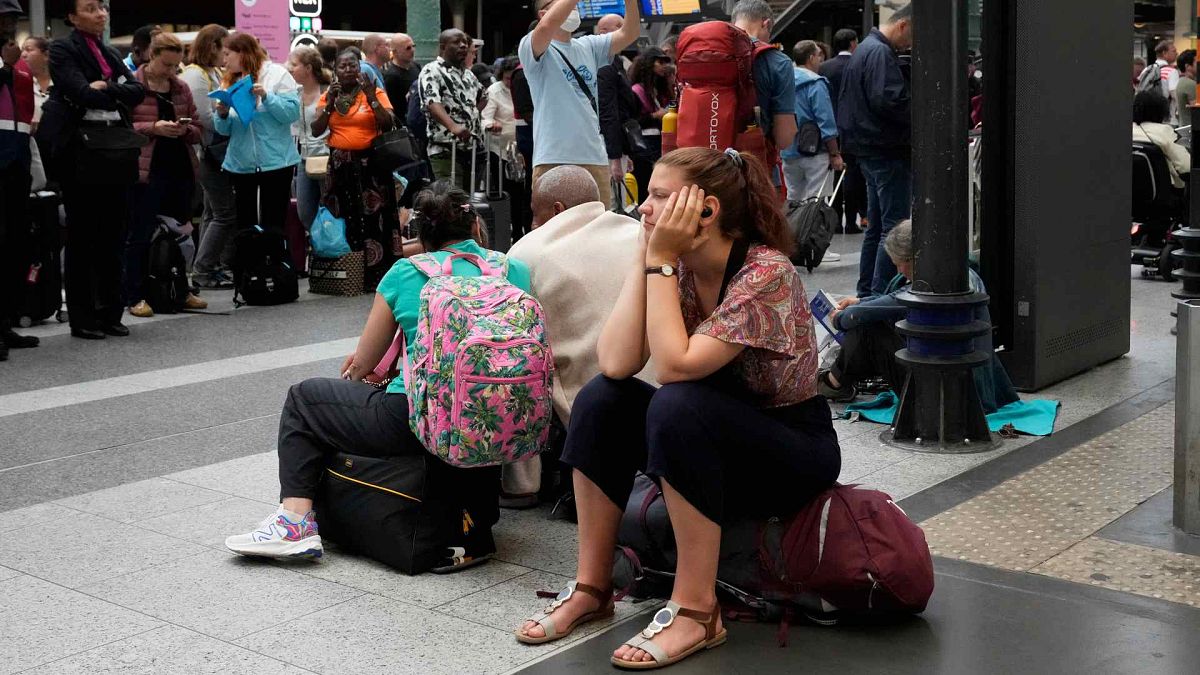
Fires were started along several high-speed lines causing most trains to be cancelled and chaos for 100,000s travellers on one of the busiest travel weekends of the year.
SNCF urged passengers not to travel to the station this morning as most trains were cancelled with many others delayed - impacting some 800,000 travellers.
This afternoon, there has been a partial resumption of services on the high-speed LGV Atlantique line and some TGVs, while the Metz-Nancy line has returned to normal traffic.
SNCF will continue to carry out emergency repairs and expects disruption to continue over the weekend.
Where in France are trains affected?
The biggest disruption is to trains arriving or departing at Gare Montparnasse in Paris, with Paris-Tours and Paris-Le Mans halted in both directions. Disruption will continue on these routes "at least over the weekend" according to SNCF.
Services from Montparnasse on Friday will be limited between Paris and south-west France, Brittany and Pays-de-la-Loire with passengers advised to postpone their journeys if possible.
Further details are available on the SNCF website.
Eurostar journeys are set to be 1.5 hours longer today because they cannot use the high-speed line.
Eurostar posted an update on X saying, "all high-speed trains to and from Paris are being diverted via the classic line. Some trains have been cancelled, others are diverted." They directed passengers to their website to check for disruption.
Most services from Paris' Gare du Nord, one of Europe’s busiest train stations, to northern France, Belgium and the UK are delayed.
SNCF's Sud Est (South East) TGV line is not affected. Therefore trains towards Lyon, the Alps and the Provence-Alps-Côte d’Azur (PACA) region are running as normal.
SNCF says: "TGV traffic on the Atlantique, Northern and Eastern lines remains severely disrupted.
We are diverting some trains to conventional lines, but will have to cancel a large number of them."
Right now, high-speed TGV trains on the Nord line are running with delays of 1.5 to 2 hours, while some are cancelled.
ADVERTISEMENTFrom 1pm onwards on the LGV Atlantique line, one in three trains heading for Brittany and New Aquitaine is running, with journey times also extended by 1.5 to 2 hours.
On the Est line, repairs have enabled normal traffic to resume on the Metz-Nancy line. Further on, towards Strasbourg, TGVs are running with delays of 1 hour and some cancellations.
It is highly likely that issues on the TGV lines will have a knock-on effect on local and regional train lines.
What is the advice to passengers?
Earlier today, SNCF advised “all passengers to postpone their journey and not to go to the station.”
ADVERTISEMENTThis will help to prevent overcrowding in stations where police are already stationed.
However, you should now check your route on SNCF's website before leaving home to see if and when your train is departing.
How can you check if your train is running?
SNCF says all affected passengers with pre-booked tickets will be contacted by email or text.
You can also check railway companies' websites, apps and social media channels for updates.
ADVERTISEMENTWill SNCF trains be running over the weekend?
SNCF said it did not know when traffic would fully resume and feared that disruptions would continue “at least all weekend”.
SNCF teams “were already on site to carry out diagnostics and begin repairs,” but the “situation should last at least all weekend while the repairs are carried out,” the operator said.
Will passengers be able to get refunds?
Yes, SNCF has already confirmed: "All tickets are exchangeable and refundable. You will be contacted by email or text if you are concerned about this situation."
What do we know about the attacks on the train lines?
Government officials denounced the incidents hours before the opening ceremony of the Paris Olympics, which are happening around France, though there was no immediate sign of a link to the Games.
ADVERTISEMENTNational police said authorities are investigating what happened. French media reported a big fire on a busy western route.
Transport Minister Patrice Vergriete said in a post on X that he “firmly condemns these criminal incidents,” and that SNCF is working to restore traffic.
Sports Minister Amélie Oudéa-Castera said authorities are working to “evaluate the impact on travellers, athletes, and ensure the transport of all delegations to the competition sites” for the Olympics.
Speaking on BFM television, she said, “Playing against the Games is playing against France, against your own camp, against your country.” She didn't identify who was behind the vandalism.
ADVERTISEMENTParis police chief Laurent Nunez, speaking on France Info radio, said he would send police reinforcement to overcrowded train stations in relation to the SNCF incidents.
There were no known reports of injuries from the attacks.
Attacks thought to be 'prepared and coordinated'
French Prime Minister Gabriel Attal said France’s intelligence services have been mobilised to find the perpetrators of the "acts of sabotage” which he described as “prepared and coordinated”.
Attal said that the actions had “a clear objective: blocking the high-speed train network”. He said the vandals strategically targeted routes from the north, east and west toward Paris hours before the Olympics opening ceremony.
ADVERTISEMENTIt was “a premeditated, calculated, coordinated attack” that indicates “a desire to seriously harm” the French people, said the CEO of the national railway company SNCF, Jean-Pierre Farandou.
“The places were especially chosen to have the most serious impact, since each fire cut off two lines,” Farandou said.
Railway maintenance workers had managed to thwart a suspected sabotage attempt along tracks heading south-east of Paris, Farandou said.
Workers on the night shift spotted intruders and alerted police, Farandou said. “These people left, of course, very quickly when they realised they were spotted. So, thank you to the railway workers,” Farandou said. “Unfortunately, we couldn’t do it everywhere.”
ADVERTISEMENTFarandou said repairs were being made as police conducted forensic examinations and searched for the perpetrators. He said fires were predominantly set in pipes containing critical signalling cables. “We have to repair cable by cable, so it’s very meticulous work,” Farandou said.
The coordinated train line attacks targeted remote locations far from the capital, where 35,000 police officers are being deployed each day for the Olympics, with a peak of 45,000 for the opening ceremony.