

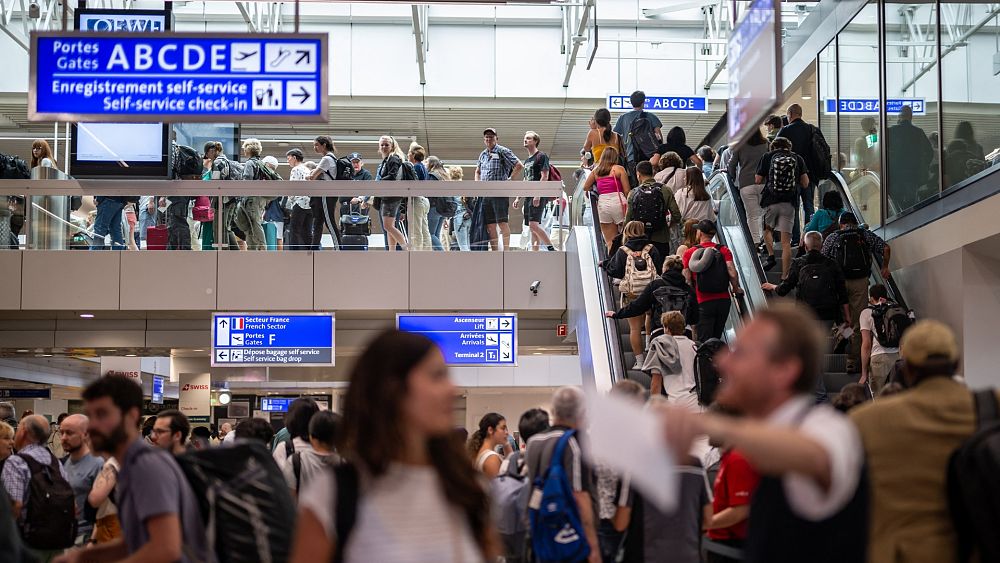
Travel chaos could return this summer as the aviation industry warns of overloaded airports, crowded skies and longer flight times.
Eurocontrol, the organisation that manages Europe’s airspace, has said that this summer will be a “challenging” period with an estimated 33,000 flights per day over the next eight weeks. On Fridays, one of the most popular days to travel, that number could exceed 34,000.
This is 8 per cent more flights overall than took off during the same period last year.
But as air traffic continues to increase into the peak summer period, passengers could be facing another summer of delays, disruption and cancellations.
Why is Europe facing a ‘challenging’ summer for air travel?
With increased demand comes more pressure on the industry to cope with its current challenges.
Last month, the International Air Transport Association (IATA) said demand for air travel is up thanks to growing confidence following the COVID-19 pandemic. And the European Travel Commission has predicted a strong appetite for holidays in Europe this summer.
Eurocontrol itself reported that the record for the most aircraft movements at one airport had been broken last month by Turkey's Istanbul Airport - 1,684 flights in total.
The surge in air traffic has led the organisation to issue warnings for key cities and regions across Europe including Athens, Barcelona, Brussels, Budapest and London. It says passengers could face longer flight times and significant delays as airlines attempt to avoid congested areas.
Eurocontrol’s director general Raul Medina has warned that Europe faces a “challenging” summer. On top of the increased number of flights, there is around 20 per cent less airspace available due to the war in Ukraine, creating further pressure.
"To be successful over the summer, we need everyone to play their part,” he added at an Airports Council International (ACI) meeting in Barcelona this week.
"Airports need to be well staffed, it is vital [air traffic controllers] provide enough capacity and that airlines stick to their schedules.”
Where in Europe will be overloaded with flights?
Seven key ‘Area Control Centres’, which handle air traffic across wide patches of airspace, are likely to be hit by “high overloads” according to a Eurocontrol plan.
When skies are busy, the number of flights that can enter an air traffic control area may be capped to prevent controllers from being overwhelmed. Airlines can be forced to fly longer routes or passengers might be delayed as air traffic controllers cope with the overcrowding.
Athens in Greece and Reims and Marseille in France are likely to be affected on most days this summer, according to Eurocontrol.
On peak days like Fridays or summer weekends, Budapest, Warsaw and Nicosia could also experience “high overloads” of traffic, it warns. The 8 and 15 July could see a high overload in Zagreb and Belgrade too.
London, Barcelona and Brussels have also received similar warnings.
Will strikes cause problems for Europe’s airports this summer?
While many of the causes of last year’s summer travel chaos have now been rectified, there are some “expected and unexpected events” that will impact travel. Medina said that this includes industrial action, weather issues or military exercises.
In June alone, low-cost carrier Ryanair had to cancel more than 900 flights, mostly it says due to air traffic controller strikes in France. IATA chief Willie Walsh said at an annual meeting in June that disruption was already “well beyond normal for the time of year” as the situation in France disrupted traffic across Europe.
When air traffic controllers go on strike, domestic departures in France and long-haul flights which overfly the country are prioritised. This can mean widespread cancellation of short-haul flights that pass over France but don’t land.
Other recent industrial action has also caused delays across the network.
While situations like this can easily be managed outside of peak periods, if it happens during summer, Medina explains that coping with disruption will be much more challenging.