

 ADVERTISEMENT
They’re normally the holy grail of a winter holiday, but last night people living in more southern parts of Europe were left awestruck as the Northern Lights visited them at home.
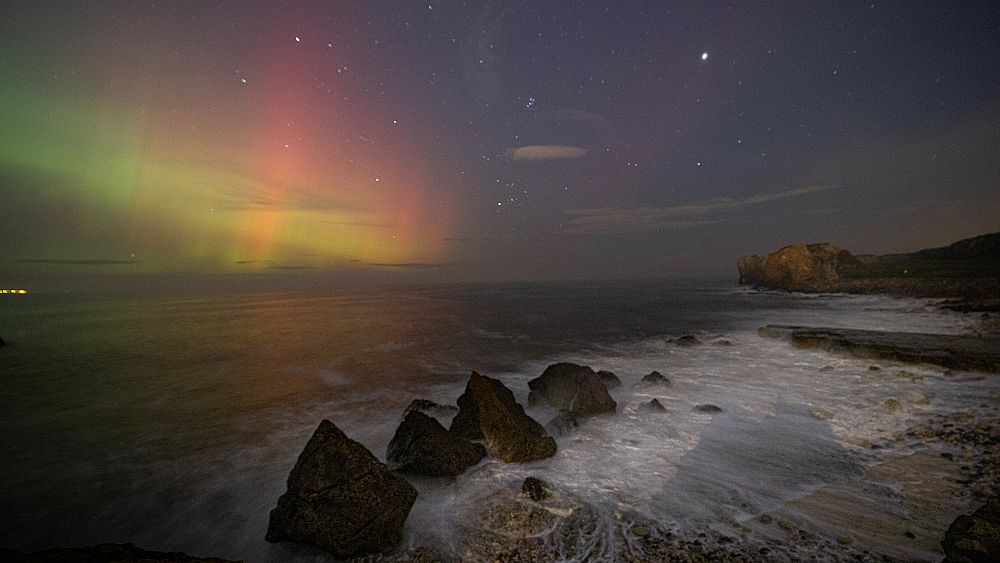
The aurora borealis put on a spectacular display as far south as Italy and Greece thanks to a major geomagnetic storm. In the UK, they stole the show from Bonfire Night fireworks from York to the Isle of Wight.
These vivid ribbons of red, green and magenta are caused by the interaction of particles coming from the sun - known as the solar wind - with the planet’s atmosphere.
When these particles reach the Earth they are channelled by our planet’s magnetic field towards the polar regions.
Why were the Northern Lights so visible last night?
In the northern hemisphere, the Northern Lights are typically only seen over the Arctic Circle - with people booking trips to Norway, Sweden and the Shetland Islands for a glimpse of nighttime magic.
A large eruption on the surface of the sun was observed by solar physicists on Friday, so there was a spike in geomagnetic activity forecast over the weekend.
Auroras usually occur in a band called the annulus (a ring about 3,000 kilometres across) centred on the magnetic pole, the UK’s Met Office explains. The arrival of a Coronal Mass Ejection (CME) - an expulsion of plasma and magnetic field from the outermost layer of the sun’s atmosphere - can cause the annulus to expand.
This brings the aurora to lower latitudes - meaning the lights are visible in the UK and further south in Europe.
The Northern Lights in the UK, Germany, Italy
Stunning photos and sped-up videos of last night’s aurora borealis have flooded in from surprising corners of the continent.
Social media users have shared photos of fantastic magenta skies over Italy on 5 November, from Liguria and Emilia Romagna in the north right down to Puglia.
People in Bulgaria, Romania, Slovenia and even Central Macedonia in Greece have shared pictures of the rare phenomenon.
Germany also got a good showing over Berlin and Frankfurt, helped by clear skies. As did Austria, the Netherlands and Ireland.
In the UK, where people were celebrating Guy Fawkes night, firework shows were upstaged by a plethora of colours. Photos have streamed in from Aberdeenshire to Kent.
And one particularly ethereal shot shows the Mirrie Dancers (as they’re called up in Shetland) lighting up the sky over Stonehenge.
Local palettes depend on which gas molecules are hit and where they are in the atmosphere, the Met explains, as different amounts of energy are released as different wavelengths of light.
Oxygen gives off green light when it is hit 60 miles (around 100 km) above the Earth but at 100-200 miles (160-320 km), it produces all-red auroras - a rare sight. Nitrogen causes the sky to glow blue yet when higher in the atmosphere the glow has a purple hue.
Of course, the heightened geomagnetic activity also meant that the Aurora Australis (or Southern Lights) were visible down under.
Australians have shared equally breathtaking images of last night’s sky from Western Australia to Tasmania.
ADVERTISEMENTWhy are the Northern Lights stronger this year?
If you missed the northern lights at home or on holiday, don’t despair. Your chances to see them are still higher than usual this autumn and winter.
That’s because the sun is getting more active, translating into brighter aurora displays. A more active sun isn’t cause for alarm, but simply due to where the star is in its ‘solar cycle’.
Every 11 years, the sun’s magnetic field completely flips. As we’re approaching that peak in 2024 or 2025, there’s been a dramatic increase in ‘sunspots’ - a measure of how active the sun is.
So the Northern Lights are currently looking stronger than they have in at least a decade making it the perfect time to book that bucket list trip north to see them in all their splendour.