

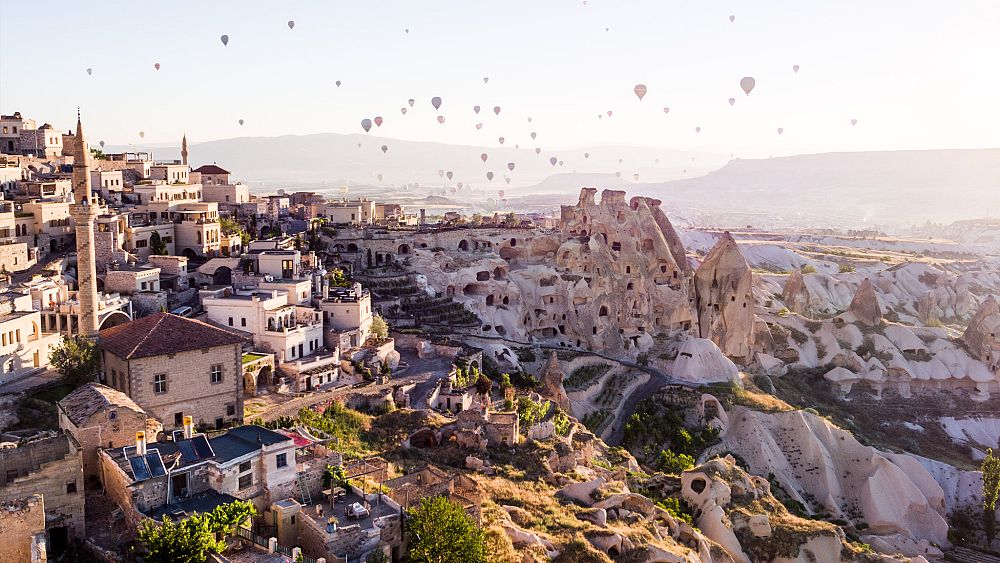
I’m standing at the summit of Uçhisar castle, the highest point in Cappadocia, Turkey, and reachable by climbing some 120 lung-busting steps.
Surveying the otherworldly landscape of conical rock towers and misshapen stone mounds below, it’s hard to believe this is fertile ground for growing crops.
But an underground natural water reservoir and ashy terrain from prehistoric volcanic eruptions mean fruit and vegetables have flourished here for millennia.
The area is one of the oldest in the world for winemaking, just behind Georgia, with several indigenous grape varieties.
It also has a rich regional food culture. I’m already thinking of the time-honoured dishes deeply rooted in the land’s bounty that await me on my descent.
Cooking in Cappadocia’s ancient caves
Eating has historically been both a pleasure and a peril in Cappadocia, as I learn from a visit to the Göreme open-air museum.
This is one of the region’s top attractions and the third most visited museum in the country.
Göreme is a microcosm of Cappadocia’s natural and man-made splendours. For thousands of years, the area’s spectacular rock forms, known as “fairy chimneys”, have been hollowed out into a warren of houses, monasteries and churches.
At the museum, I duck into cave churches and wonder at ceilings painted with brilliantly coloured biblical scenes.
Returning to a corporeal level, a visit here is also an education on how the cave system’s earliest residents cooked.
Between the magnificent churches, I find dark, unadorned spaces once used as refectories. They house a long table and benches carved out from the soft tuff stone and a niche at the table head for the priest.
A small round hole has been dug out of the floor that is known as a tandir or tandoor. Over a wood fire, these early monks would have cooked meat, vegetables and a bagel-shaped bread called simit in pottery containers.
Despite the romantic image, cooking wasn’t a pleasant experience. As early Christians were persecuted by the pagan Romans, the cave dwellers could not construct chimneys for fear of being spotted by the smoke.
As such, the interiors were filled with ashy smog during cooking. In some caves the rock ceilings are still blackened from years of making food.
What to eat in Cappadocia: Tandoor-cooked meat
Cappadocians still use this ancient tandoor cooking method, albeit now with smoke-extracting chimneys.
Visitors to the region should look out for restaurants offering testi kebap, or “pottery kebab”. This dish is made of lamb meat and vegetables are cooked slowly inside an earthenware pot in a tandoor. In some places, the waiter brings the pot to the table and smashes it in half before diners.
For saç tava, instead, a large metal skillet is set over the tandoor oven to saute small pieces of meat along with aubergines, tomatoes and green peppers.
What to eat in Cappadocia: meat ravioli and pottery cheese
Besides fire-roasted meat, there are plenty of other foods being celebrated on restaurant menus.
At Argos, a legendary cave hotel cited by National Geographic as one of the 250 must-see places in the world, a new restaurant is serving up speciality dishes from Cappadocia’s Nevşehir province.
Called Nahita, the dining spot inside these rock-hewn walls offers a menu using ingredients from within a 60-kilometre radius.
One dish on the menu is a simple salad inspired by shepherd’s meals containing tomato, cucumber, red onion and Çömlek cheese. Also known as “pot cheese”, this tangy artisan product is stored in earthenware pots and left to age naturally in the cool caves.
Another sumptuous salad with grilled lettuce uses local Ezine goat’s cheese and hard-aged kasseri cheese for a creamy, peppery sauce.
For a main course, I try homemade yağlama (like thin soft tortillas) topped with rich minced meat in the Nevşehir fashion, fresh mint, yoghurt and tomato sauce.
The restaurant also prepares tandoor foods. One of the most traditional dishes is Nevşehir tava, a cornucopia of pan-fried beef tenderloin, garlic, peppers and pita bread enlivened with allspice and cumin.
In their sister restaurant Seki, I am warmed by Cappadocia’s take on comfort food, Nevşehir mantı. These are like tiny ravioli filled with meat smothered in a tomato and chickpea sauce.
There is also a vegetarian version of mantı with fried onions and served with a garlic-infused yoghurt.
Cappadocia’s 3,000-year-old winemaking tradition
Thousands of years ago, vines would have clung to the sloping terraces of the fairy chimneys all over Cappadocia.
The grapes would have been crushed inside the caves, which also acted as perfect, naturally cool cellars.
At Argos Hotel, I descend a steep flight of stone steps that take me from the scorching sun into the chilly depths of their own cave wine cellar.
Bottles are squeezed into every available hollow, crevice and crack. In one room, there is still a hole in the ceiling where the grapes would have been dropped through into a basin for crushing below.
Turkey’s modern-day winemaking industry is little known outside the country, partly because of the government’s conservative leanings which restrict publicity on alcohol.
But there are still winemakers in Cappadocia creating products from the region’s local grapes.
Argos produce a fruity red from the boğazkere variety. In a wine tasting in their cave cellar, I also try a crisp, citrusy white wine from the emir grape.
It pairs perfectly with cave-aged cheese, and makes me wonder if Cappadocia’s ancient cave residents were also partial to a cheese and wine party.