

It seems like the ancient Silk Road is no longer just a cultural reference point. It is becoming one of the fastest-reviving travel corridors in Eurasia.
Fresh data and industry signals presented at the 30th Tashkent International Tourism Fair (TITF-2025) show that tourism across Central Asia and the South Caucasus is accelerating far beyond pre-pandemic levels, driven by new flight routes, nature tourism development, craft industries, and the rapid rise of AI-based planning tools.
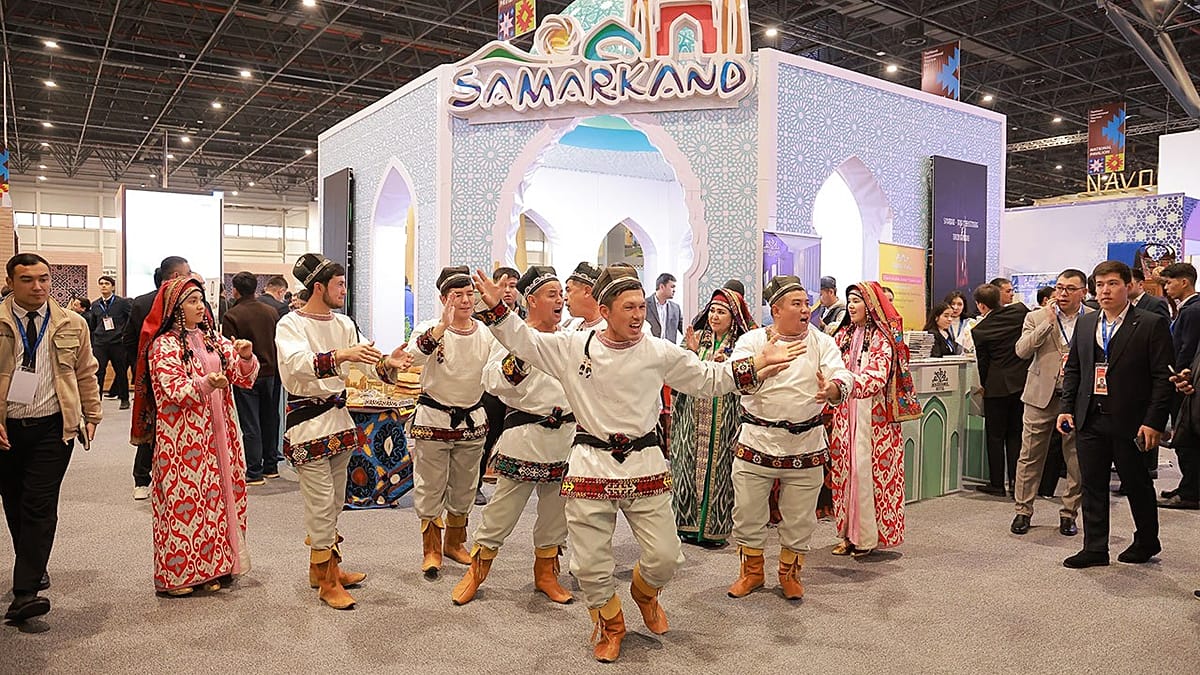
Representatives of more than 40 countries gathered in Tashkent for three days of B2B negotiations, sector forums, youth programmes and digital travel showcases — producing a rare, multi-country snapshot of how the Silk Road tourism economy is being rebuilt in real time.
Uzbekistan’s tourism boom
One of the strongest indicators came from Uzbekistan. According to data highlighted at the Fair by the country’s Tourism Committee, foreign arrivals have soared from just over 2 million in 2017 to more than 10 million last year.
And as tourism officials say, this fivefold jump reflects growing multi-country travel loops rather than short single-destination stays.
“Travellers now ask for longer, multi-city loops, often crossing borders during one trip,” explained to Euronews Aziz Mirjalilov, head of marketing at Uzbekistan’s Tourism Committee.
He also noted that the region has opened for travel circulation, not only for short stops but for longer 7 to 9-night combined itineraries through several cities and countries in one journey.
Connectivity is leading the growth
A major factor behind this surge is improved air mobility. The Azerbaijan–Uzbekistan corridor is one of the clearest examples. Daily flights now operate between the two countries, and twice-weekly flights have been added between Samarkand and Baku.
More than 50,000 Uzbeks travelled to Azerbaijan this year
“It is a 35 per cent rise year–on–year”, Jalal Ismailov, Azerbaijan Tourism Bureau representative, tells Euronews.
He adds that most travellers come for thermal springs, sanatorium stays, weekend trips and corporate groups.
“Together with Uzbekistan’s PR partners, we also presented joined routes in cities like Barcelona, Vienna and Prague during a 6-city roadshow,” he explains, signalling that promotion is increasingly happening via shared route products, not single-destination messaging.
New tourist attractions
Outside major cities, regions are racing to formalise eco-tourism. Uzbekistan’s Namangan region is mapping its mountainous districts like Pop, Chust, Kosonsoy and Chortoq to build structured adventure and cave tourism routes.
“We cooperate with alpinist groups to map caves and include them in eco and adventure itineraries,” says Deputy Governor Botir Nuriddinov. Summer seasons in villages like Chodak and Nanay now attract growing flows of domestic and foreign visitors.
This represents a broader Silk Road trend: nature destinations are now introduced through mapped coordinates, safety routes, elevation data and seasonal timing, before becoming official itinerary products.
Long-distance route planners from Japan and Europe are adapting to this new structure. Tomohito Hirasawa, founder of MegaTour Japan, emphasised that tourism itineraries across Central Asia are now built with seasonal variation and educational segments as formal components.
“We organise sightseeing, FIT tours and education trips for students aged 9 to 80,” he said, noting cooperation with universities to combine cultural learning with route travel.
Local crafts fuel tourism growth
Not all tourism growth is driven by airlines and ministries. Craft artisans, many of them working with century-old methods, are becoming essential to the region’s tourism identity.
Tajik craftsman Dzhovidon Mukhabbatov, who works with Pamir stones such as lapis, jade, crystal and jasper, described a growing global demand for handmade goods with visible material origin.
He explains that his workshop continues to participate in large-scale international fairs and references past examples with a characteristic craftsman's matter-of-fact tone.
“We participated in EXPO Shanghai in 2010 for 6 months, Japan in 2025, many local fairs,” Mukhabbatov says.
His remarks also reflect a corridor-wide tourism curiosity: travellers increasingly want to take back something shaped by locality and handwork. They want objects with visible material identity, not freight labels.
AI enters the travel planning stage
Perhaps the most modern shift discussed at the Fair is technology’s role in fixing a long-standing bottleneck: slow, fragmented trip planning.
Murod Abdullayev, founder of TourAI, explained how AI is now speeding up the earliest stage of travel: Instant tour search, 24/7 replies through text or voice, and review analysis from famous tourist apps.
“Earlier, many agents couldn’t reply on time, especially late evening, or find tours fast,” he describes. “Our AI finds tours fast, replies anytime by text or voice, and analyses Booking and Tripadvisor reviews. It works through Telegram, WhatsApp, Instagram, Viber.”
Across the region, AI-based tools are reducing the delays that used to frustrate travellers before their journey even began.
Well-educated young tourism managers
Tourism growth also depends on who will run it next.
University representatives framed readiness through skills infrastructure.
Department head of the Silk Road International Tourism and Cultural Heritage University, Jamshid Xolboyev, says that tourism is becoming an academic pipeline industry.
“We train students in tourism, hospitality, economics and business management completely in English,” he describes. “Students do internships locally and abroad through tourism organisations, gaining applied industry experience.”