

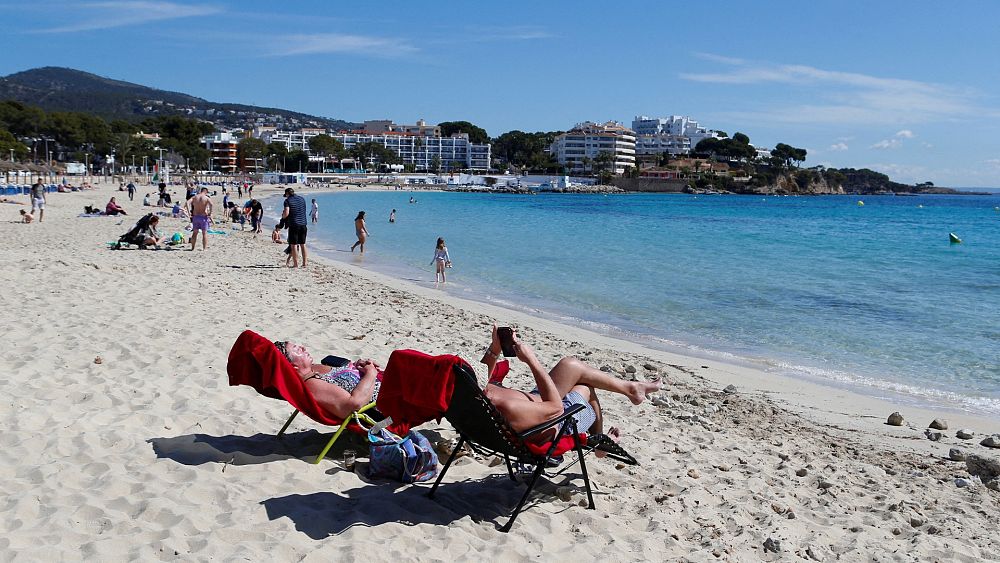
Activists have put up fake warning signs at beaches across Mallorca, Spain to keep English-speaking tourists away.
 ADVERTISEMENT
Some posters warn of “dangerous jellyfish”, “falling rocks” or seawater polluted with sewage. Others say that the beach is closed with a ‘no swimming’ symbol below or warn that it takes hours to walk there despite the ocean being less than 100 metres away.
A few small lines of text in Catalan underneath, however, reveal to locals that these warnings aren’t real. They explain that “the problem isn’t a rockfall, it’s mass tourism” or that the “beach is open, except for foreigners and jellyfish”.
The unofficial warning signs appeared at Cala Morlanda, Es Calo, Cala Petita, Porto Cristo, Cala Murta, Cala Magraner and Cala Bota.
Who is behind the fake warning signs?
The fake notices were put up by the anti-capitalist group Caterva based in the town of Manacor. Its members have criticised the island's overcrowded beaches and called attention to the problem of mass tourism in Mallorca.
In a post on social media site X, formerly known as Twitter, the group said that the campaign is “charged with humour”.
In a statement sent to the local press, Caterva claimed that the culprits are “the hoteliers and Rafael Nadals” who are just as much to blame as the Balearic Government. It has reportedly criticised the Spanish tennis player for owning a restaurant and tourist business on the island in the past.
Despite claims of tourism creating work and wealth for locals, Caterva says that the only people seeing the economic benefits are those who already have money.
The debate on overtourism stalled as visitor numbers dropped off during COVID-19 but, as they start to recover to pre-pandemic levels and beyond, the Balearic Islands are once again suffering the consequences of overtourism.
The group has offered to share the posters for free with anyone that wants to use them.
Is overtourism a problem in the Balearic Islands?
In 2022, more than 16 million people visited Spain’s Balearic Islands. Mallorca alone saw more than a million tourists last year in August alone - more than the island’s entire population. And local statistics institutes are estimating that the number of holidaymakers could peak even higher this year.
Overcrowding is particularly bad during the summer season with wars over resort sunbeds and queues just to set foot on some of the most popular beaches.
ADVERTISEMENTBoozy parties and rowdy tourists have been a particular problem for the islands for a number of years. Local councils and the Balearic Government have been trying to control the situation with stricter rules and regulations with little success.
Rules for tourists include smoking bans on 28 different beaches across the islands, a limit on the number of all-inclusive alcoholic drinks they can buy, dress codes for restaurants and resorts as well as fines for not showing up to your dinner reservation.
Earlier this year, the Balearic Government launched a campaign alongside the British Embassy which reinforced a policy of zero tolerance for “tourism in excess”.