

 ADVERTISEMENT
The US National Oceanic and Atmospheric Administration (NOAA) issued a rare severe geomagnetic storm warning when a solar outburst reached Earth on Friday afternoon, hours sooner than anticipated.
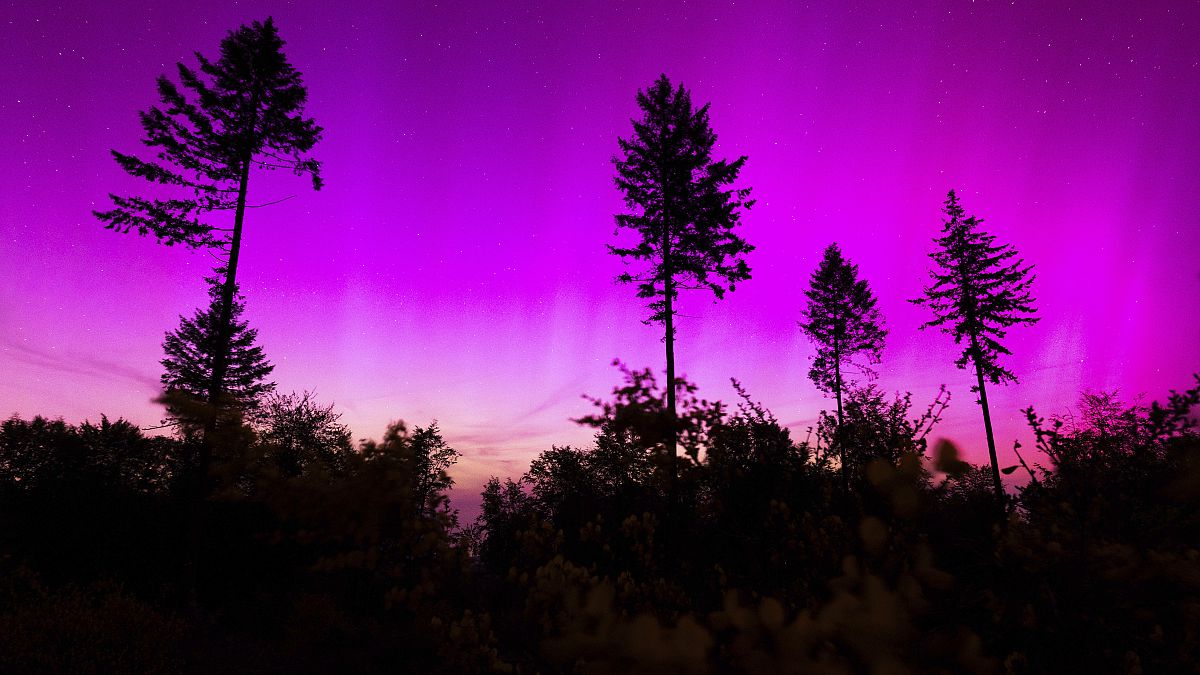
The effects of the Northern Lights, which were prominently on display in the UK, were due to last through the weekend and possibly into next week.
NOAA alerted operators of power plants and spacecraft in orbit, as well as the Federal Emergency Management Agency, to take precautions.
''For most people here on planet Earth, they won’t have to do anything,'' Rob Steenburgh, a scientist with NOAA’s Space Weather Prediction Center, said.
Photos of the spectacular phenomenon were also captured in parts of the United States, including California, Missouri and Oregon, as well as other countries such as China, New Zealand and Australia.
Friday's storm is the first severe geomagnetic storm watch NOAA has issued since 2005.
The most intense solar storm in recorded history, in 1859, prompted auroras in central America.
This storm poses a risk for high-voltage transmission lines for power grids, not the electrical lines ordinarily found in people’s homes, NOAA space weather forecaster Shawn Dahl said. Satellites also could be affected, which in turn could disrupt navigation and communication services on Earth.
An extreme geomagnetic storm in 2003, for example, took out power in Sweden and damaged power transformers in South Africa.
Even when the storm is over, signals between GPS satellites and ground receivers could be scrambled or lost, according to NOAA. But there are so many navigation satellites that any outages should not last long, Steenburgh noted.
The sun has produced strong solar flares since Wednesday, resulting in at least seven outbursts of plasma. Each eruption, known as a coronal mass ejection, can contain billions of tons of plasma and magnetic field from the sun’s outer atmosphere, or corona.
The flares seem to be associated with a sunspot that’s 16 times the diametre of Earth, NOAA said. It is all part of the solar activity ramping up as the sun approaches the peak of its 11-year cycle.
NASA said the storm posed no serious threat to the seven astronauts aboard the International Space Station. The biggest concern is the increased radiation levels, and the crew could move to a better shielded part of the station if necessary, according to Steenburgh.
Increased radiation also could threaten some of NASA’s science satellites. Extremely sensitive instruments will be turned off, if necessary, to avoid damage, said Antti Pulkkinen, director of the space agency’s heliophysics science division.
Several sun-focused spacecraft are monitoring all the action.
''This is exactly the kinds of things we want to observe,'' Pulkkinen said.