

 ADVERTISEMENT
In July, Kyoto celebrates the historic Gion Matsuri festival, one of Japan’s most famous and long-running traditions.
With origins dating back to 869, the event draws more than one million people each year.
It’s a bucket list experience for many visitors to the Japanese city. Here are some expert tips from Japanese rail company JR Pass on how to enjoy the festival in the most authentic and memorable way possible.
What is Japan’s Gion Matsuri festival?
Gion Matsuri is one of Japan’s three most iconic festivals, alongside Tenjin Matsuri and Kanda Matsuri. Its origins trace back to the time when Kyoto was still the capital.
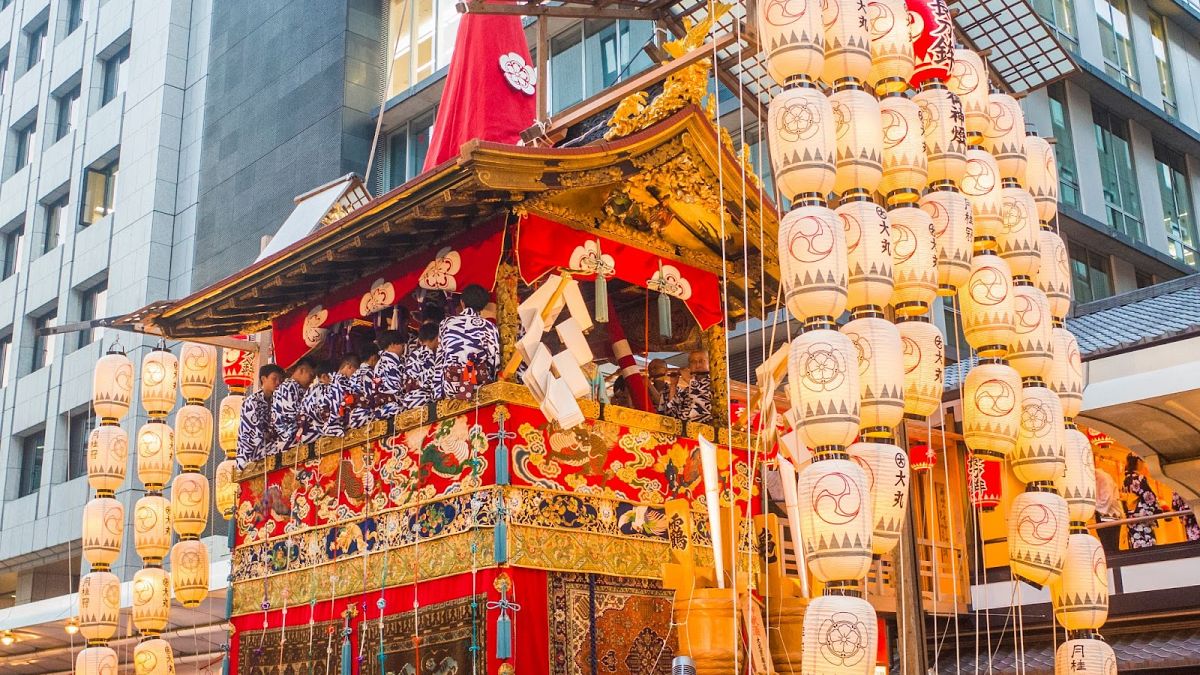
Spanning across the entire month of July, the most spectacular feature of the event is the procession of Yamahokos on 17 July where floats, known as ‘moving museums’, are paraded through the city, followed by the second, smaller procession on the 24.
Despite its name, many of the main festivities don’t take place in Kyoto’s Gion district; instead, they happen on the other side of the Kamo River.
The famous floats of the Gion Matsuri festival
A total of 34 floats are used throughout the festival, with 23 featuring at the Early Festival Yamahoko Junko (17 July), and the remaining 11 being shown at the Latter Festival Yamahoko Junko (24 July).
The floats take a guided three-kilometre route through the Shijo, Kawaramachi and Oike streets, with viewpoints available along the way.
They are divided into two categories: 23 yama floats and 10 hoko floats. Yama floats have platforms whose sides are decorated to resemble mountain scenery while hoko floats are topped by tall wooden poles originally intended to summon the Plague God. The latter are particularly impressive as they can be up to 7.5 metres tall and weigh up to 11,000 kilos.
Each float is associated with a historical or mythological tale. Learning even one or two can enrich your experience, and locals are often happy to share these stories if you ask.
Though lesser known, there are also three portable shrines (mikoshi) that are paraded on the night of the 17th, carrying deities of Yasaka Jinja to Otabisho in the downtown of Kyoto, where they remain until the 24th.
These shrines represent the physical transfer of the deities from Yasaka Shrine to the Otabisho - a temporary resting place.
The mikoshi procession is the sacred heart of Gion Matsuri, enacting the movement of divine spirits into the city to bless and protect it. While lesser known to tourists, for locals and worshippers, it’s the most spiritually meaningful part of the festival.
Alongside the floats, the festival has also maintained its practice of choosing a young boy to ride atop the Naginata hoko, the first float of the parade.
This boy is selected as a sacred messenger to the gods, first sitting on the float on 13 July and being unable to touch the ground until the parade ends on 17 July.
Join Kyoto’s night parties for festival food specialities
Each parade is preceded by three nights of celebration, during which the general public can visit (and sometimes go inside) the floats, which are parked up in various locations throughout the city.
On these nights, the streets are packed with various food and drink vendors, allowing visitors and locals alike the chance to try Kyoto’s regional specialities.
Look for Kyoto-style okonomiyaki, yatsuhashi sweets, or locally made kakigori (shaved ice). Many stalls are run by families from Kyoto and only operate during festivals.
You can also purchase chimaki (good luck charms). More than just souvenirs, these charms are tied to specific floats and meant to ward off misfortune. Buying one directly from the float’s neighbourhood team supports local traditions and lets you engage with the community.
If you want to truly soak up the Japanese festival traditions, many locals welcome tourists to wear yukatas - lightweight robes that have become a hallmark of Japanese festivals.
Rent one of these robes and learn the basics of how to wear it respectfully (e.g. folding left over right). Some include small accessories, such as folding fans (sensu) or drawstring bags (kinchaku).
How to avoid the crowds at the Gion Matsuri festival
As one of Japan’s most famous festivals, it’s no surprise that the event draws large crowds. While the parade itself is packed no matter what, there are steps you can take to navigate it more comfortably.
If you’re hoping to avoid the busiest times, consider visiting the floats in the afternoon. Most of the heavy traffic comes from teenagers and office workers, who arrive in the evening when lanterns are lit and the festival atmosphere peaks.
If you want to escape the crowd entirely, take a walk to the nearby Maruyama Park. It’s a quieter spot where you can relax, enjoy a snack and decompress from the excitement of the festivities.
How to get to Kyoto by train
According to JR Pass, the most convenient way to reach Kyoto is via Japan’s extensive railway system, most notably its bullet trains (Shinkansen).
The Tokaido Shinkansen line connects Tokyo, Yokohama, Osaka, and Nagoya to Kyoto. From Tokyo, it takes just over 2 hours to reach Kyoto. From Osaka, the trip is as short as 15 minutes, and from Nagoya, it's around 35 minutes.
For travellers coming from Hiroshima or Fukuoka, the Sanyo Shinkansen provides a direct route to Kyoto, taking roughly 1 hour and 40 minutes from Hiroshima and around 3 hours from Fukuoka (Hakata Station).
Visitors from northern cities such as Kanazawa can take the Limited Express Thunderbird, which reaches Kyoto in about 2 hours and 20 minutes.
For a cheaper option, standard trains run all across the country, stopping at both major hubs such as Tokyo, Fukuoka, and Kyoto, as well as quieter towns and villages.