

 ADVERTISEMENT
Chasing after the northern lights usually means booking a trip to far-flung destinations like Iceland or the tip of Norway.
But this year, the celestial phenomenon will be appearing closer to home for many.
Across southern Europe, the aurora borealis could be lighting up the skies in magical displays like those witnessed in November 2023.
Here’s why 2024 will be a bumper year for northern lights sightings.
What are the northern lights?
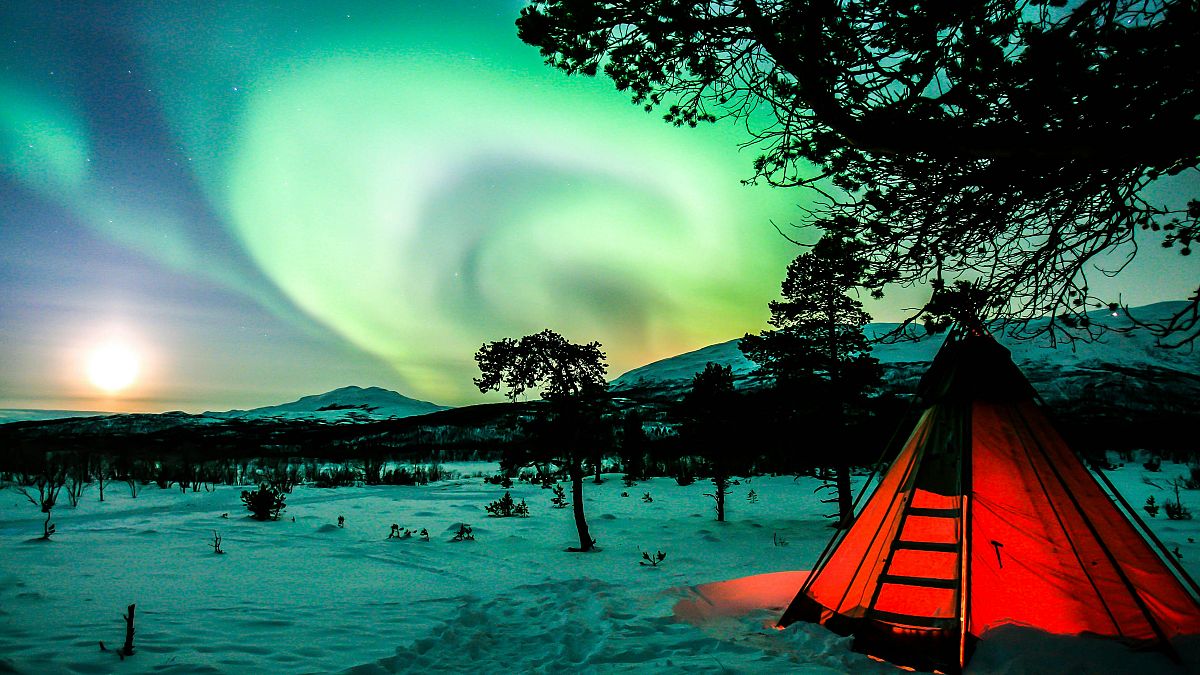
The vivid ribbons of red, green and magenta commonly termed the northern lights are caused by the interaction of particles coming from the sun - known as the solar wind - with the planet’s atmosphere.
When these particles reach the Earth they are channelled by our planet’s magnetic field towards the polar regions.
This means that in the northern hemisphere, the phenomenon is typically only seen over the Arctic Circle.
Why are the northern lights sometimes visible further south?
In November last year, night skies from southern England to Slovenia glowed magenta and fuschia thanks to an unusually strong aurora borealis spectacle.
A large eruption on the surface of the sun was observed by solar physicists the day before the event, so there was a spike in geomagnetic activity forecast over the following days.
Auroras usually occur in a band called the annulus (a ring about 3,000 kilometres across) centred on the magnetic pole, the UK’s Met Office explained. The arrival of a Coronal Mass Ejection (CME) - an expulsion of plasma and magnetic field from the outermost layer of the sun’s atmosphere - can cause the annulus to expand.
This brings the aurora to lower latitudes - meaning the lights are visible in the UK and further south in Europe, as happened in 2023.
The ethereal skies, lit up in a sensational range of colours, were captured by photographers as far south as Puglia in Italy and Central Macedonia in Greece.
Local palettes depend on which gas molecules are hit and where they are in the atmosphere, the Met explains, as different amounts of energy are released as different wavelengths of light.
Oxygen gives off green light when it is hit around 100 km above the Earth but at 160-320 km, it produces all-red auroras - a rare sight. Nitrogen causes the sky to glow blue, yet when it’s higher in the atmosphere the glow has a purple hue.
Why are the northern lights stronger this year?
If you missed the northern lights at home or on holiday, don’t despair. Your chances of seeing them are still higher than usual this year, particularly around the March and October equinoxes.
That’s because the sun is getting more active, translating into brighter aurora displays. A more active sun isn’t cause for alarm, but is simply due to where the star is in its ‘solar cycle’.
Every 11 years, the sun’s magnetic field completely flips. As we’re approaching that peak in 2024 or 2025, there’s been a dramatic increase in ‘sunspots’ - a measure of how active the sun is.
So the northern lights are currently looking stronger than they have in at least a decade making it the perfect time to book that bucket list trip north to see them in all their splendour.