

Polygon Price Crashes As Transactions Rise After Madhugiri Hardfork, As Expert Questions Its Valuation

Polygon price continued its steady downtrend this week, even as the network’s activity surged after the Madhugiri hard fork.
Summary
- Polygon price has slumped to the lowest point this year.
- The network activated the Madhugiri hard fork this week.
- The number of transactions in the network has soared.
Polygon (POL) token slumped to a new fresh low after it transitioned to POL from MATIC last year. It was trading at $0.1200, down by double-digits from the September high of $0.2970.
The ongoing Polygon price crash is happening despite the network having some of the best fundamentals. For example, the number of transactions has gone parabolic after the developers activated the Madhugiri hard fork, which introduced new features.
It boosted the transaction speeds by 33%, introduced 1-second block consensus, and the supported of the recently launched Ethereum Fusaka upgrade.
Data shows that Polygon handled over 8.1 million transactions within a single day after this upgrade happened. More numbers by Nansen show that the network’s transactions have risen by 93% in the last 30 days to over 158 million. This growth makes it the second-fastest-growing chain in crypto after Monad.
https://twitter.com/chainspect_app/status/1999447643379126392
More data reveals that the number of active addresses on Polygon has jumped by 54% in the last 30 days to 13 million. As a result, the amount of fees collected jumped by 27% to $778,000. This is important as Polygon constantly burns its fees, a move that helps to offset new POL issuance.
Polymarket has played a role in boosting the Polygon ecosystem. Data shows that the network had a volume of $4.3 billion in November, a figure that will keep growing now that it has expanded in the United States. Polymarket runs on Polygon’s network.
The ongoing Polygon price crash has led to concerns that it has become highly undervalued. A popular analyst compared its market cap with that of Sui (SUI).
Polygon has a DeFi TVL of over $1.19 billion compared to Sui’s $931 million. It also has over $2.825 billion in stablecoin supply compared to Sui’s $0.5 million. Polygon also makes more money, has fewer unlocks, and yet it is 5x smaller than Sui.
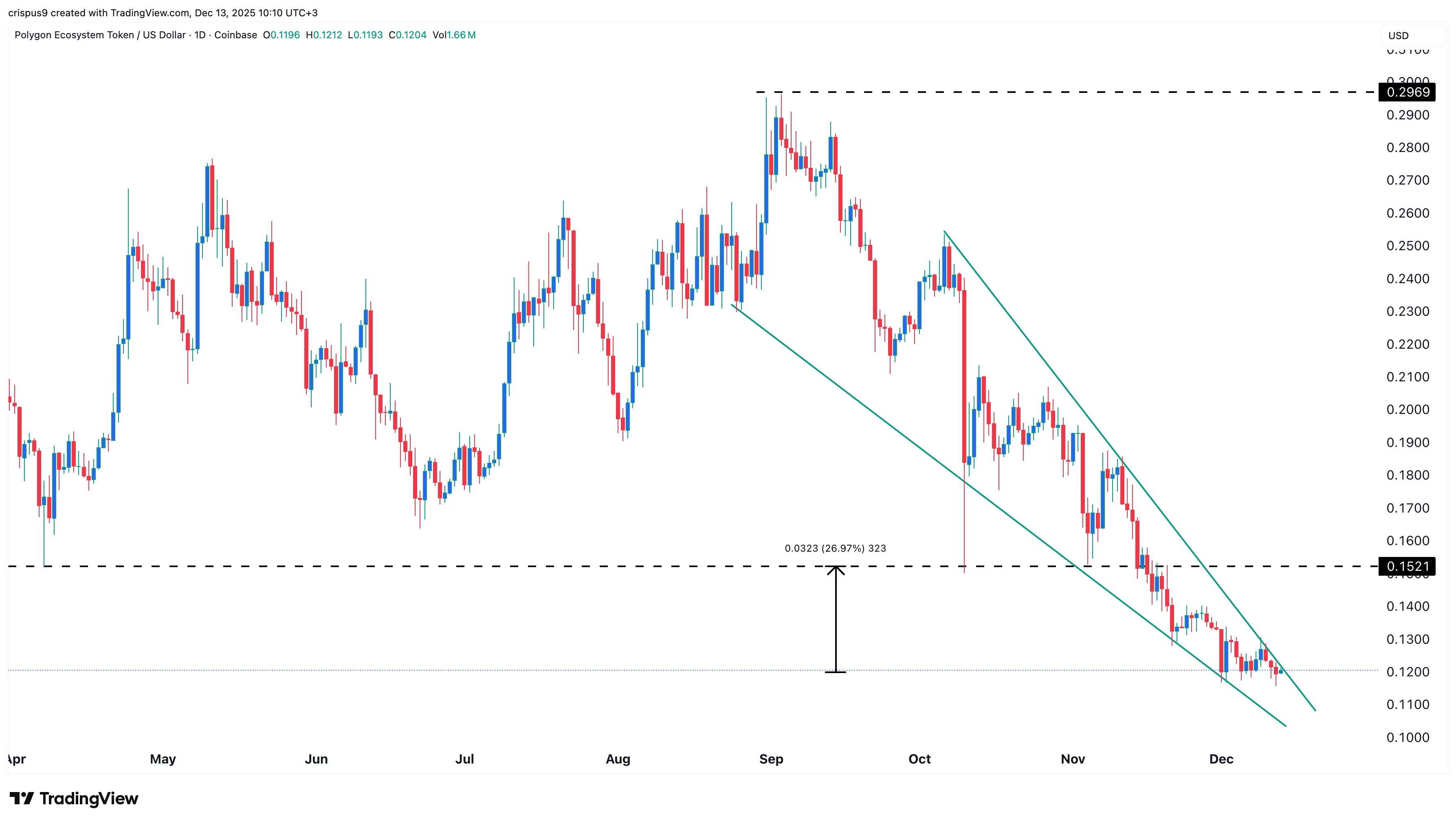
The daily chart shows that the POL price has been in a steady freefall in the past few months. It has tumbled from a high of $0.2970 in September to $0.12 today. As a result, it has moved below the key support level at $0.1520, a point it failed to move below several times.
Polygon price remains below all moving averages, while top oscillators have continued falling. On the positive side, the token has formed a falling wedge pattern whose two lines are about to converge.
The wedge pattern means that the POL price may rebound soon. Such a rebound may see it rise to the key resistance level at $0.1520, which is nearly 30% above the current level.
Major Players In Crypto Hacked
Crypto's Billion-Dollar Blind Spot: Inside the Bitget Heist and the Revolut Extortion PlotThere is a particular kind of ... Read more
Bitcoin Suisse Turns Regulation Into Growth
For much of crypto’s short history, growth was measured in trading volumes, token prices and the number of customers w... Read more
Circle Wins Landmark US Banking Licence
Circle Internet Group has finally secured the regulatory prize it has been chasing for more than a year, with the Office... Read more
Crypto Treasuries Chase A New Kind Of Capital
There is a peculiar irony at the heart of the crypto treasury movement. Companies that staked their futures on digital a... Read more
What Strategy's Bitcoin Sale Really Tells Us
There is a moment in every bull run when the narrative starts to fray. Not with a crash, not with a scandal, but with so... Read more
The Clock Is Ticking On UK Stablecoins
The world is not waiting for Britain to make up its mind. While the United States and the European Union have spent the ... Read more